Building materials compared
Concrete block, brick, aerated concrete, timber frame, mineral wool or hempcrete: where does the hemp block stand? A clear look at its strengths.
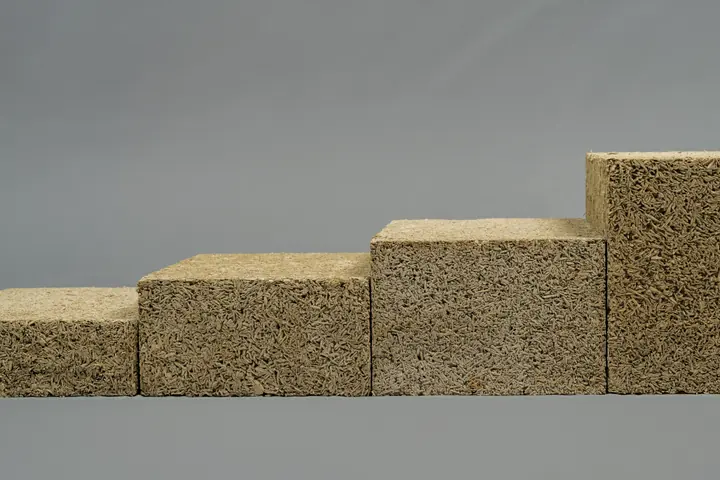
| Criterion | Concrete block | Clay brick | Aerated concrete | Timber frame + wool | Hemp block |
|---|---|---|---|---|---|
| Thermal insulation | Poor | Average | Good | Good | Good |
| Thermal mass / thermal lag | High | Good | Low | Low | High |
| Moisture regulation | — | Average | Average | Variable | Excellent |
| Summer comfort | Average | Good | Low | Low | Very good |
| Bio-based | No | No | No | Partly | Yes |
| Healthy air (VOC-free) | Yes | Yes | Yes | Variable | Yes |
| Reaction to fire | A1 | A1 | A1 | Variable | B-s1,d0 |
| Load-bearing | Yes | Yes | Yes | Timber structure | Non-load-bearing |
Qualitative comparison for guidance only. Actual performance depends on the products, densities and thicknesses. Figures to be confirmed by a thermal study.
Head to head, material by material
How hemp compares with other materials
Hemp block or concrete block: which should you choose?
They do not do the same job. A concrete block is load-bearing but a poor insulator: it needs extra insulation. A hemp block is not load-bearing, but it insulates, regulates humidity and adds thermal mass. The two complement each other: a concrete block wall can be lined with hemp blocks on the inside or the outside.
Hemp block or aerated concrete?
Both insulate well, but aerated concrete offers little thermal mass and less summer comfort, whereas the hemp block delays heat transfer (a thermal lag of up to 18.5 h in 30 cm) and regulates humidity. Aerated concrete is load-bearing; the hemp block is always combined with a load-bearing structure.
Hemp or glass wool: what is the difference?
Mineral wool insulates but, having no mass, it does not store heat and therefore offers no thermal lag. The hemp block insulates, provides thermal mass in summer and winter alike, and regulates humidity without a vapour barrier in standard walls. It also corrects out-of-plumb old walls.
Is hemp as fire-resistant as mineral blocks?
Concrete blocks, bricks and aerated concrete are rated A1. The hemp block is rated B-s1,d0, a very good rating for a bio-based material, and the BIOSYS system achieves EI 90 fire resistance.
Which material should you use to renovate an old house?
On stone or rammed-earth walls, choose a vapour-permeable material: a hempcrete lining insulates without trapping moisture, whereas an impermeable insulation material can encourage condensation and saltpetre. See the applications.
The right material for your project?
Our advisers will help you choose the right solution and thickness.
Request a quote