Sprayed hempcrete and hemp blocks: technical and price comparison
Sprayed hempcrete and hemp blocks have different uses and costs. Blocks are easier to install, better suited to renovation and distributed insulation, with indicative prices by thickness. Sprayed hempcrete is more flexible for complex shapes but less standardised. The right choice depends on your project and objectives.
 By Julien Compain
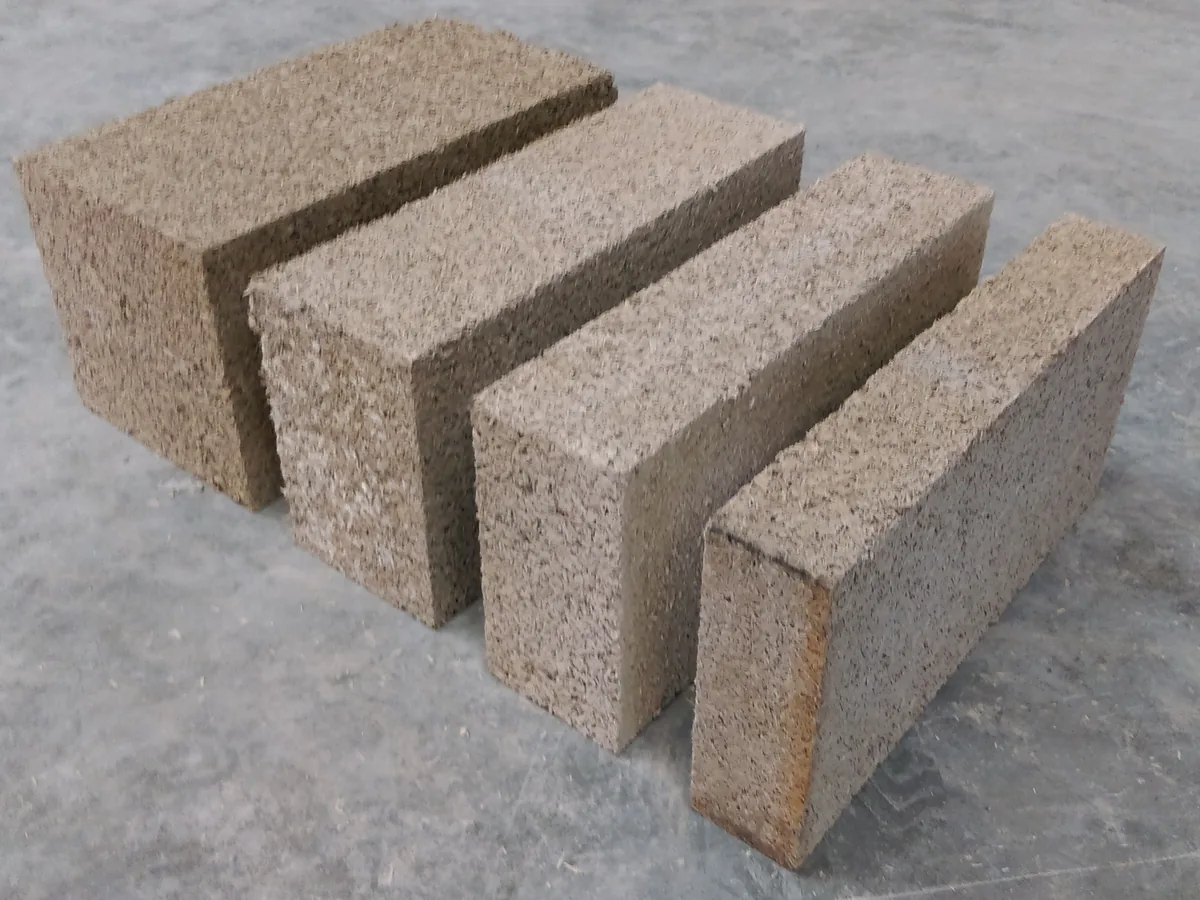
Sprayed hempcrete and hempcrete blocks have different uses and costs. Blocks are simpler to install and better suited to renovation and distributed insulation, with indicative prices by thickness. Sprayed hempcrete is more fluid and adapts to complex shapes, but is less standardised. The choice depends on the site and project goals.
Overview: sprayed hempcrete and hempcrete blocks
Sprayed hempcrete is a fluid mix of hemp shiv, vapour-open hydraulic binder and water, mechanically applied to a substrate. This solution is ideal for adapting to complex shapes, corners and uneven surfaces. Sprayed hempcrete is often used where continuous insulation is needed with no visible joints, especially in renovation or some new builds.
Hempcrete blocks, on the other hand, are prefabricated elements made from 84% hemp shiv bound with natural prompt cement, a vapour-open hydraulic binder. The blocks are industrially produced in 60 × 30 cm format (MULTICHANVRE) or 60 × 30.8 × 30 cm (BIOSYS), and are laid by hand using specific techniques depending on the range. They offer a more standardised installation and are suitable for distributed insulation (IWI or EWI), partitions, floors, or infill for timber or reinforced concrete frames.
Both solutions are used in renovation and new build, but meet different requirements. Sprayed hempcrete is suitable for complex or irregular shapes, while blocks form part of a more rigid modular system, making installation and sizing easier. Installation methods, thermal performance and technical constraints also differ, guiding the choice according to the project.
Thermal performance and comfort
The MULTICHANVRE range offers four block thicknesses, with the following dry thermal resistance values: 1.5 m².K/W for 10 cm, 2.3 m².K/W for 15 cm, 3.0 m².K/W for 20 cm and 4.6 m².K/W for 30 cm. The value to use in a thermal study is slightly lower, for example 4.2 m².K/W for the 30 cm block. These blocks offer significant thermal lag, up to 18.5 hours for the 30 cm block, which helps prevent summer overheating. The hemp shiv formulation also ensures good humidity regulation, maintaining optimal indoor moisture levels.
Sprayed hempcrete also benefits from these intrinsic qualities of hemp shiv and vapour-open binder. However, its performance is less standardised as it depends on the exact mix, applied density and sprayed thickness. Thermal lag is generally lower, and thermal resistance varies depending on the site and application.
In terms of impact on usable floor area, hempcrete blocks have a fixed thickness due to their format, which may be greater than an equivalent sprayed layer for the same thermal resistance. For example, a 30 cm MULTICHANVRE block offers high thermal resistance but reduces usable space for IWI. Sprayed hempcrete can be more precisely adjusted to the available thickness, but requires suitable equipment for application.
Installation and site application
MULTICHANVRE blocks are installed in three steps: apply lime-based mortar (M.B.M. mortar) with a notched trowel, lay thin joints of around 3 mm, and stagger the blocks with at least one third overlap. The blocks are fixed to the substrate using brackets, straps or washers before the finishing render. The first course is laid on a 2 cm waterproof mortar bed to provide a capillary break and correct level. This method ensures good consistency and a neat finish, with drying times to be observed between stages.
Sprayed hempcrete is applied mechanically, usually with a spray lance, onto prepared substrates. This method requires specific equipment, trained operatives and suitable site logistics. It is well suited to large volumes or complex shapes, but controlling thickness and density can be more challenging. Installation time varies with surface area and equipment, and is often shorter for regular surfaces than manual block laying.
The BIOSYS block, a dry-stacked system on a reinforced concrete post-and-beam frame, allows a build rate of around 30 m² per day with two workers on a suitable site. The blocks interlock without glue or mortar, avoiding some thermal bridging. In contrast, sprayed hempcrete does not offer this modularity and depends on site preparation and application conditions.
For electrical services, MULTICHANVRE blocks can be chased and drilled with suitable filling, while sprayed hempcrete is applied after services are installed. Heavy loads can be fixed to MULTICHANVRE blocks depending on thickness and method (screws or chemical anchors), which is more complex with sprayed hempcrete.
Durability, strength and maintenance
Both sprayed and block hempcrete have a track record in France since the 1980s, with few reported issues. Our own references date back to 2017. The hemp shiv and natural prompt cement formulation provides natural resistance to rodents and limits the risk of biological degradation.
Fire reaction is rated B-s1,d0, equivalent to M1, for both solutions. The BIOSYS system has a fire resistance of EI 90 thanks to the associated concrete structure.
Moisture protection is essential. Hempcrete naturally regulates indoor humidity and does not require a vapour barrier as long as the wall remains open to liquid and vapour transfer. For closed walls or wet rooms, a specific study is recommended to check feasibility and define protection (lining, ventilation).
Blocks must be stored in a dry shelter and not stacked, to avoid damage. This precaution is independent of their natural resistance to rodents or mould.
Carbon impact and raw material sourcing
The hemp shiv used in our blocks is sourced 100% from the Franche-Comté region, via the Eurochanvre supply chain which works with around 200 local farmers. This local sourcing limits indirect impacts from raw material transport.
Hemp absorbs a large amount of carbon during growth, which remains stored in the hempcrete block. This is a notable environmental benefit. However, life cycle analysis assumes this carbon is released at end of life, which moderates the overall carbon balance. The system's FDES (environmental product declaration) has been verified but does not give precise kg CO2 figures to avoid misinterpretation.
The formulation of sprayed hempcrete can vary, affecting its carbon impact. Blocks, produced industrially to a fixed recipe, guarantee identical composition for each batch.
Indicative prices and economic comparison
| Criteria | MULTICHANVRE block | Sprayed hempcrete |
|---|---|---|
| Indicative price incl. VAT per m² | €35 (10 cm), €51 (15 cm), €66 (20 cm), €95 (30 cm) | Varies by site, mix and application, no standard price |
| Packing | Pallets of 56 to 120 blocks depending on thickness, delivered via builders' merchant network | No standard packing, material delivered ready to spray on site |
| Installation cost | Manual installation with M.B.M. mortar, staggered joints, known and controlled time | Mechanical application, specific equipment, specialist labour |
| Accessories and finishes | Lime renders, spray plaster, earth renders, compatible plasterboard | Similar finishes, but adapted to sprayed surfaces and substrates |
| Delivery | Nationwide delivery via merchants, typical lead time about one week | Site-specific logistics, depends on volume and access |
Choosing the right solution: renovation, new build, specific uses
The MULTICHANVRE block is recommended for internal (IWI) and external (EWI) insulation, partitions, floor insulation and timber frame infill. Its standard sizes make planning and installation easier. In renovation, it is particularly suitable for existing walls where a lining or render is planned. For floors, thicker blocks (20 and 30 cm) are preferred.
Sprayed hempcrete is more suitable for complex shapes such as curves, vaults or uneven surfaces, where continuous insulation is important. It is also used for large areas requiring rapid, continuous work.
Neither blocks nor sprayed hempcrete are loadbearing. They must always be combined with a structural support, such as a supporting wall, timber frame or reinforced concrete post-and-beam system, as with the BIOSYS system.
Sizing should be based on a prior thermal study to adapt thickness and thermal resistance to project requirements. The reduction in usable space with IWI using blocks should be considered when choosing the system.
Resources and technical support
Comprehensive technical documentation is available, including installation guides, quick reference sheets and flyers in PDF (in French) for hempcrete blocks. Training in the BIOSYS system is offered by our partner Vicat, while training for sprayed hempcrete depends on the applicator.
The builders' merchant network plays a key role in distribution, delivery and technical support. Our technical team is available to answer questions and direct you to the merchant partner nearest your site.
We invite you to request a free, personalised quote for each project. This helps clarify requirements, receive a tailored offer and be put in touch with the merchant network. For purchasing queries, the regional partner merchant network page lists all distribution points.
Outlook and development of hempcrete solutions
Currently, MULTICHANVRE blocks are undergoing certification, with no confirmed date, and do not have a technical assessment or validated ATEx. The BIOSYS system had a CSTB Technical Assessment which has expired, with renewal in progress but no known date. It is therefore important to monitor regulatory developments and official publications before making any commitment.
Future developments will focus on technical validation, optimising formulations and integration into bio-based supply chains. Hemp cultivation, which is highly effective at capturing carbon, remains a key driver for sustainable construction.
Our technical and pragmatic approach aims to provide honest information, clearly outlining the limitations and constraints of our products, to enable informed choices that comply with regulations and suit each project.
Frequently asked questions
What is the main difference between sprayed hempcrete and hempcrete blocks?
Sprayed hempcrete is a fluid mix applied mechanically, suitable for complex shapes, while blocks are prefabricated elements laid by hand with a specific mortar. Blocks offer simpler, more standardised installation.
What is the indicative price per m² for hempcrete blocks by thickness?
Indicative prices for MULTICHANVRE blocks range from €35 incl. VAT/m² for 10 cm thickness to €95 incl. VAT/m² for 30 cm. These prices should be confirmed with partner merchants via a quote.
Are sprayed hempcrete or blocks loadbearing?
Neither sprayed hempcrete nor blocks are loadbearing. They must be combined with a structural support, such as a post-and-beam frame, supporting wall or timber frame.
Can heavy loads be fixed directly to hempcrete blocks?
For MULTICHANVRE blocks in 20 and 30 cm thickness, loads up to 10 kg can be fixed with screws without pre-drilling, and up to 30 kg with chemical anchors. For heavier loads, fixings must be made to the structural frame.
Do sprayed hempcrete or blocks require a vapour barrier?
Hempcrete naturally regulates humidity and does not require a vapour barrier if the wall remains open to liquid and vapour transfer. For closed walls or wet rooms, a study should check feasibility.
What are the thermal performance figures for hempcrete blocks?
The MULTICHANVRE range offers dry thermal resistance from 1.5 to 4.6 m².K/W depending on thickness (10 to 30 cm), with significant thermal lag for summer comfort.
How are hempcrete blocks distributed?
Blocks are sold exclusively via a network of partner builders' merchants with delivery throughout France. Typical lead time is one week, varying by destination and season.
Read next
Planning a hemp block project?
Tell us about your project: we will reply within 48 working hours with a tailored costing.