Hempcrete block price per m²: reference prices and technical analysis 2026
The price of a hempcrete block per m² starts at around €35 incl. VAT for 10 cm thickness, excluding installation. The price varies with thickness, order volume, delivery distance and accessories. This material combines structure and insulation, so should be compared overall with a traditional wall plus insulation.
 By Julien Compain
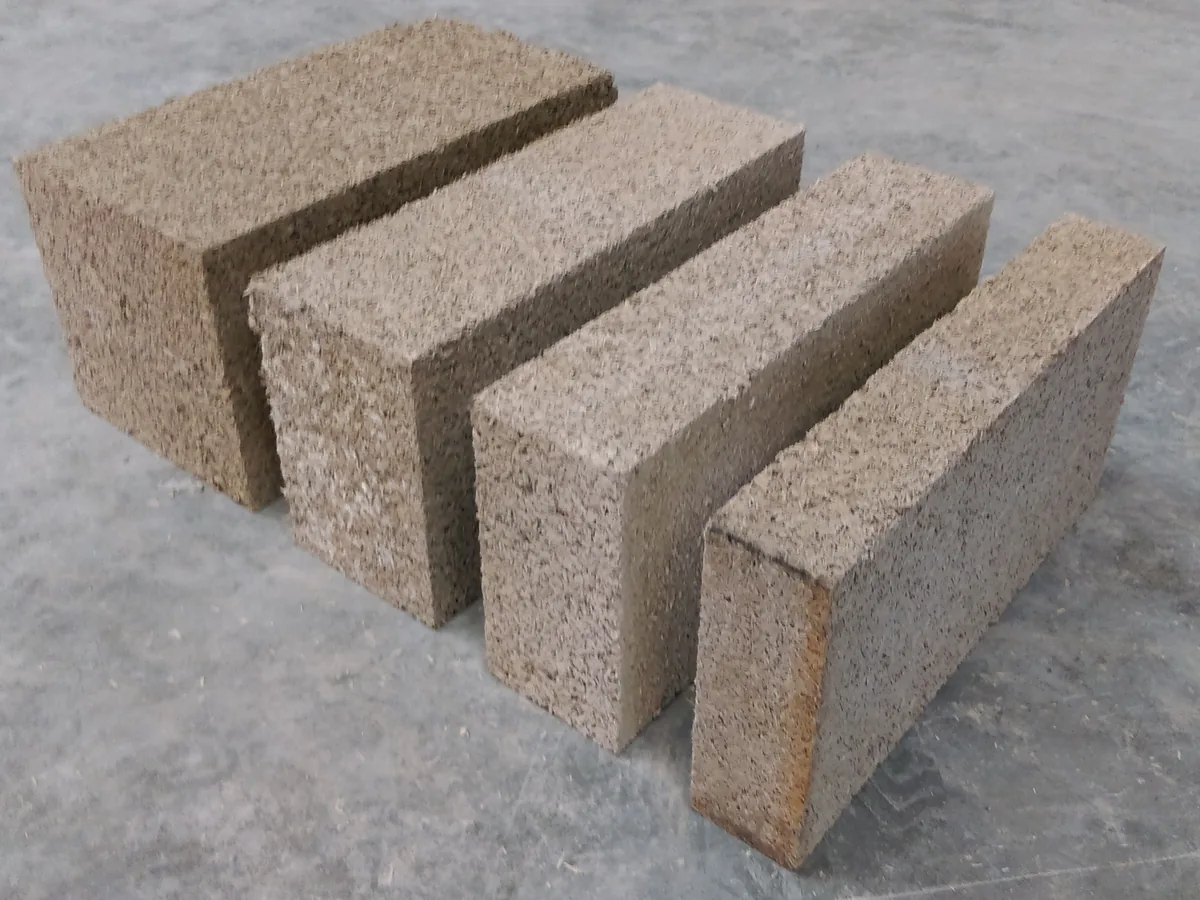
The price of hempcrete blocks per m² starts at around €35 incl. VAT for 10 cm thickness, excluding installation. The price varies depending on thickness, volume, delivery distance and accessories. This material combines structure and insulation, so it should be compared overall with a traditional wall plus insulation.
Composition and technical characteristics of hempcrete blocks
The hemp blocks offered by blocs-de-chanvre.fr are made primarily from hemp shiv, the woody core of the hemp stem, making up 84% of the mix. This plant-based core is bound with Vicat natural prompt cement, a hydraulic binder that is vapour-open, ensuring the block’s durability and dimensional stability. This formulation results in a bio-based, renewable and recyclable material, with all raw materials sourced entirely from France.
The standard block size is 60 × 30 cm, with a density of around 300 kg/m³. Its dry thermal conductivity is approximately 0.065 W/(m·K), making it an effective natural insulator. The block is rated B-s1 d0 for fire, meaning it has limited reaction to fire and does not emit corrosive smoke.
For comfort, the block is rated A+ for indoor air quality, with a sound absorption coefficient α of 0.4, providing notable noise reduction. Its natural moisture regulation keeps humidity within a comfortable range, reducing condensation risks and helping preserve the building’s durability.
Finally, the block offers significant thermal lag—up to 18.5 hours for a 30 cm thickness—which improves summer comfort by delaying heat transfer from outside to inside. This thermal mass reduces the need for air conditioning and helps stabilise indoor temperatures.
Price guide by thickness
The indicative price for a MULTICHANVRE block starts from €35 incl. VAT per m² for a 10 cm thickness, excluding installation and mortar. This entry price is for use in partitions or lightweight linings. Four thicknesses are available, each offering a different level of thermal resistance for various applications:
| Thickness (cm) | Thermal resistance R (m².K/W) | Typical use | Indicative price incl. VAT €/m² |
|---|---|---|---|
| 10 | 1.5 | Partitions, lightweight lining | From €35 |
| 15 | 2.3 | Internal wall insulation (IWI) | Increases with thickness |
| 20 | 3.0 | Enhanced IWI, timber frame infill | Increases with thickness |
| 30 | 4.6 | Full wall, distributed insulation | Increases with thickness |
The block is non-loadbearing: it is used to line an existing supporting wall or to fill a timber frame. This distinction is important for the structural design of the building.
For more details on the range, see The MULTICHANVRE range.
What affects the price of a project?
The final cost of a project using hemp blocks depends on several factors beyond the unit price of the block:
- Order volume: Larger orders often benefit from better trade rates. The unit price may drop above certain thresholds.
- Delivery distance: The blocks are manufactured in Mérey-sous-Montrond (Doubs). Although lightweight, they are bulky, so transport costs depend on the site location.
- Accessories: Lime-based laying mortar, fixings for attaching to the substrate (2 to 5 fixings per m²), starter strips and other equipment must be included in the initial costing and are often overlooked.
- Finishes: Depending on the type of render or plaster chosen (sprayed plaster, lime, earth, clay), for interior or exterior, costs can vary significantly. Finishes can represent a large share of the total budget per finished m². For an overview of compatible renders, see Which renders for a hemp block wall?
Installation cost and process
Hemp block installation is designed to fit standard masonry practice. Blocks are laid in a staggered bond with lime-based mortar applied using a notched trowel. As the blocks are prefabricated, there is no wall drying time before continuing with the works, speeding up the build process.
Three main factors explain the labour savings:
- A traditional mason can install the material after a short familiarisation, with no special training or tools required.
- Structure and insulation are completed in a single operation, avoiding a second stage for additional insulation, as well as the need for rails or vapour barriers in most cases.
- The blocks are easily cut with a saw, reducing waste and making on-site adjustments straightforward.
These factors help keep costs and timelines under control. The full technical installation guide is available in the professionals’ documentation.
Comparing like with like: hemp blocks vs traditional solutions
A common mistake is to compare the price per m² of hemp blocks with that of a simple insulation material. Hemp blocks replace several elements in a single operation:
- The loadbearing or supporting wall (concrete block, brick, timber frame);
- Thermal insulation;
- The fixing framework for the insulation;
- The vapour barrier and its joints;
- The labour for all these stages.
When you add up these items for a traditional build, the cost difference with finished hemp block walls per m² narrows significantly. This overall comparison is essential for a meaningful cost analysis.
The site offers a detailed comparison between hemp blocks, concrete blocks, brick, aerated concrete, timber frame and conventional insulation, covering both technical and financial criteria.
Thermal comfort and energy savings with hemp
Hemp blocks offer high thermal resistance, varying with thickness, and natural moisture regulation. These combined features improve building comfort:
- Thermal lag, which can reach 18.5 hours for 30 cm thickness, slows down heat transfer, avoiding uncomfortable temperature spikes in summer.
- Moisture regulation limits condensation and related damage in the building, especially in renovation projects.
- In winter, thermal resistance reduces heat loss, resulting in lower heating bills.
- Summer comfort is achieved without systematic use of air conditioning, reducing energy costs and carbon footprint.
For an in-depth analysis, see the guide on thermal performance: R-value, thermal lag and summer comfort.
Available systems: MULTICHANVRE and BIOSYS
Two systems are available:
- MULTICHANVRE, a range of straight-edged blocks in 60 × 30 cm format, available in four thicknesses. Laid with mortar in a staggered bond. This system is currently undergoing certification, which will further enhance its reliability and technical recognition.
- BIOSYS, a dry-stacked interlocking system with tongue and groove, manufactured by Vieille Matériaux for the Vicat group. The blocks measure 60 × 30.8 × 30 cm and are combined with a reinforced concrete post-and-beam structure. This system offers a thermal resistance R of 4.6 m².K/W (useful value 4.2).
Installation rates and usage conditions differ: BIOSYS requires a concrete structure and more specialised assembly, while MULTICHANVRE is suitable for a wider range of renovation and new-build applications.
For more information, see The MULTICHANVRE range and The BIOSYS building system.
Getting an accurate quote and choosing the right thickness
The best way to get an accurate price is to provide as much information as possible about your project:
- The area to be insulated or built,
- The desired block thickness,
- The type of finish planned,
- The site location, to estimate delivery costs.
The online form allows you to request a personalised quote with a response within 48 working hours, available via Request a quote.
In advance, a MULTICHANVRE calculator is available to estimate the thickness needed to achieve the required thermal resistance according to regulations and project constraints.
A tailored thermal study is still recommended to validate the insulation solution and optimise performance.
Indicative prices for MULTICHANVRE blocks by thickness
| Thickness (cm) | Thermal resistance R (m².K/W) | Typical use | Indicative price incl. VAT €/m² |
|---|---|---|---|
| 10 | 1.5 | Partitions, lightweight lining | From €35 |
| 15 | 2.3 | Internal wall insulation (IWI) | Increases with thickness |
| 20 | 3.0 | Enhanced IWI, timber frame infill | Increases with thickness |
| 30 | 4.6 | Full wall, distributed insulation | Increases with thickness |
These prices are indicative and should be confirmed by a quote based on your project’s specifics. For more information, see the page Hemp block price per m²: 2026 guide.
Frequently asked questions
What is the indicative price of hemp blocks per m² in 2026?
The indicative price for a MULTICHANVRE block in 10 cm thickness starts at around €35 incl. VAT per m², excluding installation and mortar. The cost increases with thickness and varies depending on order volume, delivery distance and accessories.
Do hemp blocks require a specialist mason?
No. Hemp blocks are installed like traditional concrete blocks, in a staggered bond with mortar. A standard mason can lay them after a short familiarisation, with no special tools or lengthy drying times.
What are the differences between the MULTICHANVRE and BIOSYS systems?
MULTICHANVRE is laid with mortar using straight-edged blocks in several thicknesses. BIOSYS is a dry-stacked interlocking system with thicker blocks, combined with a reinforced concrete post-and-beam structure.
How do I choose the right hemp block thickness for my project?
The choice depends on the required thermal resistance, the application (IWI, EWI, partition) and the building’s thermal study. A MULTICHANVRE calculator is available to estimate the necessary thickness based on your criteria.
What are the main factors affecting project costs?
The main factors are order volume, delivery distance from the factory, accessories (mortar, fixings) and the type of finish chosen, which can account for a significant share of the total cost.
Are hemp blocks more cost-effective than traditional insulation?
In terms of supply, hemp blocks are more expensive. But they replace structure, insulation and vapour barrier in a single operation. This integration means the overall finished cost per m² is closer to that of traditional solutions.
What thermal benefits do hemp blocks provide?
With good thermal resistance and thermal lag up to 18.5 hours, hemp blocks improve summer comfort by limiting overheating and reduce winter heating bills thanks to their natural moisture regulation.
Read next
Planning a hemp block project?
Tell us about your project: we will reply within 48 working hours with a tailored costing.