External wall insulation: hemp block or polystyrene?
Polystyrene provides slim, cost-effective insulation, but blocks vapour and melts in fire. Hempcrete blocks, though thicker, deliver greater thermal lag, better moisture regulation, natural fire resistance and a positive carbon footprint. The right choice depends on your building, comfort requirements and budget constraints.
 By Julien Compain
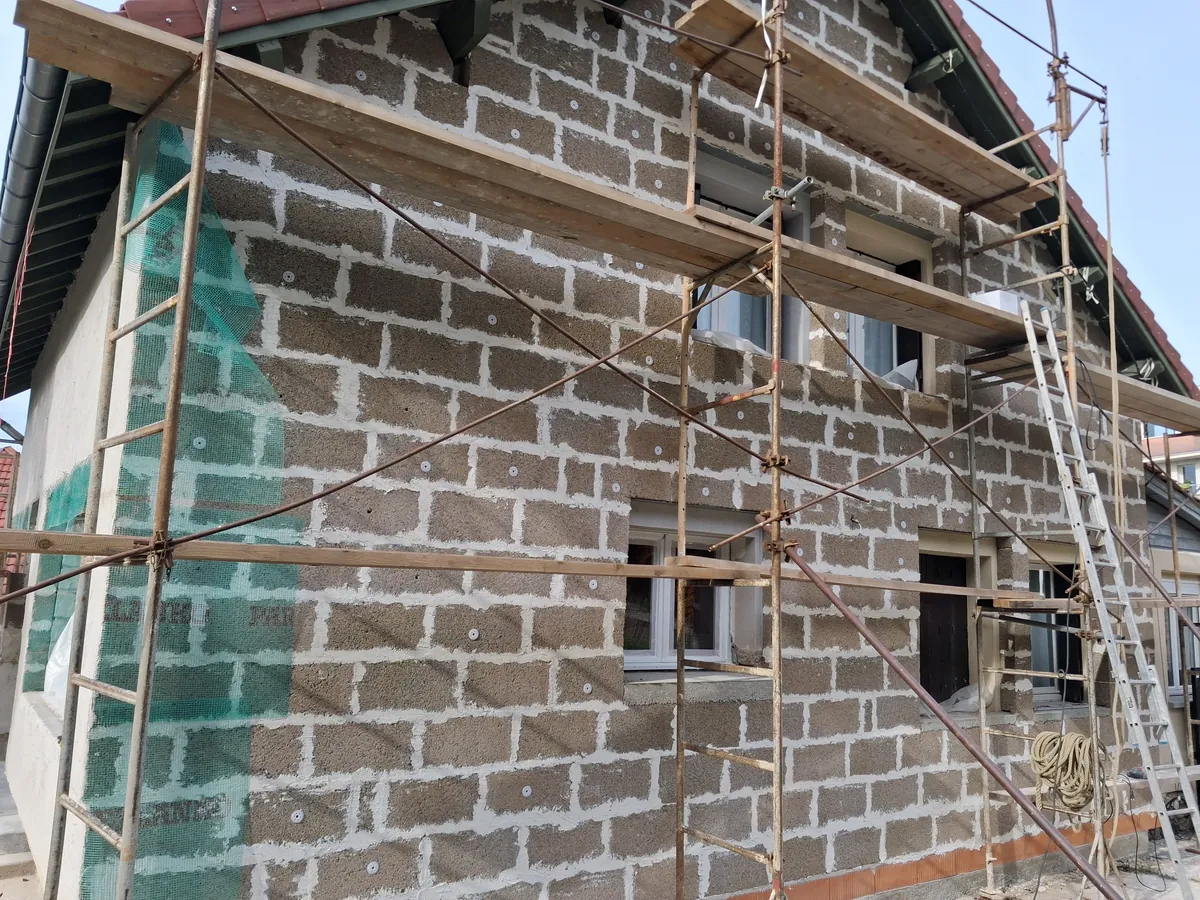
Polystyrene provides slim, cost-effective insulation, but it blocks vapour permeability and melts in fire. Hempcrete blocks, though thicker, deliver superior thermal lag, better moisture regulation, natural fire resistance, and a positive carbon footprint. The right choice depends on the building, the level of comfort desired, and budget constraints.
Thickness and thermal performance
Thermal performance, often measured by thermal resistance R, is a key consideration when choosing between hemp block or polystyrene EWI. Expanded polystyrene (EPS) has a thermal conductivity λ between 0.032 and 0.038 W/(m.K), while hempcrete blocks have a higher conductivity, around 0.065 W/(m.K). This means that to achieve a thermal resistance of R = 4.6 m².K/W, you need about 14 to 16 cm of polystyrene, compared to around 30 cm of hempcrete block.
This doubled thickness has real implications for architectural design and the installation of external wall insulation. Adding 15 cm to the façade usually requires adapting roof overhangs, modifying window sills, and repositioning rainwater downpipes. These technical adjustments can add 10 to 15% to the total project budget for a typical detached house.
Loss of living space, especially in renovation, is another factor to consider. Hempcrete blocks require a compromise between thermal performance and footprint, which may be a drawback for some projects. For a detailed overview of thicknesses, thermal resistance and lag times for hempcrete blocks, see the MULTICHANVRE range and thermal performance of hemp blocks.
Detailed comparison of technical criteria
| Criterion | Expanded polystyrene | Hempcrete block |
|---|---|---|
| Thermal conductivity λ | 0.032 to 0.038 W/(m.K) | ≈ 0.065 W/(m.K) |
| Thickness for R = 4.6 | 14 to 16 cm | 30 cm |
| Thermal lag | 2 to 4 hours | ≈ 18.5 hours (at 30 cm) |
| Water vapour permeability | Low, blocks wall breathability | High, allows wall to breathe |
| Fire behaviour | Melts and releases toxic fumes | Class B-s1 d0, does not propagate flame |
| Density | Approx. 20 kg/m³ (very light) | Approx. 300 kg/m³ |
| Sound absorption (α) | Low | 0.4 (sound absorption coefficient) |
| Origin | Petro-based, from petrochemicals | 84% bio-based (hemp shiv), mineral binder |
| End of life | Non-recyclable waste | Crushable, recyclable as aggregate or soil improver |
These technical data highlight the fundamental differences between the two materials. Polystyrene, very light and thin, is effective for thermal insulation but restricts vapour permeability, which can be problematic for some walls. Hempcrete blocks, heavier and thicker, offer favourable hygrothermal behaviour and better sound absorption, but at the cost of increased thickness and weight.
Summer comfort: a key factor
Thermal lag—the time it takes for heat to pass through a material—is crucial for comfort in summer. Polystyrene, with a typical lag of 2 to 4 hours, does little to delay heat ingress. In practice, heat accumulated during the afternoon enters the home in the early evening, keeping indoor temperatures high and causing discomfort, especially in converted lofts or on south-west facing façades.
By contrast, hempcrete blocks, with a lag of around 18.5 hours for 30 cm, delay this heat until the early hours of the next morning. This allows you to open windows at night to cool the house naturally, limiting daytime overheating. This effect has been observed on hempcrete EWI projects, particularly on 1970s houses, where residents consistently report a noticeable improvement in summer comfort—often more so than just a reduction in energy bills.
This improved summer comfort is a major advantage for projects in temperate and warm regions, or for buildings with converted loft spaces. It often justifies the extra thickness and cost of hempcrete blocks.
Behaviour of the wall behind the insulation
Vapour permeability is key to the durability of the building, especially in renovation. A vapour-tight insulant like polystyrene can block moisture movement, preventing internal humidity from escaping. On a sound concrete or dry blockwork wall, this is often not a major issue. However, on older masonry—stone, solid brick or rammed earth—often prone to rising damp, this blockage can worsen moisture problems by stopping the wall from drying naturally.
Hempcrete blocks, with their high vapour permeability, allow the wall to breathe. They act as a moisture buffer, regulating humidity within a comfortable range, which limits condensation risks and material degradation. This moisture regulation helps preserve masonry and improves indoor air quality, with an A+ rating.
However, hempcrete blocks are not a substitute for proper water management, such as drainage and waterproofing of foundations. Good practice and technical guidelines must be followed to avoid moisture-related issues.
Environmental impact and end of life
The origin and end-of-life of insulation materials are increasingly important factors in construction choices, especially with the introduction of RE2020 (France's environmental building regulation). Expanded polystyrene is a petrochemical product with a negative carbon footprint, and its end-of-life is problematic: when glued as EWI, it becomes a composite waste that is difficult to recycle and cannot be reused.
By contrast, hempcrete blocks are made from 84% hemp shiv—the woody core of the hemp stem—a renewable, locally sourced resource, combined with a vapour-open hydraulic binder, Vicat natural prompt cement. Manufacturing takes place in Bourgogne-Franche-Comté using 100% French raw materials. The block stores carbon long-term, contributing positively to the building's overall carbon footprint.
At end of life, hempcrete blocks can be crushed and reused as aggregate or agricultural soil improver, reducing landfill waste. This re-use improves its environmental impact in a simplified life cycle assessment (LCA) and meets RE2020 requirements for carbon impact.
Costs and overall budget
The supply price of polystyrene is generally two to three times lower than that of hempcrete blocks. For example, a 10 cm hempcrete block starts at around €35/m² incl. VAT, increasing with thickness. Polystyrene, being thinner, uses less raw material and is cheaper to produce.
However, the total installed cost—including accessories, compatible renders, labour, and technical adaptations (fixings, mesh, protection)—reduces this gap to around 30 to 50%, depending on façade complexity, roof overhangs, and project type. Energy renovation grants are generally based on achieved thermal performance, not the material used, and do not fully offset this difference.
Economic choices should therefore be weighed against comfort, durability, carbon footprint, and the building's health. The extra cost may be justified by better quality of life and a lower environmental impact.
Technical compatibility and installation
Hempcrete blocks are laid with lime-based mortar applied using a notched trowel, in staggered joints, then fixed to the substrate with brackets (2 to 5 per m²). The block is non-loadbearing: it is used to line a supporting wall or fill a frame. Compatible interior finishes include spray plaster, lime, earth or clay, while externally a lime render with full fibreglass mesh in three coats provides weather protection.
The BIOSYS system, designed for dry stacking with interlocking joints and no mortar, is combined with a reinforced concrete post-and-beam structure. The MULTICHANVRE range is currently undergoing certification. These technical documents are important references for professionals and design offices.
Polystyrene is usually glued to the existing wall, often with a reinforced render system. Installation is quick, lightweight and well understood by façade contractors, but requires good substrate preparation and fire protection management.
For more details, see the installation guides and technical data sheets available on the technical documentation page and information on compatible renders for hempcrete blocks.
Use cases and recommendations by building type
- Older buildings (stone, solid brick, rammed earth): hempcrete blocks are recommended for their permeability and moisture regulation, allowing the wall to dry and reducing the risk of damp.
- New builds or sound blockwork: polystyrene can be a rational, economical solution, especially if the budget is tight and roof overhang constraints are significant.
- Situations with tight overhangs or where living space is at a premium: thinner polystyrene helps limit adaptations and loss of floor area.
- Projects subject to RE2020 or aiming for low carbon impact: hempcrete blocks are preferable for their favourable carbon footprint and bio-based content.
- Depending on orientation and climate zone: on south-west facing façades or where summer comfort is a priority, hemp's thermal lag offers a real advantage.
These recommendations are based on feedback and thermal studies. For more, see the case study: EWI on a 1970s house and the guide which thickness of hempcrete block to choose.
Summary comparison: hempcrete block or polystyrene EWI
| Criterion | Expanded polystyrene (EPS) | Hempcrete block |
|---|---|---|
| Thermal conductivity λ | 0.032 to 0.038 W/(m.K) | ≈ 0.065 W/(m.K) |
| Thickness for R = 4.6 | 14 to 16 cm | 30 cm |
| Thermal lag | 2 to 4 hours | ≈ 18.5 hours (at 30 cm) |
| Water vapour permeability | Low, blocks wall breathability | High, vapour-open wall |
| Fire behaviour | Melts, emits toxic fumes, needs protection | Class B-s1 d0, does not propagate flame |
| Density | Light, approx. 20 kg/m³ | Heavier, approx. 300 kg/m³ |
| Sound absorption | Low | 0.4 (absorption coefficient) |
| Origin | Petro-based | Bio-based (84% hemp shiv) and mineral binder |
| End of life | Non-recyclable waste | Crushable, recyclable |
| Installation | Glued, reinforced render, quick | Lime mortar, staggered joints, lime or earth renders |
| Cost (supply) | 2 to 3 times cheaper | Higher, but gap narrows when installed |
| Summer comfort | Low lag, heats up quickly | High lag, delays heat ingress |
| Compatibility with old walls | Risk of increased damp | Permeable and moisture regulating |
| Certification | Standard, widely used solution | BIOSYS, MULTICHANVRE in progress |
Frequently asked questions
What thickness of hempcrete block is needed to match the insulation of 14 cm of polystyrene?
For a thermal resistance R of around 4.6 m².K/W, you need about 30 cm of hempcrete block, compared to 14 to 16 cm of expanded polystyrene. This is due to hemp's higher thermal conductivity.
Are hempcrete blocks compatible with external renders in EWI?
Yes, for external wall insulation, hempcrete blocks are finished with a lime render, fully reinforced with fibreglass mesh in three coats, ensuring weather resistance and protection of the material.
How do hempcrete blocks perform in fire compared to polystyrene?
Hempcrete is classed B-s1 d0: it does not propagate flame and does not produce flaming droplets. Polystyrene melts and releases dense smoke, requiring specific fire protection measures.
What are the end-of-life differences between polystyrene and hempcrete blocks?
Polystyrene glued as EWI becomes non-recyclable waste. Hempcrete blocks can be crushed and reused as aggregate or soil improver, improving their overall environmental impact.
What is the extra cost of hempcrete block EWI compared to polystyrene?
For supply only, polystyrene is 2 to 3 times cheaper. The total installed cost, including render and accessories, reduces the gap to 30–50% depending on project complexity and required adaptations.
Are hempcrete blocks suitable for renovating old stone or brick walls?
Yes, thanks to their vapour permeability and ability to let the wall breathe, they reduce the risk of moisture build-up, making them suitable for old walls prone to rising damp.
What are the benefits of hemp for summer comfort in EWI?
Hempcrete blocks offer a thermal lag of around 18.5 hours, delaying heat ingress and providing superior summer comfort compared to polystyrene.
Read next
Planning a hemp block project?
Tell us about your project: we will reply within 48 working hours with a tailored costing.