External wall insulation with hempcrete blocks for house renovation
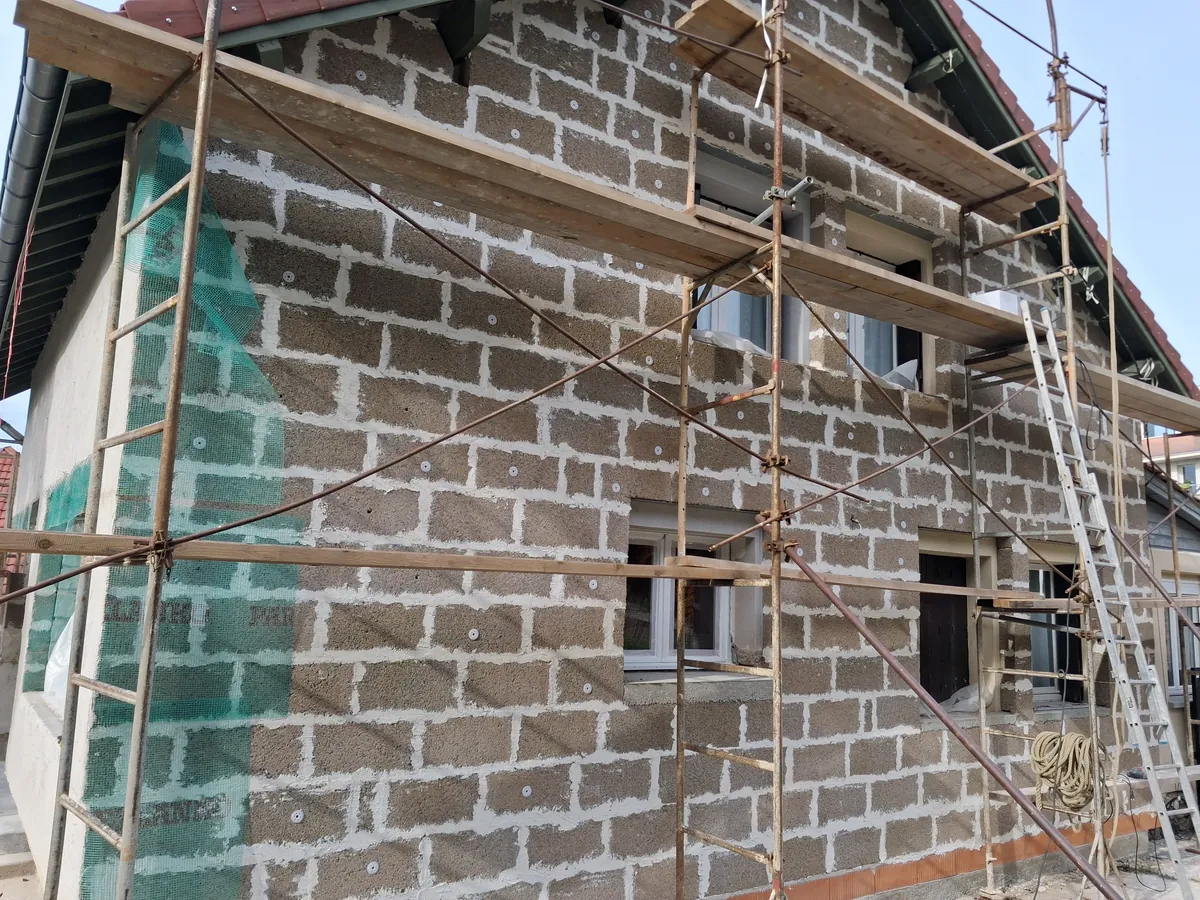
EWI with hempcrete blocks on a renovated house delivers a significant thermal upgrade without reducing living space. This system enhances thermal mass and moisture regulation, addresses thermal bridges, and is installed with specific fixings and a protective render. It is fully compatible with RE2020 (France's environmental building regulation).
| Solution used | EWI · 20 cm |
|---|---|
| Area treated | 157 m² of facades |
| Town | Besançon |
| Département | Doubs |
| Year | 2025 |
External wall insulation (EWI) using hemp blocks on a renovated detached house delivers a significant thermal upgrade without reducing the living space. This system optimises thermal mass and humidity regulation, addresses thermal bridges, and is installed with dedicated fixings and a protective render. Its use is fully compatible with the RE2020 (France's environmental building regulation).
Why choose EWI over internal insulation?
Opting for external wall insulation (EWI) with hemp blocks for a renovation project is based on several technical and practical criteria, especially for houses from the 1970s, which often present specific challenges.
- Impact on living space: For a typical 100 m² house, internal insulation with 30 cm hemp blocks would reduce the living area by almost 8 m²—a significant compromise. With EWI, the internal space is preserved, which is a major advantage for comfort and property value.
- Addressing thermal bridges: 1970s houses often have features such as slab edges, internal walls, lintels, and ring beams, which are common sources of thermal bridging. EWI provides continuous, uniform coverage of these areas, significantly reducing heat loss and improving thermal comfort.
- Preserving and enhancing thermal mass: By insulating externally, the 20 cm brick loadbearing wall remains on the warm side, inside the building. This thermal mass then becomes beneficial for both winter and summer comfort, as it stores heat and releases it gradually with a time lag.
- Effects on vapour diffusion: Hemp block EWI, a material that naturally regulates humidity, promotes healthy vapour management, preventing moisture build-up in the walls and contributing to better indoor air quality (A+ rating). In contrast, keeping a vapour-impermeable internal insulation blocks this migration, which is counterproductive.
These factors justify the technical choice of hemp block EWI, especially in renovations where interior space is limited and managing thermal bridges is crucial. For more details on the applications of hemp blocks for insulation, the website offers comprehensive resources.
The solution implemented
For this project, the chosen solution was the MULTICHANVRE 20 cm block, with the following characteristics:
- Size: 60 × 30 cm, weighing around 14 kg per block.
- Thermal resistance R = 3 m².K/W, providing a substantial insulation value for EWI.
- Thermal lag of around 12 hours, which is beneficial for summer comfort.
The blocks are laid in a bonded masonry pattern, with staggered joints, using a lime-based mortar applied with a notched trowel. Mechanical fixing is provided by brackets, about two per square metre, ensuring the system’s stability before finishing. These brackets provide a solid connection to the existing wall and withstand mechanical stresses from wind or weather loads.
The external finish is a hydraulic lime render applied in three coats, reinforced with a full fibreglass mesh to ensure mechanical strength and weather resistance. This rendering process is essential to protect the hemp block, which is not itself waterproof and requires durable protection against driving rain.
The existing substrate, a 20 cm brick wall, was prepared and checked to ensure good adhesion and compatibility with the EWI system. This type of application complies with technical recommendations for this material and substrate.
For a detailed description of the range and installation methods, see the MULTICHANVRE range for insulation page for full technical data.
Technical and thermal comparison with other EWI solutions
| Indicator | MULTICHANVRE 20 cm block | Expanded polystyrene (EPS) 12 cm | Aerated concrete 20 cm |
|---|---|---|---|
| Thermal resistance R (m².K/W) | 3 | 3.3 (approximate) | 3.5 - 4.0 (variable) |
| Thermal lag (h) | ≈ 12 | 1 to 2 | 3 to 5 (estimated) |
| Humidity regulation | Natural regulation between 50-60% RH | Low, impermeable material | Moderate, porous material |
| Indoor air quality | A+ rating | Neutral | Neutral to moderate |
| Durability | Good with lime render and maintenance | Good, but sensitive to UV | Good, requires treatment |
This comparison highlights several advantages of hemp blocks, notably their high thermal lag, which improves summer comfort by delaying heat transfer into the building. Their ability to regulate humidity contributes to a healthy indoor climate, which synthetic insulants like polystyrene cannot provide. However, installation does require a specific protective render, unlike polystyrene, which is often protected by cladding or a synthetic render.
For a more in-depth technical comparison, see the comparison of hemp block and polystyrene EWI page and the hemp block thermal performance guide.
Technical considerations on site
Renovating a 1970s house with hemp block EWI involves several technical adaptations:
- Extending roof overhangs: Adding 20 cm of façade insulation requires extending the eaves to maintain weather protection. On this project, the roof structure was extended with additional 35 cm rafters, and the verge was completely rebuilt. This accounted for around 14% of the works budget and should be planned from the design stage to avoid unexpected costs.
- Replacing window sills: The original concrete sills were too short for the insulation thickness and were replaced with projecting reconstituted stone sills, complete with drips and throatings. These prevent water pooling and protect the base of the render.
- Treating the wall base: The insulation was stopped 15 cm above ground level on a ventilated starter profile. This ventilation prevents rising damp and stagnant moisture. The plinth is protected with a water-repellent render on the hemp block, which should never be in direct contact with damp ground.
- Logistics management: The weight and volume of the blocks (14 kg each for 20 cm) require careful site organisation for storage, handling, and installation, especially in confined or elevated areas.
These technical points are essential to ensure the durability and performance of the EWI. Full technical documentation is available on the technical documentation page.
Observed thermal performance and summer comfort
The thermal improvement achieved with hemp block EWI is significant. Before works, the 20 cm brick wall had a thermal resistance of around 1.3 m².K/W. Adding the MULTICHANVRE 20 cm block increases this R-value to about 4.3 m².K/W—tripling the insulation performance.
Thermal lag increases from 5 hours in the original configuration to around 15 hours after insulation, meaning heat penetration is delayed for much of the day. This is beneficial for summer comfort, as heat absorbed during the day is released at night when windows can be opened for natural ventilation.
During a heatwave in August, the maximum indoor temperature in a loft bedroom dropped from 31.5°C to 26.8°C without air conditioning. This reduction greatly improves occupant comfort during hot periods.
In terms of energy use, gas consumption fell by 61% in the first year, even with a slightly higher setpoint temperature (from 19°C to 20°C), reflecting improved comfort. This upgrade moved the home’s Diagnostic de Performance Énergétique (DPE, French energy performance rating) from class E to class B.
These figures are based on real-world feedback and illustrate the combined benefits of hemp blocks for thermal performance and summer comfort.
Regulatory aspects and environmental impact
Hemp blocks comply with the RE2020 framework, which sets requirements for energy performance and reducing the environmental impact of buildings. The material is bio-based, made from 84% hemp shiv (the woody core of hemp) and a mineral binder—Vicat natural prompt cement—which is vapour-open.
The environmental and health declaration sheet (FDES, in French) shows a low carbon footprint, contributing to a positive carbon balance. In addition, the block stores CO₂ during its lifetime, helping to reduce overall emissions.
Indoor air quality is rated A+, with good natural humidity regulation within a comfortable range—an asset for occupant comfort and health. The fire rating is B-s1 d0, ensuring good fire resistance.
The MULTICHANVRE range is undergoing certification (an ATEx for internal insulation is being processed by CSTB), and the Technical Approval (Avis Technique) previously held by BIOSYS has expired and is being renewed.
For more information on regulations and environmental impacts, see the Hemp block and RE2020 page.
Cost and economic considerations for hemp block EWI
The indicative price for MULTICHANVRE blocks in 10 cm thickness is around €35/m² incl. VAT, with prices increasing for greater thickness. For 20 cm external insulation, the material cost is therefore higher, but delivers superior thermal performance and enhanced summer comfort.
In renovation, you also need to factor in additional costs for technical adaptations, including:
- Extending the roof structure and reworking the covering for the eaves.
- Replacing window sills with elements suitable for the insulation thickness.
- Treating the wall base with ventilated profiles and water-repellent renders.
These items can account for a significant share of the overall budget—around 14% in the example studied. A detailed assessment should be carried out at the planning stage to avoid surprises during the build.
Compared to other EWI solutions such as polystyrene or aerated concrete, hemp blocks offer a competitive overall cost when you include benefits such as air quality, durability, humidity regulation, and summer comfort. The return on investment is also measured in energy savings and increased property value.
For a detailed estimate, see the hemp block price per m² page and request a quote for hemp blocks.
Maintenance, durability and usage recommendations
Hemp blocks require an external hydraulic lime render, applied in several coats with fibreglass mesh reinforcement. The render protects against rain, frost and mechanical impacts. Regular maintenance is recommended to preserve both weatherproofing and appearance.
The fibreglass mesh in the render can be repaired in case of cracks or impact, avoiding major interventions. Periodic inspection of façades is therefore advised.
To prevent rising damp, direct contact between the block and the ground must be avoided. Stopping the insulation 15 cm above ground level on a ventilated profile is good practice, complemented by a water-repellent render on the plinth.
The expected lifespan for a well-maintained hemp block façade is comparable to that of traditional lime renders—several decades. Durability also depends on installation quality, mechanical protection and regular upkeep.
For more details, the lifespan and maintenance of a hemp block wall page provides specific recommendations.
Frequently asked questions about hemp block EWI
- Is it suitable for older houses with brick walls? Yes, hemp blocks are suitable for this type of substrate, with mechanical fixings and a protective render.
- Is it always necessary to remove existing internal insulation? Not always, but it is often recommended to optimise thermal mass and vapour management.
- What are the advantages of 30 cm compared to 20 cm for EWI? The 30 cm block offers higher thermal resistance (4.6 m².K/W) and greater thermal lag (around 18.5 h), further improving summer comfort.
- How are details like window sills and roof overhangs managed? These require specific adaptations, such as extending the roof structure, replacing sills, and installing ventilated profiles.
- Is lime render sufficient for external protection? Yes, provided it is properly applied in several coats with full fibreglass mesh reinforcement and maintained regularly.
For further information, see the dedicated frequently asked questions page.
Frequently asked questions
Are hemp blocks suitable for all loadbearing walls in renovation?
Hemp blocks are mainly used for lining or infilling a frame; they are not loadbearing. In renovation, they are well suited to brick, concrete block or stone walls, provided they are securely fixed with brackets and appropriate renders.
Should internal insulation be removed before installing hemp block EWI?
Not always, but it is often recommended. Internal insulation that blocks vapour migration can reduce the effectiveness of the thermal mass and humidity regulation provided by hemp EWI.
Why choose 30 cm thickness for EWI rather than 20 cm?
30 cm provides a higher R-value (4.6 m².K/W) and greater thermal lag (≈18.5 h), significantly improving summer comfort and energy performance without reducing living space.
How are hemp blocks fixed for EWI?
The blocks are mechanically fixed with brackets, two to five per square metre, ensuring mechanical stability before applying the protective lime render.
What are the key points to anticipate when renovating EWI on an older house?
You need to plan for extending roof overhangs, adapting window sills, and ensuring good ventilation and moisture protection, especially at the base of the walls.
Are hemp blocks weather-resistant in EWI applications?
The block itself is not waterproof. Weather protection is provided by the lime render with fibreglass mesh, which must be properly applied and maintained.
What is the environmental impact of hemp block EWI?
The block is bio-based, made from hemp shiv and natural prompt cement, stores CO₂, has a low FDES (in French), and contributes to better indoor air quality (A+ rating).
Similar projects in pictures
MULTICHANVRE projects of the same kind, carried out by our customers.
Read next
Planning a hemp block project?
Tell us about your project: we will reply within 48 working hours with a tailored costing.