Hempcrete block or aerated concrete: differences, performance and uses
Aerated concrete is a monolithic loadbearing and insulating material, while hempcrete block is a non-loadbearing insulant, used as a lining or infill. Hemp offers better thermal insulation and a lower carbon footprint, but requires a supporting structure. The right choice depends on your structural, thermal and environmental needs, as well as site constraints.
 By Julien Compain
Aerated concrete is a monolithic loadbearing and insulating material, whereas hempcrete block is a non-loadbearing insulant, used as a lining or infill. Hemp provides better thermal insulation and a lower carbon footprint, but requires a supporting structure. The choice depends on structural, thermal and environmental needs, as well as site constraints.
The fundamental difference
Aerated concrete is an expanded mineral material, produced by autoclave curing. Its cellular structure, made up of millions of air bubbles, gives it insulating properties while also providing structural strength. Aerated concrete can be used to build loadbearing walls over several storeys without additional structure, making monolithic wall construction straightforward.
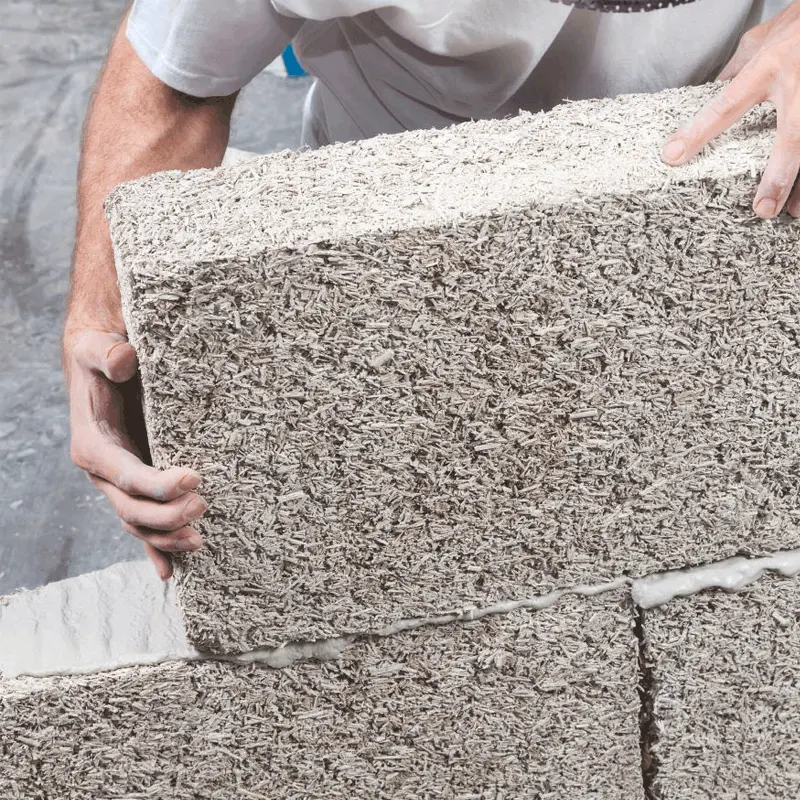
Hemp block, by contrast, is a bio-based composite made from 84% hemp shiv (the woody core of the hemp stem) bound with a mineral binder, in this case Vicat natural prompt cement. This block is non-loadbearing: it is designed to line an existing loadbearing wall, infill a timber frame, or form a partition wall. For loadbearing construction with hemp, the BIOSYS system, which combines these blocks with a reinforced concrete post-and-beam structure, is required.
This fundamental distinction between monolithic aerated concrete walls and double-skin walls with hemp blocks has significant implications for design, installation, thermal performance and durability. Aerated concrete offers an integrated solution, whereas hemp is part of a more complex construction system.
Detailed technical comparison
| Criterion | Aerated concrete | MULTICHANVRE hemp block |
|---|---|---|
| Structural function | Loadbearing, monolithic wall | Non-loadbearing (lining or infill) |
| Thermal conductivity λ | 0.09 to 0.12 W/(m·K) | ≈ 0.065 W/(m·K) |
| Density | 400 to 600 kg/m³ | ≈ 300 kg/m³ |
| Water vapour permeability | Good, vapour-open material | Good, with capillary regulation effect |
| Thermal resistance R by thickness | Varies, e.g.: R ≈ 3.4 for 36.5 cm |
|
| Thermal lag | Moderate, low thermal capacity | 18.5 h at 30 cm, good summer comfort |
| Fire rating | Standard to NF EN | B-s1 d0 (block fire rating) |
| Indoor air quality | Standard | Class A+ (no harmful emissions) |
| Sound absorption α | Moderate | 0.4 (notable absorption) |
| Composition | Mineral, autoclave cured | 84% hemp shiv, natural prompt cement binder |
| Origin of raw materials | Mineral, heavy industry | 100% French, bio-based and recyclable |
| Site water sensitivity | High, requires protection | Moderate, dries naturally |
| FDES (carbon footprint) | Higher (not precisely stated) | Verified FDES |
Thermal performance
The thermal conductivity of hemp block is around 0.065 W/(m·K), lower than that of aerated concrete, which ranges from 0.09 to 0.12 W/(m·K). This means that, for the same thickness, hemp provides better thermal insulation.
However, this direct comparison is incomplete. Aerated concrete is a monolithic material: it provides both structure and insulation. For example, a 36.5 cm thick monolithic aerated concrete wall achieves a thermal resistance of around 3.4 m²·K/W.
By contrast, hemp block is an insulant added to an existing loadbearing wall. A 30 cm lining of MULTICHANVRE hemp block provides a thermal resistance of 4.6 m²·K/W, higher than aerated concrete at a similar thickness, but the finished wall also includes the supporting wall, increasing the total thickness and reducing usable floor area, especially for internal wall insulation (IWI). This is an important trade-off.
In terms of summer comfort, hemp block benefits from a higher thermal lag (around 18.5 hours for 30 cm), thanks to its fibrous composition and moderate density. Aerated concrete, despite its cellular structure, has limited thermal capacity, reducing its effectiveness in regulating summer heat.
Both materials are vapour-open, helping to manage moisture and limit condensation risk. Hemp block also acts as a natural humidity regulator thanks to its capillary action. Indoor air quality is another advantage of hemp, which is rated A+ for low emissions.
For a more in-depth analysis of thermal performance, see our dedicated guide, as well as references relating to RT2020.
Where hemp makes the difference
- Carbon footprint: Hemp is a fast-growing plant that absorbs CO₂ during cultivation, with no irrigation or pesticides. Hemp block has a verified FDES, reflecting its low carbon impact, notably thanks to low-energy, kiln-free production. Aerated concrete is autoclaved at 180°C under pressure, an energy-intensive process with higher emissions.
- Summer comfort: The high thermal lag of hemp block improves comfort by limiting indoor heat peaks, an advantage over aerated concrete, which has lower thermal capacity.
- Local bio-based supply chain: The raw materials for hemp block are 100% French, from a dry, renewable and recyclable supply chain, supporting local sourcing and traceability.
- Natural resistance: Hemp is naturally resistant to rodents, reducing the risk of long-term degradation.
- Indoor air quality: The block is rated A+ for volatile organic compound emissions, contributing to a healthy environment.
These environmental and comfort aspects are key differentiators for both renovation and new-build projects, especially to meet the requirements of the RE2020 (France's environmental building regulation).
Where aerated concrete has the advantage
- Structural function: Aerated concrete is loadbearing. It allows loadbearing walls to be built without a lining, simplifying design and reducing overall wall thickness.
- Simplicity and speed of installation: Only one material is used, with well-established techniques familiar to professionals. This avoids interfaces between materials and the risks associated with installation.
- Mechanical strength: Aerated concrete supports heavy loads and allows easy fixing with standard plugs, unlike hemp block, which requires specific precautions.
- Often lower overall cost: For new builds, monolithic aerated concrete is generally more economical, especially for simple houses, as it does not require a separate structure for insulation.
- Proven standards and supply chain: Aerated concrete benefits from certifications, standards and a well-developed industrial supply chain, providing reassurance on quality and durability.
Hemp block or aerated concrete: comparison table
| Criterion | Aerated concrete | MULTICHANVRE hemp block |
|---|---|---|
| Block size | Varies, often 60 x 25 to 60 x 30 cm | 60 x 30 cm (thicknesses 10, 15, 20, 30 cm) |
| Density | 400 to 600 kg/m³ | ≈ 300 kg/m³ |
| Thermal conductivity λ | 0.09 to 0.12 W/(m·K) | ≈ 0.065 W/(m·K) |
| Thermal resistance R (by thickness) | Example: 36.5 cm → R ≈ 3.4 |
|
| Thermal lag | Moderate | 18.5 h at 30 cm |
| Structural function | Loadbearing | Non-loadbearing (except BIOSYS with post-and-beam structure) |
| Composition origin | Mineral, autoclave cured | 84% hemp shiv, natural prompt cement binder |
| Site water sensitivity | High, requires protection | Moderate, dries naturally |
| Fire rating | Standard | B-s1 d0 |
| Indoor air quality | Standard | A+ |
| Sound absorption α | Moderate | 0.4 |
| FDES | Not specified, higher | Verified FDES |
| Installation | Monolithic wall, laid with adhesive or mortar, rendered finish | Lime-based mortar, staggered joints, metal ties, compatible renders |
| Applications | Loadbearing walls, monolithic insulation | Internal wall insulation (IWI), external wall insulation (EWI), partitions, timber frame infill |
Installation and practical applications
MULTICHANVRE hemp blocks are laid with a trowel using lime-based mortar in staggered joints. The connection to the supporting wall is made with metal ties, two to five per square metre, ensuring mechanical stability. The block is ready to receive a render, compatible with spray plaster, lime, earth or clay indoors, and a lime render with full mesh reinforcement outdoors.
Hemp block has a range of uses: internal wall insulation (IWI), external wall insulation (EWI), partitions, floor insulation under screed, timber frame infill. Each application requires precise technical detailing, especially to avoid thermal bridges and ensure continuous insulation. These aspects are covered in our dedicated applications section and the installation guide.
Aerated concrete, as a monolithic wall, is installed using tried-and-tested techniques, usually with special adhesive or mortar, with blocks cut to size. It is sensitive to moisture during construction and must be protected from rain. Its installation is simpler as it provides both structural and insulating functions.
The choice between these materials also depends on context: for renovation, hemp block improves insulation without major structural changes. For new builds, aerated concrete offers an integrated, fast and proven solution. For optimal environmental and thermal performance, combinations are possible.
Combining hemp block and aerated concrete: complementarity and use cases
It is common and effective to combine a loadbearing aerated concrete wall with a hemp block lining. This approach leverages the strengths of each material:
- Structure: Aerated concrete provides mechanical stability and loadbearing capacity.
- Insulation and comfort: Hemp block delivers higher thermal resistance, greater thermal lag and enhanced humidity regulation.
- Environmental impact: Hemp reduces the overall carbon footprint of the building envelope and improves indoor air quality.
This approach is compatible with RE2020 requirements and meets expectations for durable, comfortable performance. Case studies are available in our projects section.
Frequently asked questions
To answer the most common questions about hemp block and aerated concrete, a detailed FAQ is available, covering loadbearing capacity, insulation thickness, carbon footprint, compatibility of use and installation techniques.
You can consult this comprehensive FAQ to deepen your understanding and refine your choice.
For more technical information, see our detailed comparison, the MULTICHANVRE range or the BIOSYS building system.
Frequently asked questions
Can hemp block support loads like aerated concrete?
No, MULTICHANVRE hemp block is not loadbearing and must be used as a lining or infill to a supporting structure. For new-build hemp construction, the BIOSYS system combines the blocks with a reinforced concrete post-and-beam structure, which carries the loads.
What thickness should I choose for effective insulation with hemp block?
MULTICHANVRE blocks are available in 10, 15, 20 and 30 cm thicknesses, with thermal resistances from 1.5 to 4.6 m².K/W. The choice depends on the required insulation level, wall configuration and space constraints. Detailed technical guides are available to help with these choices.
How does the carbon footprint of hemp block compare to aerated concrete?
Hemp block has a verified FDES, reflecting its low impact thanks to carbon storage by the plant and low-energy manufacturing. Aerated concrete, autoclaved, has a higher carbon footprint.
Is hemp block suitable for external wall insulation?
Yes, the MULTICHANVRE range includes blocks up to 30 cm thick, suitable for external wall insulation (EWI) with lime render finish. The system ensures good humidity regulation.
What types of render are compatible with hemp block?
Interior renders based on spray plaster, lime, earth or clay are compatible. For exteriors, a lime render with full mesh reinforcement is recommended to protect the block while maintaining its properties.
Can hemp block and aerated concrete be combined in the same wall?
Yes, combining a loadbearing aerated concrete wall with a hemp block lining is a solution that brings together the simplicity and strength of aerated concrete with the insulation, summer comfort and humidity regulation of hemp.
What are the installation requirements for hemp block?
Hemp block is laid with a trowel using lime-based mortar in staggered joints, requires connection to the substrate with metal ties, and a render. Installation requires suitable expertise, especially to avoid thermal bridges and ensure continuous insulation.
Read next
Planning a hemp block project?
Tell us about your project: we will reply within 48 working hours with a tailored costing.