How to install hempcrete blocks for internal and external insulation, partitions and floors
MULTICHANVRE hempcrete blocks are laid in a bonded masonry pattern with staggered joints, on a sound, level base. Use a suitable mortar and take care with the first course. Blocks are easy to cut and naturally regulate heat and moisture. Finishes must be vapour-open to preserve the material’s performance.
 By Julien Compain
Official installation guides in PDF: MULTICHANVRE installation guide (in French) (masonry with lime mortar) and BIOSYS installation guide (in French) (dry-stacking and concrete frame).
MULTICHANVRE hemp blocks are laid in a traditional masonry bond with staggered joints, on a sound, level substrate. The system requires a suitable mortar and particular care with the first course. Blocks are easy to cut, and offer natural hygrothermal regulation. Finishes must be vapour-open to preserve the material’s properties.
Before you start: tools, materials and preparation
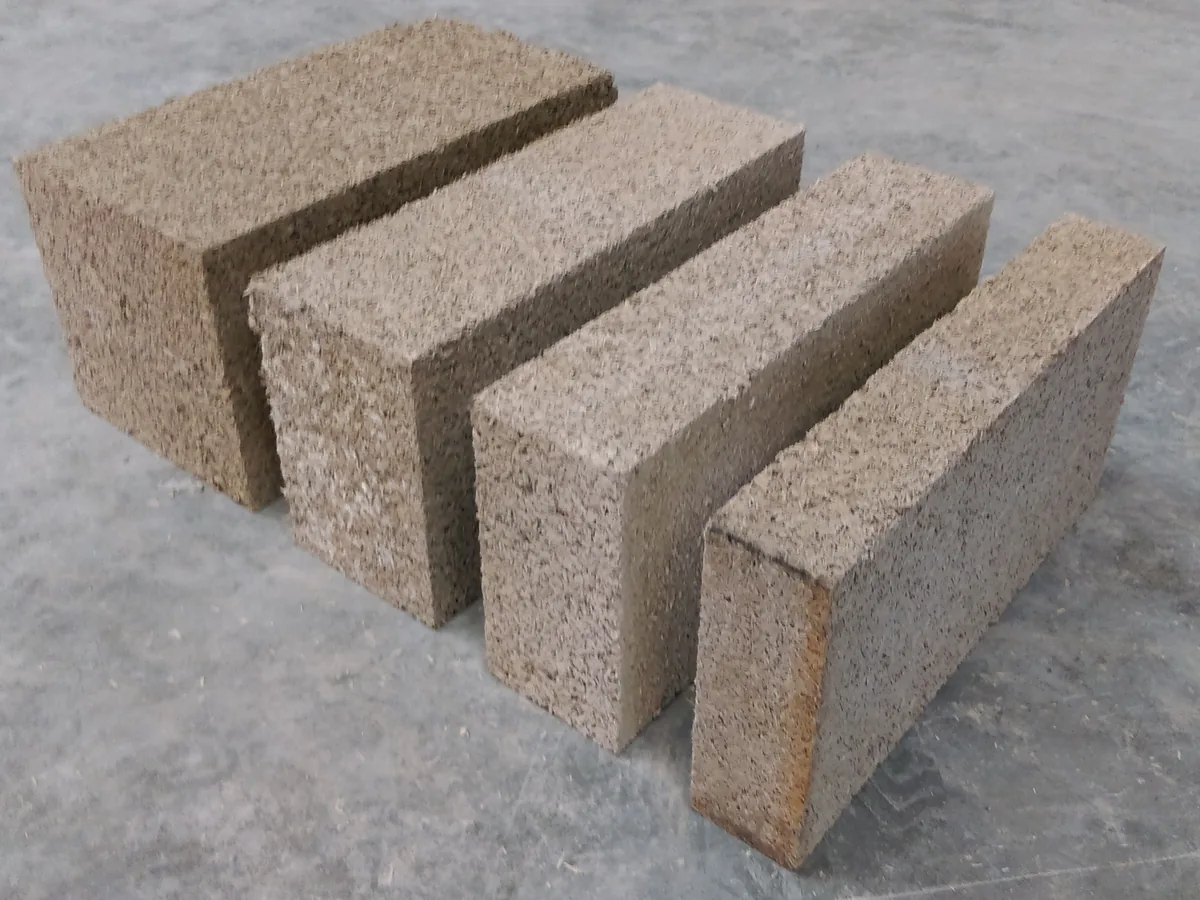
Gathering everything you need before starting work is essential. MULTICHANVRE hemp blocks are available in four thicknesses (10, 15, 20 or 30 cm), each with thermal resistance values suited to different applications (see The MULTICHANVRE range). It’s important to order blocks in the correct thickness for your intended use: internal insulation (IWI), external insulation (EWI), partitions or floors.
- The blocks in your chosen thickness, weighing from 6.5 kg (10 cm) to 21 kg (30 cm) each, are easy to handle without excessive effort.
- Lime-based mortar suitable for bonded masonry. This vapour-open hydraulic binder ensures good adhesion between blocks and to the substrate.
- Cutting tools: a coarse-toothed handsaw or an alligator saw will give clean cuts without problematic fine dust.
- Installation tools: notched trowel for spreading mortar, mixing tub, straight edge, spirit level, chalk line for accurate marking.
- Standard PPE for masonry (gloves, goggles, helmet) is sufficient, as the material is lightweight and non-irritant.
Logistics: keep pallets of blocks close to the work area to minimise handling, prepare mortar in advance, and plan your schedule according to the quantities involved. Laying is quick thanks to the lightness of the blocks and no need to wait for each course to dry, unlike cast hempcrete.
For detailed installation guidance, the official installation guide (in French) in PDF, available for download on the website, is an essential resource.
Preparing the substrate: flatness, moisture and stability
A suitable substrate is vital to ensure the insulation’s performance and durability. It must be clean, sound, flat and stable, compatible with the lightweight and porous nature of the blocks.
- Flatness: check and correct any irregularities. Excessively uneven substrates cannot be compensated for by the masonry after the first course. Identify and remove any high spots as needed.
- Moisture: identify and treat any rising damp before installation. Hemp regulates ambient humidity but cannot resolve underlying structural moisture problems. The substrate must be dry before starting.
- Stability: remove any loose render, degraded plaster or flaking paint to ensure good mortar adhesion to the substrate.
At the base of the wall, install a damp-proof course to protect against long-term moisture ingress. Raising the first course is also recommended to reduce the risk of rising damp.
Laying the first course: a critical step
The first course determines the stability and appearance of the entire masonry wall.
- Mark out the layout with a chalk line, carefully checking squareness to avoid misalignment as you build up.
- Spread an even bed of mortar along the full length of the first course, using a notched trowel to ensure uniform adhesion.
- Lay each block, checking both horizontal and vertical levels course by course. Regularly check alignment with the chalk line.
- Check final alignment before the mortar starts to set. Mistakes at this stage are difficult to correct later on.
Poorly laid first courses will cause visible defects and make it difficult to adjust subsequent courses. This step requires care and patience.
Building up: laying subsequent courses in a staggered bond
The method is the same as for traditional masonry: vertical joints must be staggered to ensure the wall’s strength and cohesion.
- Apply lime-based mortar to the horizontal bed and the vertical end of the previous block.
- Lay blocks one by one, adjusting and checking level and plumb regularly.
- The light weight of the blocks (between 6.5 and 21 kg, depending on thickness) makes handling easy and speeds up installation.
- Unlike cast hempcrete, there’s no need to wait for each course to dry, allowing for efficient, continuous work.
This staggered bonded masonry technique optimises airtightness and mechanical stability.
Cutting, service runs and electrical conduits
Hemp blocks are easy to cut with standard tools, and do not produce problematic fine dust.
- Blocks can be cut with a handsaw or alligator saw, depending on the required precision.
- For electrical conduits, chase out a groove in the block before installation. A wall chaser or gouge is sufficient.
- Grooves should be filled with mortar before applying plaster or render, ensuring thermal continuity and airtightness.
- Plan for technical services (back boxes, MVHR, water pipes) before installation to minimise later alterations and simplify the build.
- Compared to chasing into concrete or concrete block, chasing into hemp block is quicker, produces less dust and is less arduous.
Openings, junctions and detailing
As with all masonry, openings require special attention:
- Follow standard rules: properly sized lintels, suitable sills, and movement joints to prevent cracking and defects.
- Hemp blocks are compatible with standard joinery, with no need for special accessories.
- Take care with junctions to existing walls, floors and roof structures to avoid thermal bridges and air leakage.
- Use flexible joints rather than rigid fillers to accommodate building movement and prevent cracking.
- Ensure loads are properly distributed onto the structural frame, as hemp blocks are non-loadbearing.
Fixing loads to the wall: recommendations by weight
With a density of around 300 kg/m³, hemp blocks are lightweight and not designed to support heavy point loads directly. Fixings must be chosen according to the intended load:
- Light loads (pictures, lights, empty shelves): use fixings suitable for low-density, hollow materials.
- Medium loads (wall units, radiators): use chemical anchors or load-spreading plates to avoid damaging the block.
- Heavy loads (full furniture, wall-hung sanitaryware): integrate reinforcements at design stage, such as a timber batten embedded in the wall, a metal rail, or transfer the load to a dedicated structural element.
Anticipating these needs at the planning stage avoids costly and complex remedial work later.
Compatible finishes and render recommendations
The MULTICHANVRE block is supplied ready for rendering, with no need for a bonding coat or special surface preparation.
- Recommended internal finishes: spray plaster, lime, earth or clay. These materials are vapour-open.
- External renders: lime with full mesh reinforcement, providing mechanical protection while remaining vapour-open.
- Vapour permeability is essential to maintain the block’s hygrothermal regulation, prevent condensation and avoid material degradation.
- Cement renders or film-forming paints are not recommended, as they trap moisture and compromise performance and durability.
For further information, see the compatible renders guide (in French) available on the website.
Performance comparison and technical characteristics by thickness
| Thickness (cm) | Thermal resistance R (m².K/W) | Thermal lag (h) | Block weight (kg) | Packing (blocks/pallet) | Area per pallet (m²) | Recommended use |
|---|---|---|---|---|---|---|
| 10 | 1.5 | 6.1 | 6.5 | 120 | 21.6 | Partitions, lightweight lining |
| 15 | 2.3 | 9.25 | 10 | 80 | 14.4 | Standard lining, partitions |
| 20 | 3.0 | 12.3 | 13 | 60 | 10.8 | High-performance internal (IWI) and external (EWI) insulation |
| 30 | 4.6 | 18.5 | 21 | 56 | 10.08 | High-performance external insulation (EWI) |
Thermal conductivity λ remains constant at around 0.065 W/(m.K), regardless of thickness. Thermal lag increases with thickness, improving summer comfort by delaying heat transfer. The low density (~300 kg/m³) makes handling easy, but means precautions are needed for heavy loads.
Thickness choice should take space constraints into account, especially for IWI where loss of living area is a key consideration. For more on this, see the thickness selection guide (in French).
The various applications for IWI, EWI, partitions and floors are detailed on the applications for IWI, EWI, partitions and floors page.
Frequently asked questions
Can hemp blocks be laid directly onto a damp wall?
No, it’s essential to identify and treat any rising damp before installation. Hemp regulates humidity but cannot resolve structural moisture problems in the substrate.
Do I need special tools to cut hemp blocks?
No, a coarse-toothed handsaw or alligator saw is sufficient. The material is lightweight and easy to cut, with no problematic fine dust.
What types of loads can be fixed to a hemp block wall?
Light loads such as pictures or lights can be fixed with anchors suitable for hollow, low-density materials. For medium loads, use chemical anchors or load-spreading plates. Heavy loads require reinforcement built in at the design stage.
Why must renders be vapour-open?
Vapour permeability is crucial to allow moisture exchange, preventing condensation and block degradation. An impermeable render would trap moisture and negate the hemp’s natural hygrothermal regulation.
Can BIOSYS hemp blocks be installed like MULTICHANVRE?
No, BIOSYS is a dry-stacked system combined with a reinforced concrete post-and-beam frame. Its installation is different from the bonded masonry method used for MULTICHANVRE.
What are the advantages of staggered bonded masonry?
This technique ensures wall cohesion and airtightness, with staggered vertical joints to avoid weak points. It allows rapid installation thanks to the lightweight blocks and no need for drying time between courses.
How can I plan for service runs in a hemp block wall?
It’s best to plan locations for electrical boxes, MVHR ducts and water pipes in advance. Service runs can be chased out before installation to minimise costly alterations later.
Read next
Planning a hemp block project?
Tell us about your project: we will reply within 48 working hours with a tailored costing.