Hemp block or glass wool: comparison guide for the right insulation
Glass wool provides better thermal insulation for the same thickness, but hempcrete blocks offer greater thermal lag, regulate humidity naturally without a membrane, deliver higher thermal mass, and are more durable. The best choice depends on your project—renovation or new build, thickness constraints, and summer comfort requirements.
 By Julien Compain
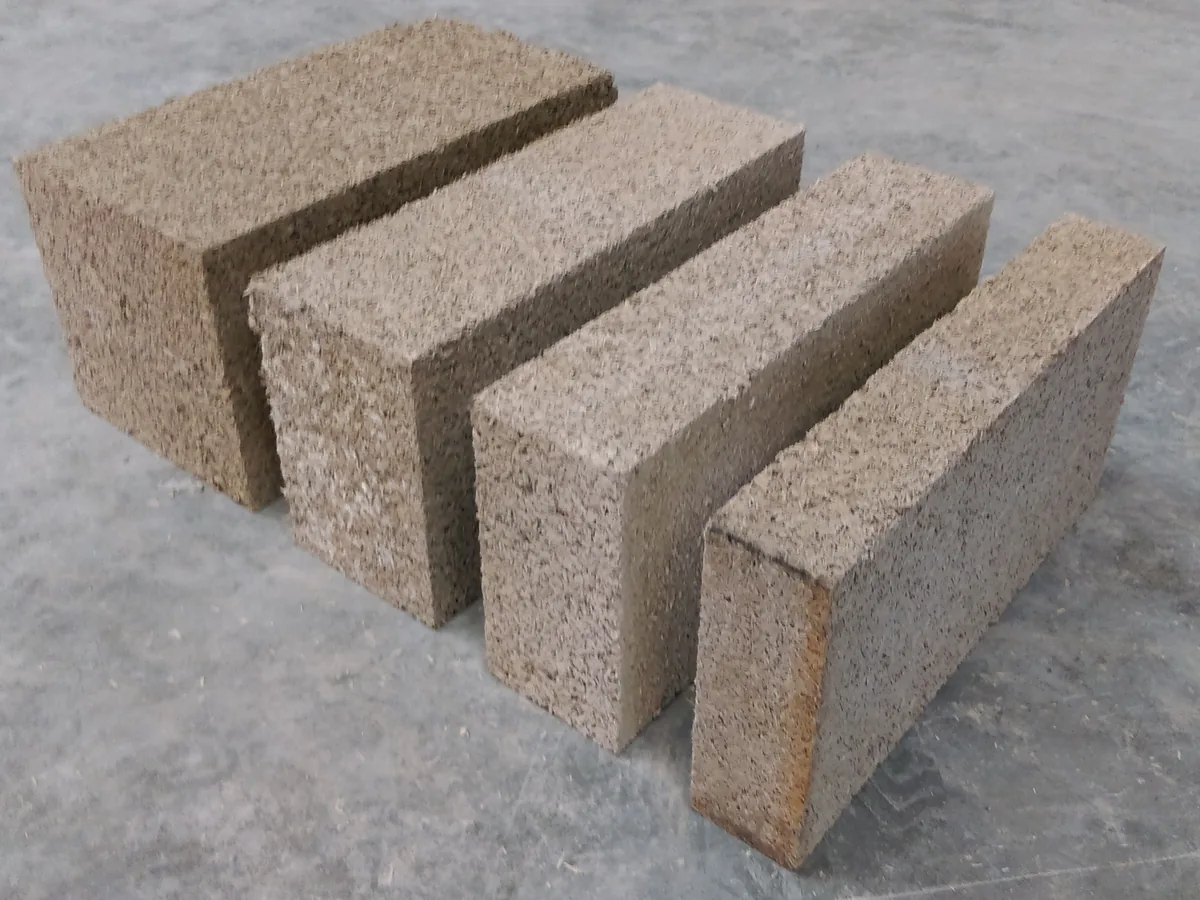
Glass wool provides better thermal insulation for the same thickness, but hempcrete blocks offer greater thermal lag, regulate humidity without a membrane, deliver higher thermal mass, and are more durable. The right choice depends on the context—such as renovation or new build, thickness constraints, and summer comfort requirements.
What lambda tells you—and what it doesn’t
Thermal conductivity λ measures how quickly heat passes through a material. Glass wool has a λ of around 0.035 W/(m.K), while hempcrete blocks are about 0.065 W/(m.K). This means, at equal thickness, glass wool insulates roughly twice as well as hempcrete blocks. This is an important factor, especially for projects where available thickness is limited.
However, this parameter only describes steady-state thermal performance, typically in winter, with stable temperatures on both sides of the wall. It does not account for moisture management, summer comfort, or long-term durability of performance. These are essential aspects for a complete assessment—and precisely where hempcrete blocks offer notable advantages.
| Criterion | Glass wool | Hempcrete block |
|---|---|---|
| Thermal conductivity λ | ≈ 0.035 W/(m.K) | ≈ 0.065 W/(m.K) |
| Thickness for R = 3.0 | ≈ 10.5 cm | 20 cm |
| Thermal lag at R = 3.0 | 3 to 5 h | ≈ 12 h |
| Density | 15 to 25 kg/m³ | ≈ 300 kg/m³ |
| Water vapour management | Vapour barrier required | Breathable material, no membrane |
| Indicative supply price | €8 to €15/m² | from ≈ €35/m² incl. VAT at 10 cm |
| Long-term settlement | Possible | None (mineralised material) |
For a deeper comparison of thermal performance, see our detailed analysis.
Summer comfort: the biggest difference
Summer comfort is often overlooked when choosing insulation. Here, the density of the material is crucial. Glass wool weighs between 15 and 25 kg/m³, while hempcrete blocks are around 300 kg/m³—over ten times heavier.
This difference results in much greater thermal lag for hempcrete blocks. For example, a 30 cm hempcrete block provides a lag of about 18.5 hours, whereas glass wool typically tops out at 3 to 5 hours. This delay in heat transfer means the afternoon heat peak is pushed back to the night, when the building can be effectively ventilated.
In practice, glass wool only delays heat by a few hours, which can lead to overheating in the evening—particularly problematic in homes facing south or south-west. Hempcrete blocks therefore significantly improve thermal comfort during hot periods, which has become essential in modern homes with high solar gains and frequent overheating.
Humidity: two incompatible approaches
Moisture management is a key difference between glass wool and hempcrete blocks. Glass wool requires a vapour barrier on the warm side to prevent water vapour condensing inside the insulation. This barrier must be continuous and airtight, which demands careful installation and ongoing attention to its integrity.
If the barrier is punctured—by a downlight, a poorly fitted cable, or peeling tape—water vapour can condense in the glass wool, causing settlement, loss of thermal performance, and risk of mould. These issues are especially critical in renovations, particularly on older or stone walls, which are often not very airtight and sensitive to moisture.
By contrast, hempcrete blocks are naturally breathable. They absorb excess moisture and release it when the air is drier, with no need for an airtight membrane. This humidity regulation helps preserve the building’s durability and limits condensation risks. That’s why hempcrete blocks are often chosen for renovating older buildings, as explained in our guide to applications for internal and external insulation, partitions and floors.
Price and total costs: an honest analysis
Supply price is often a decisive factor. Glass wool typically costs between €8 and €15/m², while hempcrete blocks start from around €35/m² incl. VAT for 10 cm thickness. This is a significant difference and should be factored into the initial budget.
However, the comparison doesn’t end with the material price. Glass wool requires a metal frame, vapour barrier, plasterboard, and the associated labour. Factory-made hempcrete blocks are laid directly as bonded masonry with staggered joints, requiring no frame or membrane, which simplifies installation.
When these elements are included, the total installed cost gap narrows to around 20–40%, depending on the site configuration, though it does not disappear entirely. For an accurate estimate, it’s best to request a quote tailored to your project. Detailed benchmarks are also available in our hempcrete block price guide.
Detailed comparison of technical characteristics
| Criterion | Glass wool | Hempcrete block |
|---|---|---|
| Composition | Glass fibres | 84% hemp shiv + Vicat natural prompt cement |
| Format | Mats or boards | Blocks 60 × 30 cm (thicknesses 10 to 30 cm) |
| Thermal conductivity λ | ≈ 0.035 W/(m.K) | ≈ 0.065 W/(m.K) |
| Thermal resistance R (examples) | ≈ 3.0 at 10.5 cm | 3.0 at 20 cm; 4.6 at 30 cm |
| Thermal lag | 3 to 5 h | 6.1 h (10 cm) to 18.5 h (30 cm) |
| Density | 15 to 25 kg/m³ | ≈ 300 kg/m³ |
| Water vapour management | Vapour barrier required on warm side | Breathable material, no membrane |
| Durability | Possible settlement, especially if damp | No settlement, stable mineralised material |
| Compatible finishes | Plasterboard, paints | Sprayed plaster, lime, earth or clay renders |
| Indoor air quality | Neutral to variable depending on vapour barrier | A+ rating, natural humidity regulation |
| Acoustic performance | Variable, generally low α | Absorption coefficient α = 0.85 |
| Environmental impact | Mineral fibre, moderate embodied energy | Bio-based, renewable, recyclable, verified FDES |
| Installation | Fixed to frame, vapour barrier, boards | Bonded masonry, staggered joints, fixed with brackets |
| Certifications | European insulation standards | BIOSYS Technical Approval renewal in progress, MULTICHANVRE certification in progress |
This data highlights the structural and functional differences between the two materials. For a detailed study, see our hempcrete block or glass wool comparison.
Typical applications and usage advice
Hempcrete blocks are mainly used in renovation on old stone, earth, or solid brick walls, where humidity management is critical. They are suitable for internal wall insulation (IWI), external wall insulation (EWI), partition walls, floor insulation under screed, and for infilling timber frames. These uses are detailed on our dedicated page for applications in IWI, EWI, partitions and floors.
Glass wool remains the preferred option where thickness is limited, especially in lofts, roof slopes, and partitions where thermal mass or humidity regulation are not key concerns. It offers good performance for the price in these situations.
The choice between hempcrete block and glass wool therefore depends on several factors:
- Available thickness and the need for high thermal resistance.
- Building type, with hemp preferred for renovating old walls.
- Desired summer comfort, where hemp offers a real benefit.
- Overall budget and installation constraints.
Case studies and feedback are available in our project showcase, providing useful insights to help you decide.
Installation constraints and durability
Glass wool requires careful installation of the vapour barrier on the warm side. Any poor installation, puncture, or peeling can lead to condensation, causing the insulation to settle, reducing thermal efficiency, and encouraging mould growth. This vulnerability calls for particular care, especially in renovation.
Hempcrete blocks, factory-made and mineralised with a natural mineral binder, do not settle over time. Their durability is assured provided good installation practices are followed: bonded masonry with lime mortar applied using a notched trowel, staggered joints, fixing blocks to the substrate with brackets (about 2 per m²), and applying a suitable protective render.
Compatible finishes vary depending on use:
- Sprayed plaster, lime, earth or clay renders indoors.
- Lime render with full mesh reinforcement outdoors.
These finishes contribute to the system’s durability and performance. They also help regulate humidity and improve indoor air quality.
Following these recommendations is essential to ensure the longevity and effectiveness of hempcrete blocks over time.
For more technical details, our technical documentation offers installation guides, quick reference sheets and flyers in PDF format.
Frequently asked questions
The most common questions on this topic are answered in our dedicated FAQ, covering performance, cost, durability, and possible combinations of materials.
Finally, for help choosing the right thickness for your project, see our technical guide with recommendations based on the RT2020 regulation and site constraints.
This comparison shows that both hempcrete blocks and glass wool are valid insulation solutions, but with different technical profiles and uses. The choice depends on a precise analysis of the project’s thermal, hygrothermal, economic and environmental requirements.
Frequently asked questions
Are hempcrete blocks suitable for renovating old walls?
Yes, hempcrete blocks are particularly well suited to old stone, earth or solid brick walls because they naturally regulate humidity without the need for a vapour barrier, allowing the wall to dry out and reducing the risk of damage.
Can hempcrete blocks be installed without a render?
Hempcrete blocks require a suitable finish to protect the masonry and ensure performance. Indoors, sprayed plaster, lime, earth or clay renders are recommended; outdoors, a lime render with full mesh reinforcement ensures durability.
What thickness of hempcrete block should I choose for good winter and summer comfort?
The thickness depends on thermal requirements: for example, 20 cm provides a thermal resistance R of 3.0 and a lag of around 12 hours, ensuring good comfort in both winter and summer. The choice should also consider the loss of usable floor area.
Are hempcrete blocks compatible with RE2020 regulations?
Yes, hempcrete blocks are a renewable, recyclable bio-based material with a favourable carbon footprint that meets the requirements of RE2020 (France’s environmental building regulation) for new builds, notably due to their CO₂ storage and low embodied energy.
What is the lifespan of hempcrete block insulation?
Hempcrete blocks are a mineralised material that does not settle and maintains its thermal performance over time, provided installation is correct and the render finishes are properly maintained.
Can glass wool and hempcrete blocks be combined in the same wall?
This combination is not recommended in the same wall due to their opposite approaches to vapour management, which can create condensation points. However, they can be used in different parts of a building—for example, hemp on walls and glass wool in the loft.
What are the main risks of poor glass wool installation?
Poor installation of the vapour barrier (punctures, peeling) can lead to condensation inside the insulation, causing settlement, loss of thermal efficiency, and risk of mould, especially on old, less airtight walls.
Read next
Planning a hemp block project?
Tell us about your project: we will reply within 48 working hours with a tailored costing.