Internal hempcrete blocks vs common insulations: comparison guide
Internal hempcrete blocks provide effective thermal and moisture regulation, naturally managing humidity levels. They require greater thickness than conventional insulations for the same R-value, and installation calls for a suitable fixing system. Their environmental credentials are based on carbon capture during hemp cultivation, but there is no official certification. This comparison highlights both the advantages and limitations.
 By Julien Compain
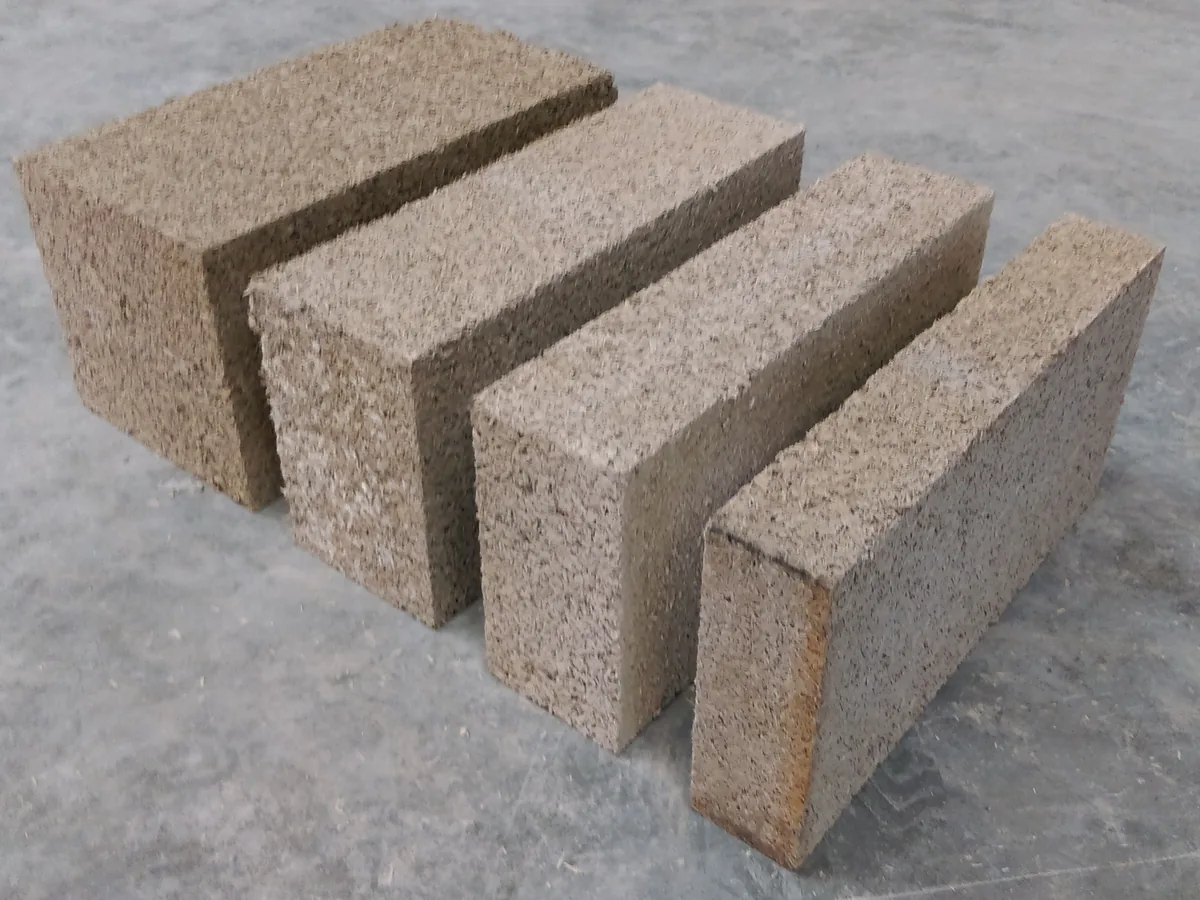
Internal hempcrete blocks provide effective thermal and moisture insulation, naturally regulating humidity levels. They require greater thickness than conventional insulants to achieve the same R-value, and installation calls for a suitable fixing system. Their environmental credentials are based on the carbon captured during hemp cultivation, but there is no official certification. This comparison highlights the key benefits and limitations.
Thermal performance and thermal lag
Internal hempcrete blocks, especially the MULTICHANVRE range, are available in thicknesses from 10 to 30 cm, offering useful thermal resistance values between 1.4 and 4.2 m².K/W. The thermal conductivity λ is around 0.065 W/(m.K) when dry, placing this material among the more effective bio-based insulants. However, to meet current regulatory requirements, greater thicknesses are needed than for conventional insulants such as mineral wool or polystyrene, which have lower λ values.
Thermal lag—the ability of the block to slow down heat transfer—is another important factor. A 30 cm hempcrete block achieves a calculated thermal lag of around 18.5 hours, which significantly improves summer comfort. This level of thermal mass exceeds that of synthetic and mineral insulants, which typically have much lower lag times even at equivalent thickness. Note that the BIOSYS system achieves a thermal lag of between 8 and 10 hours according to internal, non-standardised tests, which is lower than MULTICHANVRE at 30 cm thickness.
The thickness required to achieve a given thermal resistance (R-value) affects internal space, especially for internal wall insulation (IWI). Hempcrete blocks therefore require a balance between performance and loss of living space—an important consideration when choosing materials. For further details, see our guide to choosing the right hemp block thickness.
Moisture management and indoor air quality
Internal hempcrete blocks naturally regulate humidity, thanks to their composition of 84% hemp shiv and a binder based on natural prompt cement. This allows optimal indoor humidity without always needing a vapour barrier. However, this only applies if the wall remains vapour-open on one side. If not—for example, on an existing wall that is sealed on the opposite side—a thermal study is essential to confirm suitability.
Synthetic and some mineral insulants do not offer this moisture-regulating ability, which can lead to condensation and damp issues if the vapour barrier is incorrectly installed. Hempcrete blocks therefore offer a clear advantage for moisture management, particularly in the renovation of older walls where vapour permeability is desirable.
Hempcrete blocks also contribute to excellent indoor air quality, achieving an A+ rating. This is due to the absence of volatile organic compounds and the ability of hempcrete to limit pollutant concentrations. For more information, see our guide to breathable insulation.
Cost and availability
Indicative prices for hempcrete blocks by thickness:
- 10 cm: from €35/m² incl. VAT
- 15 cm: from €51/m² incl. VAT
- 20 cm: from €66/m² incl. VAT
- 30 cm: from €95/m² incl. VAT
These prices are for guidance only and must be confirmed by a quote from our partner builders' merchants, which you can request via our free quote request service. Distribution is nationwide, but we do not sell directly to individuals or from the factory.
By comparison, synthetic or mineral insulants are generally cheaper per m², but the difference depends on quality, thickness and required performance. Installation costs can also vary significantly, especially as hempcrete block installation requires specialist skills, particularly for applying lime-based mortar and maintaining thin joints.
Delivery times depend on site location and hauliers, typically ranging from a few days to a month, with longer waits during holiday periods. Blocks and accessories are available from most partner merchants.
Installation and site compatibility
Installing MULTICHANVRE blocks for internal insulation involves three steps: applying lime-based mortar (M.B.M. mortar) with a notched trowel, forming thin (approx. 3 mm) crossed joints with overlap, then mechanical fixing (brackets, straps, washers) before the finishing render. This process requires skill and careful levelling, especially for the first course, which sits on a 2 cm waterproof mortar bed.
The BIOSYS system is a dry-stacked, interlocking system with tongue-and-groove blocks, requiring no glue or mortar. It is designed to infill a reinforced concrete post-and-beam structure. This rapid installation allows up to 30 m² per day for two workers on a suitable site.
Fixing loads to MULTICHANVRE blocks is only possible with 20 and 30 cm thicknesses, and within strict limits: up to 10 kg with 6 × 100 VBA screws without pre-drilling, up to 30 kg with chemical anchors. Heavier loads must be fixed to the structural frame or an additional support. 10 and 15 cm blocks are not suitable for load fixing.
Electrical services can be routed by chasing and drilling, with suitable filling compatible with the finishing render. For IWI, a service void can be left behind the hemp lining for cables. Note that hempcrete blocks are not suitable for use in roofs, sloping ceilings or lofts.
Carbon impact and durability
Hemp cultivation is recognised for its ability to capture large amounts of carbon during its growth—around 120 days without irrigation or chemical treatments. Its deep taproots loosen the soil and improve farmland quality. Vieille Matériaux issues carbon credits each year, confirming hempcrete's status as a carbon sink.
However, life cycle analysis (LCA) assumes all captured carbon is released at end of life. Therefore, hempcrete blocks should not be described as low-carbon, or as having a negative or neutral carbon footprint.
The durability of hempcrete is proven by documented use in France since the 1980s, with very few reported issues. Our own reference projects date back to 2017, demonstrating stability and longevity that meet building standards.
Comparison table: internal hempcrete block vs common insulants
| Criterion | MULTICHANVRE hemp block | Mineral wool | Expanded polystyrene (EPS) | Aerated concrete |
|---|---|---|---|---|
| Available thicknesses (cm) | 10, 15, 20, 30 | Varies, often 10 to 20 | Varies, often 10 to 20 | 10, 15, 20, 30 common |
| Useful thermal resistance R (m².K/W) | 1.4 / 2.1 / 2.8 / 4.2 | Approx. 2.5 to 5 depending on thickness | Approx. 2 to 4.5 depending on thickness | 1.2 to 3.5 depending on thickness |
| Thermal lag (h) | 6.1 to 18.5 (30 cm) | Low (1 to 3) | Very low (1 to 2) | Varies, low to medium (3 to 6) |
| Thermal conductivity λ (W/m.K) | ~0.065 | ~0.035 to 0.045 | ~0.032 to 0.038 | ~0.12 |
| Density (kg/m³) | ~300 | ~20 to 80 | ~15 to 40 | ~400 to 700 |
| Moisture management | Natural humidity regulation, no vapour barrier needed for vapour-open walls | Absorbs moisture, vapour barrier required | Vapour-impermeable, vapour barrier mandatory | Permeable, but less regulating than hemp |
| Indoor air quality | A+ rating | Varies by product | Varies, sometimes VOC emissions | Good, mineral material |
| Indicative cost per m² | €35 to €95 incl. VAT depending on thickness | Lower | Lower | Varies, often less than hemp |
| Load fixing | 20 and 30 cm: up to 30 kg with chemical anchor, otherwise fix to structure | Varies by density | Often low, fix to structure | Possible with suitable plugs |
| Installation | Lime mortar, thin joints, three-step process | Easy, mechanical fixing and adhesive | Simple, adhesive or mechanical fixing | Traditional masonry, mortar |
| Durability | Documented since 1980, few issues | Good, except moisture risks | Good, fire-sensitive | Good, mineral material |
| Environmental impact | Stores carbon via hemp cultivation, FDES verified | High embodied energy | High embodied energy, fossil-based | Mineral material, moderate embodied energy |
Suitability for different wall types and projects
Internal hempcrete blocks are suitable for both renovation and new build. In renovation, they are especially well-suited for lining old walls, particularly stone, thanks to their vapour permeability and humidity regulation. This compatibility reduces the risk of damp and helps preserve historic buildings.
For new builds, the blocks can be used to infill timber frames (MULTICHANVRE) or in reinforced concrete frame systems (BIOSYS). However, they are not loadbearing elements—the structural frame is always required.
The main drawback in some projects is the loss of living space due to the thickness of the IWI lining. This must be considered at the design stage, especially in relation to thermal and acoustic requirements and room layout.
We recommend consulting our documentation on the characteristics and uses of internal hempcrete blocks to help you choose the right solution for your project.
Acoustics and comfort in use
Hempcrete blocks have a sound absorption coefficient of 0.4 for the MULTICHANVRE range, helping to reduce impact noise and improve indoor acoustic comfort. The BIOSYS system provides a sound reduction index (Rw) of 43 dB (C=-1; Ctr=-2), suitable for individual houses and small commercial buildings.
Compared to synthetic or mineral insulants, hempcrete blocks offer additional acoustic comfort due to their mass and porous structure. This benefit is particularly noticeable in partitions and façades where sound insulation is important.
Finally, summer thermal comfort is improved by high thermal lag and humidity regulation, limiting temperature swings and discomfort. In winter, the thermal resistance provides good protection against heat loss.
For more detail on all these points, see our comparison with conventional insulants and our technical guides.
Frequently asked questions
What thickness of hempcrete block should I choose for good internal insulation?
The choice depends on your thermal requirements and available space. MULTICHANVRE blocks come in 10, 15, 20 and 30 cm, providing useful thermal resistance from 1.4 to 4.2 m².K/W. The thicker the block, the better the insulation, but the more living space is lost with IWI.
Do hempcrete blocks require a vapour barrier for internal insulation?
For standard walls, hempcrete naturally regulates humidity and does not require a vapour barrier if the wall remains vapour-open. For walls sealed on the opposite side, a thermal study is needed to check feasibility.
How do you fix loads to an internal hempcrete block wall?
20 and 30 cm blocks can take fixings up to 10 kg with VBA screws without pre-drilling, or up to 30 kg with chemical anchors. Heavier loads must be fixed to the structural frame behind or to an additional support.
Are internal hempcrete blocks suitable for renovating stone walls?
Yes, they are compatible with stone walls, especially for internal lining (IWI). Their vapour permeability helps manage humidity, which is a major advantage in renovating historic buildings.
What is the difference between the MULTICHANVRE and BIOSYS ranges?
MULTICHANVRE is a straight-edged insulation block for IWI, EWI, partitions, floors and timber frame infill, currently undergoing certification. BIOSYS is an interlocking building system for reinforced concrete frame walls, with a lapsed Avis Technique.
Are internal hempcrete blocks a low-carbon insulant?
Hemp cultivation captures a large amount of carbon during growth. Hempcrete stores this carbon in the material. However, life cycle analysis assumes all carbon is released at end of life, so it is not correct to claim a negative or neutral carbon footprint.
Where can I buy hempcrete blocks for internal use?
Sales are exclusively through a network of partner builders' merchants throughout France. We recommend requesting a free online quote to be directed to the nearest merchant for your project.
Read next
Planning a hemp block project?
Tell us about your project: we will reply within 48 working hours with a tailored costing.