Everything you need to know about the price of internal hemp insulation per m² and regulations
The price of internal hemp insulation per m² mainly depends on the thickness selected and the complexity of installation. MULTICHANVRE blocks provide thermal resistance values from 1.4 to 4.2 m².K/W (useful value), with indicative prices ranging from €35 to €95/m² incl. VAT depending on thickness. Regulations require a thermal study that takes these precise useful values into account.
 By Julien Compain
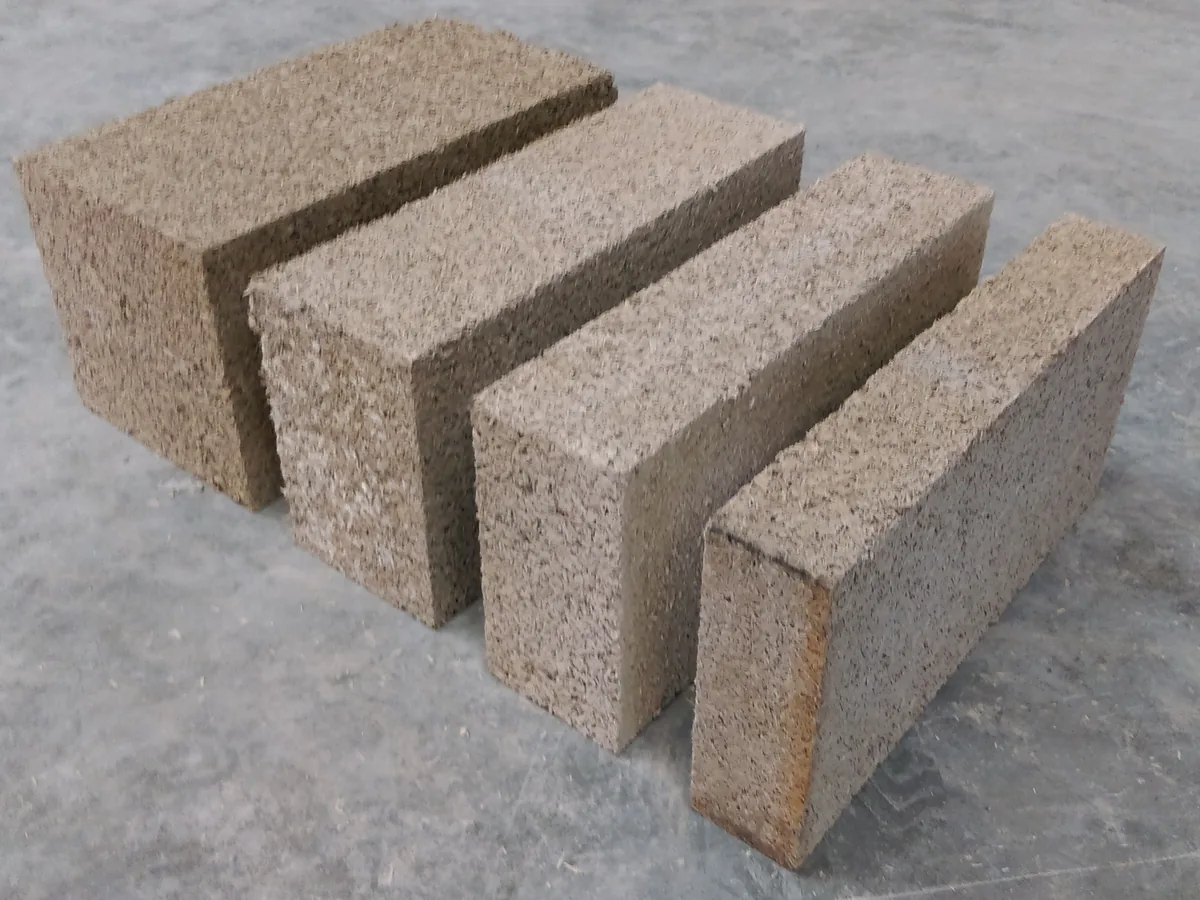
The price per m² for internal hemp insulation mainly depends on the chosen thickness and installation complexity. MULTICHANVRE blocks provide thermal resistance values from 1.4 to 4.2 m².K/W (useful value), with an indicative price ranging from €35 to €95/m² incl. VAT depending on thickness. Regulations require a thermal study that takes these precise useful values into account.
Understanding the thermal properties of hemp for internal insulation
- Thermal conductivity and density of MULTICHANVRE blocks: The blocks have a density of around 300 kg/m³ and a dry thermal conductivity of approximately 0.065 W/(m.K). These properties contribute to their insulating performance and thermal mass.
- Thermal resistance by thickness: The MULTICHANVRE range is available in four thicknesses: 10, 15, 20 and 30 cm. Dry-state thermal resistance values range from 1.5 to 4.6 m².K/W, while the useful thermal resistance values (to be used in thermal studies) are between 1.4 and 4.2 m².K/W.
- Thermal lag and summer comfort: Hempcrete offers significant thermal lag, from 6.1 to 18.5 hours depending on thickness, helping to delay heat entering the home and improving summer comfort.
- The role of hemp in regulating indoor humidity: The 84% hemp shiv formulation promotes natural regulation of indoor humidity. Hempcrete allows water vapour to pass through, reducing the risk of condensation and improving air quality.
- Fire reaction and resistance to rodents: The blocks have a fire reaction rating of B-s1,d0 and are naturally resistant to rodents and pests, with no need for specific treatment.
For more technical details, see our dedicated page on hemp blocks and characteristics and installation of internal hemp blocks.
Hemp block thicknesses and their impact on price per m²
The MULTICHANVRE range includes four standard thicknesses, each suited to different uses:
- 10 cm: mainly for internal (IWI) and external (EWI) wall insulation, with a useful R-value of 1.4 m².K/W.
- 15 cm: suitable for IWI, EWI and lightweight partitions, offering a useful R-value of 2.1 m².K/W.
- 20 cm: can be used for IWI, EWI, partitions, infill and floor insulation, with a useful R-value of 2.8 m².K/W.
- 30 cm: for high-performance IWI and EWI, heavy partitions, infill and floors, with a useful R-value of 4.2 m².K/W.
The indicative price at builders' merchants ranges from €35 incl. VAT/m² for 10 cm to €95 incl. VAT/m² for 30 cm, reflecting the thickness and amount of material used. Block weight also increases with thickness, from 6.5 kg to 21 kg per block, which affects transport, handling and packaging (number of blocks per pallet).
For installation, certain thicknesses allow for load fixings: 20 and 30 cm blocks can support up to 10 kg per fixing with VBA screws (no pilot hole), and up to 30 kg with chemical anchors. 10 and 15 cm blocks do not allow direct fixings.
Balancing thickness, thermal performance and loss of usable floor area is a key part of the decision. Greater thickness improves insulation but reduces usable space, especially for IWI. This trade-off should be assessed according to project constraints and regulatory requirements.
For more information, see our guide to the MULTICHANVRE range for internal insulation and the guide to choosing the right thickness.
Regulations for internal hemp insulation
Thermal regulations require that internal insulation is assessed according to its useful performance. For MULTICHANVRE blocks, the useful value must be used in the thermal study, as it reflects real-world performance, unlike the dry value.
Currently, the MULTICHANVRE range is undergoing certification. It does not yet have a technical assessment (Avis Technique) or ATEx approval, although an ATEx case A is being processed by CSTB for internal insulation only. This ATEx does not cover external insulation, partitions or floors and should not be presented as granted.
The blocks are non-loadbearing and must always be combined with a structural support (post-and-beam, supporting wall, timber frame, etc.). This regulatory requirement must be considered in building design.
For vapour management, hempcrete naturally regulates humidity and, except in special cases, does not require a vapour barrier. However, the wall must retain at least one face open to liquid and vapour transfer. For existing walls that are closed on the opposite side, a specific study is needed. In damp areas, additional protection is recommended, such as a plasterboard lining compliant with standards.
External finishes must be compatible, mainly lime-rich renders, to ensure durability and vapour permeability.
For more on regulations and best practice, see our page Hemp block walls: regulations in 2024.
Indicative price comparison for MULTICHANVRE blocks by thickness
| Thickness (cm) | Useful R-value (m².K/W) | Weight per block (kg) | Blocks per pallet | Surface per pallet (m²) | Indicative price incl. VAT (€ / m²) |
|---|---|---|---|---|---|
| 10 | 1.4 | 6.5 | 120 | 21.6 | 35 |
| 15 | 2.1 | 10 | 80 | 14.4 | 51 |
| 20 | 2.8 | 13 | 60 | 10.8 | 66 |
| 30 | 4.2 | 21 | 56 | 10.08 | 95 |
This table summarises data from the MULTICHANVRE range technical data sheet. The indicative price is that observed at builders' merchants and must be confirmed by a quote, taking into account location, delivery conditions and order quantity.
Palletisation varies with block weight and pallet size, affecting logistics and associated costs. Transport is a significant part of the total cost, especially for remote or hard-to-access sites.
For an accurate estimate for your project, we recommend requesting a quote for internal hemp insulation, free of charge and tailored to your location and requirements.
Installation steps and additional costs for internal hemp block insulation
Installing MULTICHANVRE blocks follows a three-step process:
- Apply a lime-based mortar (M.B.M. mortar) with a notched trowel to bond the blocks, using thin joints of around 3 mm.
- Lay the blocks in a staggered pattern, with an overlap of at least one third of the block length (20 to 40 cm).
- Fix to the substrate using brackets, metal straps or fixing discs (2 to 5 fixings per m²), then apply a compatible render.
The first course is laid on a 2 cm waterproof mortar bed, acting as a capillary break and ensuring levelness. For external insulation (EWI), the first course is placed at least 15 cm above ground level, on a concrete base or suitable profile.
Electrical services are installed using chases cut with a wall chaser and holes made with a hole saw. Conduits and boxes are fixed and then filled with a compatible product to ensure a durable, airtight finish. For IWI, if there is a gap between the supporting wall and the lining, services can be run in this space.
Load fixing depends on thickness:
- For 20 and 30 cm: up to 10 kg per fixing with 6×100 VBA screws (no pilot hole), up to 30 kg with chemical anchors (drilling, dust removal, resin injection, M8 threaded rod).
- For heavier loads, the fixing must go through the block and anchor to the structural support.
- No direct load fixing is possible on 10 and 15 cm blocks.
Compatible internal finishes include spray plaster, lime or earth renders, and plasterboard. These finishes protect the block and help regulate humidity.
Illustration: A detailed diagram shows the order of layers for installing and finishing internal hemp insulation, useful for visualising the steps.
Technical limitations and trade-offs for internal hemp insulation
One important aspect of internal hemp insulation projects is the loss of usable floor area, which depends directly on the chosen block thickness. The thicker the block, the better the thermal performance, but the more the usable internal space is reduced—this can be a key factor, especially in smaller rooms.
By comparison, mineral or synthetic insulations often provide similar thermal resistance with less thickness, reducing the impact on usable space, but these materials do not offer the same humidity regulation or thermal lag.
Hempcrete is not suitable for roof, rafter or loft insulation: these uses are not covered by our blocks. The BIOSYS U ring beam block is designed only for forming gable slopes in masonry, not as a roof insulation.
The material's durability is demonstrated by reference projects since 2017, with few reported issues since the 1980s in France. Pallets must be stored under cover, dry and not stacked, as the blocks are not rot-proof.
Finally, insulation effectiveness also depends on good ventilation and careful humidity management, to avoid problems caused by condensation or excessive moisture.
For a detailed technical comparison with other materials, see our pages Internal hemp block: technical comparison and choosing the right solution and Hemp block or wood fibre: technical comparison.
Optimising your internal hemp insulation project: advice and resources
- Thermal study: It is essential to have a thermal study carried out using the useful thermal resistance of the blocks to ensure regulatory compliance and optimise performance.
- Request a quote: A free, personalised quote can be requested via our online form. This service will direct you to the partner merchant closest to your site, making logistics and local advice easier.
- Partner merchants: Blocks are sold exclusively through a network of distributor merchants with delivery throughout France. The list of merchants is available on the Where to buy hemp blocks page.
- Training: Although there is no official training for MULTICHANVRE installation, training for the BIOSYS system is available via our partner Vicat. Contacts for qualified tradespeople can be provided for MULTICHANVRE installation.
- Technical documentation: To support installation, several documents are available, including a detailed installation guide, quick reference sheets and flyers in PDF format on the Technical documentation page.
These resources help ensure reliable, compliant installation and avoid common mistakes. For more on costs, see the hemp block prices by thickness page for a full overview.
Frequently asked questions
What is the average price per m² for internal hemp block insulation?
The indicative price ranges from €35 incl. VAT/m² for 10 cm thickness to €95 incl. VAT/m² for 30 cm. These prices are observed at builders' merchants and may vary depending on location and delivery conditions.
How do I choose the right hemp block thickness for effective internal insulation?
The choice depends on the required thermal resistance, available floor area and wall type. From 10 to 30 cm, each thickness offers a different useful R-value, which should be included in a detailed thermal study.
Does hemp require a vapour barrier for internal insulation?
Hempcrete naturally regulates humidity and does not require a vapour barrier if the wall remains open to water and vapour transfer. In certain specific cases, a study should confirm feasibility.
Can heavy loads be fixed directly to hemp blocks?
On 20 and 30 cm blocks, loads up to 10 kg can be fixed with screws (no pilot hole), and up to 30 kg with chemical anchors. For heavier loads, fixings must be anchored to the structural support.
What are the typical delivery times for hemp blocks?
Delivery times range from a few days to a month depending on destination, carrier and time of year, with an average of about a week.
Is hempcrete suitable for insulating stone walls during renovation?
Yes, MULTICHANVRE blocks are commonly used for IWI on stone walls, with care taken to maintain vapour permeability and to use a thermal study with the useful resistance value.
Can I install hemp blocks myself without training?
MULTICHANVRE installation follows a specific three-step method. There is no official training, but contacts for qualified tradespeople can be provided. An installation guide is available for support.
Read next
Planning a hemp block project?
Tell us about your project: we will reply within 48 working hours with a tailored costing.