Hemp block or wood fibre: technical choices and performance
Choosing between hempcrete block and wood fibre depends on thickness constraints, desired thermal performance and site specifics. Hempcrete blocks naturally regulate humidity without a vapour barrier, but require greater thickness than wood fibre for the same R-value. Wood fibre is thinner but often needs a vapour control layer.
 By Julien Compain
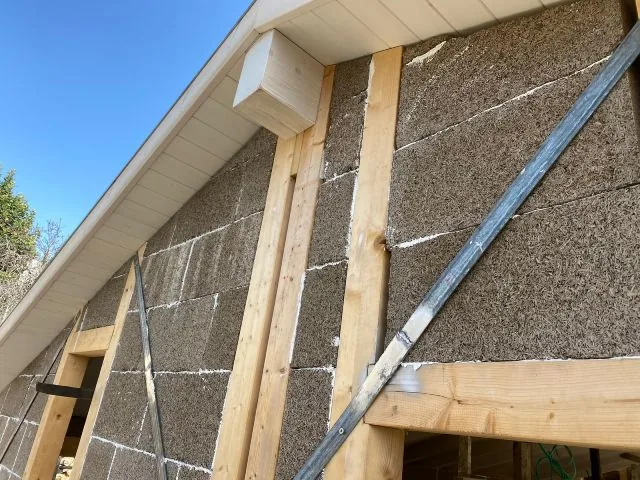
The choice between hemp block or wood fibre insulation depends on thickness constraints, the desired thermal performance, and the specific requirements of the project. Hemp blocks provide natural humidity regulation without a vapour barrier, but require greater thickness than wood fibre to achieve the same R-value. Wood fibre is thinner but often requires a vapour control layer.
Choosing between hemp blocks and wood fibre insulation
When renovating or building new, selecting the right insulation material is a key step. Both hemp blocks and wood fibre are bio-based solutions that are increasingly popular for their thermal performance and environmental credentials. This site report shares practical observations on using these materials, highlighting their advantages and limitations.
These materials, sourced mainly from the French wood and hemp sectors, are valued for their low carbon footprint and their ability to improve indoor air quality. Their use is part of a broader sustainable building approach, in line with the requirements of France’s RE2020 environmental regulation.
The aim of this technical comparison is to provide precise data, drawn from site feedback and technical data sheets, to help you choose between hemp blocks and wood fibre according to your project’s specific constraints—particularly thickness, installation, performance, and impact on usable floor area.
Overview of materials and construction systems
Hemp blocks are mainly available in two construction systems:
- MULTICHANVRE: straight-edged blocks, 60 × 30 cm, available in four thicknesses (10, 15, 20 and 30 cm) with thermal resistance values from 1.5 to 4.6 m².K/W. These blocks are laid as bonded masonry using lime-based mortar applied with a notched trowel, with staggered joints, then rendered. Suitable for a range of uses: internal wall insulation (IWI), external wall insulation (EWI), partitions, floor insulation under screed, and timber frame infill. This system is currently undergoing certification.
- BIOSYS: a dry-stacked system (tongue and groove) with no glue or mortar, combined with a reinforced concrete post-and-beam structure. The blocks measure 60 × 30.8 × 30 cm, with a declared thermal resistance of 4.6 m².K/W (useful value 4.2) for the system. This method allows for rapid installation—up to 30 m² per day (maximum, on a suitable site) by two workers, including the structure.
Hemp blocks are manufactured in Bourgogne-Franche-Comté, at Mérey-sous-Montrond, using a formulation made up of 84% hemp shiv (the woody core of the hemp stem) and a natural mineral binder—Vicat natural prompt cement.
These blocks have a dry thermal conductivity of around 0.065 W/(m.K) and a density of about 300 kg/m³. They provide natural humidity regulation, helping to keep indoor relative humidity within a comfortable range.
Wood fibre insulation is generally sold as semi-rigid boards or rolls. It is mainly used for internal or external wall insulation, and sometimes as timber frame infill. Its thermal conductivity varies depending on density and manufacturing, but is generally below 0.05 W/(m.K), allowing for high thermal resistance with less thickness.
Wood fibre is often more flexible to install, with easy cutting and adjustment on site. However, depending on the configuration, a vapour barrier or vapour control layer is often required to ensure vapour tightness.
The main differences between the MULTICHANVRE and BIOSYS systems are in the installation method: MULTICHANVRE uses bonded masonry with mortar, requiring more time and precision, while BIOSYS uses dry-stacking with tongue and groove joints, allowing for faster, mortar-free assembly.
Detailed technical comparison and figures
| Characteristic | MULTICHANVRE hemp block | BIOSYS hemp block | Wood fibre (typical) |
|---|---|---|---|
| Dimensions (cm) | 60 × 30 × 10 to 30 (four thicknesses) | 60 × 30.8 × 30 | Variable (boards 60–120 cm wide, 4–20 cm thick) |
| Thermal conductivity λ (W/(m.K)) | ≈ 0.065 | ≈ 0.065 (similar) | ≈ 0.038 to 0.045 depending on product |
| Thermal resistance R (m².K/W) |
|
4.6 (useful value 4.2) | Example 14 cm: ≈ 3.5 to 3.7 |
| Thermal lag (h) |
|
≈ 18 h (similar for 30 cm) | Variable, generally 8 to 12 h for common thicknesses |
| Density (kg/m³) | ≈ 300 | ≈ 300 | ≈ 40 to 60 (very light) |
| Fire rating | B-s1 d0 | B-s1 d0 | Varies by treatment, often B-s2 d0 or better |
| Sound absorption α | 0.4 | 0.4 | Varies, often 0.5 to 0.7 depending on density |
| Installation | Bonded masonry, staggered joints, compatible render | Dry-stacked, no mortar, reinforced concrete structure | Boards to cut, screwed or stapled, vapour barrier often required |
| Weight per m² (e.g. 20 cm) | ≈ 43 kg (13 kg per block, 3.3 blocks/m²) | ≈ 54 kg (21 kg per block, 2.6 blocks/m²) | ≈ 5 to 10 kg depending on thickness and density |
| Indicative cost | From €35/m² for 10 cm, increasing with thickness | Higher than MULTICHANVRE, to be confirmed by quote | Varies, generally cheaper than hemp blocks |
Thermal performance and impact on usable floor area
MULTICHANVRE hemp blocks cover a range of thermal resistance values from 1.5 to 4.6 m².K/W depending on thickness. For high-performance internal or external insulation, 20 to 30 cm blocks provide values suitable for current regulations.
Wood fibre, thanks to its lower thermal conductivity, achieves similar thermal resistance with less thickness. For example, 14 cm of wood fibre can provide an R-value close to 3.5 m².K/W, comparable to a 20 cm hemp block (R = 3.0).
This difference in thickness has a direct impact on usable floor area, especially for internal wall insulation (IWI). Using thicker hemp blocks reduces the usable space by around 5 to 15 cm per insulated wall, which can be a constraint in small spaces or older buildings.
However, hemp blocks offer greater thermal lag, especially at thicknesses above 20 cm, which helps improve summer comfort by limiting overheating.
The trade-off between thermal performance, thickness, and impact on usable floor area should be assessed according to project priorities and technical constraints. For a more detailed analysis, the technical comparison of hemp blocks and wood fibre provides further data.
Site feedback on installation
On site, the installation of hemp blocks varies by system:
- MULTICHANVRE: requires bonded masonry with lime-based mortar, applied with a notched trowel and staggered joints. This method demands precision to ensure airtightness and structural cohesion. Fixing to the substrate is done with brackets, two to five per square metre. As the block is non-loadbearing, it must be combined with a supporting wall or frame. Finishing requires a compatible render, such as spray plaster, lime, earth or clay indoors, and lime with mesh externally, to ensure breathability and durability.
- BIOSYS: dry-stacked system with tongue and groove, no glue or mortar. Installation is faster, with an observed rate of around 30 m² per day (maximum, on a suitable site) by two workers, including the structure. This system is combined with a reinforced concrete post-and-beam frame for stability. The absence of mortar reduces waiting times and simplifies site management.
Wood fibre, meanwhile, offers more flexible installation, especially as boards or rolls. It can be easily cut with a saw or knife, making it easy to fit to wall dimensions. However, installation often requires a vapour barrier or vapour control layer to ensure vapour tightness, with particular attention to joints and connections.
Compatible renders for hemp blocks are essential to ensure durability and vapour permeability. A comprehensive guide to compatible renders for hemp blocks is available to support this stage.
Environmental aspects and indoor air quality
Hemp blocks are made with over 80% hemp shiv, a renewable and local material, combined with a natural mineral binder—Vicat natural prompt cement—that is vapour-open. This composition limits the carbon footprint of the materials and makes end-of-life recycling easier, in line with RE2020 requirements.
Hemp blocks are rated A+ for indoor air quality, indicating very low emissions of volatile organic compounds (VOCs). They also provide natural humidity regulation, keeping relative humidity within a comfortable range, which improves indoor comfort and helps protect walls.
Wood fibre shares these bio-based qualities and the ability to regulate humidity, but the exact characteristics depend on the product and any treatments. Some boards or rolls may require treatments to improve fire resistance or durability, which can affect their environmental impact and indoor air quality.
In terms of sound absorption, the α coefficient for hemp blocks is around 0.4, while wood fibre generally offers similar or better performance, depending on density and thickness.
Limitations and practical advice
The relatively low density of hemp blocks (≈ 300 kg/m³) means walls must be designed to support this non-loadbearing material and combined with a suitable structural frame. Hemp blocks must be finished with a compatible render to ensure durability and vapour permeability. No vapour barrier is needed thanks to the material’s natural regulation, but careful installation is essential.
The greater thickness required to achieve a given thermal resistance can reduce usable floor area, especially for internal wall insulation. This compromise should be considered, particularly in older buildings or tight spaces.
Wood fibre, being thinner for comparable thermal performance, requires particular attention to airtightness and vapour control, with a vapour barrier or vapour control layer often needed. Board format makes installation easier, but managing junctions is crucial.
Depending on the project, the following is advised:
- For renovation, favour hemp blocks for internal insulation where humidity regulation is a priority and thickness is acceptable.
- For new builds, consider installation speed and structural requirements: BIOSYS may suit projects needing rapid assembly with a reinforced concrete frame.
- For partitions and lightweight linings, thinner hemp blocks (10 to 15 cm) are suitable.
- Consult technical guides on recommended thicknesses and thermal performance to tailor the solution to your context.
Summary: hemp blocks vs wood fibre
| Criterion | MULTICHANVRE hemp block | BIOSYS hemp block | Wood fibre |
|---|---|---|---|
| Thermal conductivity λ (W/(m.K)) | ~0.065 | ~0.065 | ~0.038–0.045 |
| Thermal resistance R (for 20–30 cm) | 3.0 to 4.6 m².K/W | 4.6 m².K/W (useful value 4.2) | 3.5 to 4.0 m².K/W (less thickness) |
| Thermal lag (h) | 12.3 to 18.5 | ~18 | 8 to 12 |
| Density (kg/m³) | ~300 | ~300 | 40 to 60 |
| Installation | Bonded masonry, staggered joints, compatible render | Dry-stacked, reinforced concrete structure, no mortar | Boards or rolls, easy to cut, vapour barrier often required |
| Fire rating | B-s1 d0 | B-s1 d0 | Varies by treatment |
| Indoor air quality | A+, >80% hemp formulation | A+, >80% hemp formulation | Varies, generally good |
| Indicative cost | €35/m² 10 cm, increases with thickness | Higher, to be confirmed | Varies, often lower |
| Impact on usable floor area | Greater (thicker) | Greater (30 cm thickness) | Less (thinner) |
| Humidity regulation | Natural, no vapour barrier | Natural, no vapour barrier | Good, but vapour barrier often required |
Conclusion
The choice between hemp blocks and wood fibre depends largely on technical context, thermal targets, and spatial constraints. Hemp blocks offer natural humidity regulation and good thermal lag, but require greater thickness, impacting usable floor area for internal insulation. Wood fibre is thinner, easier to install, and may require a vapour barrier to ensure vapour tightness.
The construction systems available—MULTICHANVRE for bonded masonry and BIOSYS for dry-stacking—provide options to suit different needs, with varying installation speeds. Durability, indoor air quality, and environmental impact should also be considered in your decision.
It is recommended to match the material to the specific site context, taking into account thickness constraints, structural requirements, and finishes. The site’s technical resources, including pages on the technical comparison, the MULTICHANVRE range, the BIOSYS system, thermal performance and compatible renders, provide detailed information to support your choice.
Frequently asked questions
Which is more thermally efficient: hemp block or wood fibre?
Both materials are effective, but wood fibre achieves the same thermal resistance as hemp block with less thickness. However, hemp blocks offer superior natural humidity regulation.
What is the main limitation of hemp blocks?
Hemp blocks require greater thickness to achieve a given thermal resistance, which can reduce usable floor area for internal insulation. They also require a compatible render for finishing.
Does the BIOSYS system allow for rapid installation?
Yes, the BIOSYS dry-stacked system allows for installation rates of around 30 m² per day (maximum, on a suitable site) by two workers, including the structure, with no glue or mortar required.
Is a vapour barrier needed with wood fibre?
Depending on the configuration, a vapour barrier or vapour control layer is often required with wood fibre to ensure vapour tightness, unlike hemp blocks which regulate humidity naturally.
Can hemp blocks and wood fibre be combined in the same project?
Yes, provided they are not layered on the same wall, to maintain consistent vapour management—for example, hemp for walls and wood fibre for sloping ceilings.
What is the environmental impact of hemp blocks?
Hemp blocks are made with over 80% hemp shiv and a natural mineral binder, limiting their carbon footprint and making them easy to recycle, thus contributing to better environmental performance.
Which renders are compatible with hemp blocks?
Hemp blocks require a compatible render, such as spray plaster, lime, earth or clay indoors, and lime with full mesh reinforcement outdoors, to ensure durability and vapour permeability.
Read next
Planning a hemp block project?
Tell us about your project: we will reply within 48 working hours with a tailored costing.