Hempcrete block infill for timber frames: regulations and technical guidance
Hempcrete block infill in timber frames is always combined with a load-bearing structure and subject to specific rules. The material regulates humidity, provides thermal lag and B-s1,d0 fire resistance, but does not bear loads. Thickness selection and installation must comply with thermal regulations and best practice.
 By Julien Compain
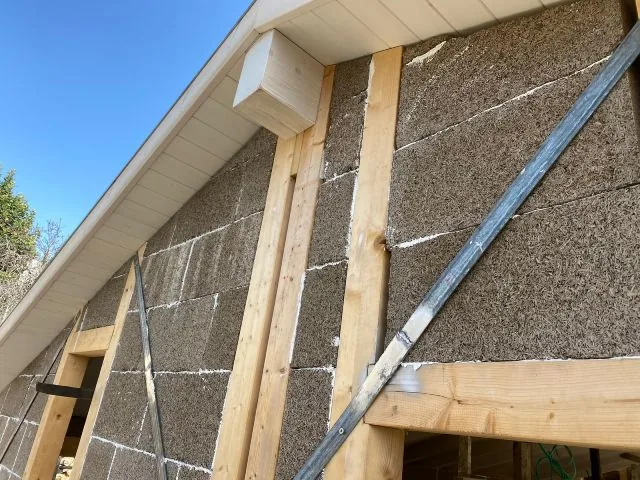
Filling a timber frame with hempcrete blocks always requires a load-bearing structure and must comply with specific rules. The material regulates humidity, provides thermal lag and is rated B-s1,d0 for fire resistance, but it is not load-bearing. The choice of thickness and installation method must comply with thermal regulations and best practice.
Composition and properties of hempcrete blocks for timber frames
- Formulation: Hemp blocks are made from 84% hemp shiv, the woody core of hemp grown in Franche-Comté, combined with Vicat natural prompt cement, a vapour-open hydraulic binder.
- Thermal conductivity and density: The dry thermal conductivity is around 0.065 W/(m.K), with an average density of about 300 kg/m³, placing the material in the category of dense, breathable insulation.
- Mechanical properties: The block is a non-load-bearing insulating material. It is designed to fill timber frames and must never support structural loads. The load-bearing structure must be independent and sized accordingly.
- Fire performance: The block is rated B-s1,d0 for reaction to fire, equivalent to M1 classification. This ensures limited combustibility with no release of dense smoke.
- Natural resistance to rodents: Hemp shiv is naturally resistant to rodents and pests, although this does not make the block rot-proof.
- Moisture regulation and summer comfort: The block’s porosity and vapour permeability allow it to regulate indoor humidity. Its high thermal lag also helps keep interiors cooler in summer by delaying heat transfer.
These features make hempcrete blocks ideal for insulating infill in timber frames, offering effective moisture management and high-performance insulation. For more details on composition and performance, see our dedicated page Hempcrete block: composition, properties, range.
Regulatory framework for hempcrete block infill in timber frames
- No valid Avis Technique: The BIOSYS system, which uses interlocking blocks as permanent formwork and infill, currently has no valid CSTB Avis Technique. Renewal is in progress but no approval date is known. Use of the block is therefore subject to general building regulations and local technical expertise.
- Role of the block: Hempcrete blocks used as infill are not load-bearing. They provide thermal insulation, moisture regulation and fire resistance, but all structural loads are supported by the associated timber or concrete frame.
- Compliance with RE2020 requirements: The current French thermal regulation requires performance to be specified by the block’s declared (in-use) thermal resistance. This value, which is lower than the dry value, must be used in thermal studies and regulatory calculations.
- Limitations: The blocks are not intended for insulating roofs, pitched ceilings or lofts. Using them in these areas does not comply with the manufacturer’s recommendations and may compromise the building’s durability and performance.
- Fire regulations: The block is rated B-s1,d0 for reaction to fire. For the BIOSYS system, fire resistance is rated EI 90, meeting requirements for timber frame buildings in certain configurations. The associated specifications for this classification must be followed.
For more on regulations, see our article Hempcrete block walls: regulations in 2026.
Choosing thickness and thermal performance for different uses
| Thickness (cm) | R dry value (m².K/W) | R in-use value (m².K/W) | Thermal lag (h) | Block weight (kg) | Pallet quantity (m²/pallet) | Recommended use |
|---|---|---|---|---|---|---|
| 10 | 1.5 | 1.4 | 6.1 | 6.5 | 21.6 | IWI and EWI |
| 15 | 2.3 | 2.1 | 9.25 | 10 | 14.4 | IWI, EWI and partitions |
| 20 | 3.0 | 2.8 | 12.3 | 13 | 10.8 | IWI, EWI, partitions, infill and floors |
| 30 | 4.6 | 4.2 | 18.5 | 21 | 10.08 | High-performance IWI and EWI, heavy partitions, infill and floors |
The MULTICHANVRE range offers four thicknesses to suit different insulation and infill needs in timber frames. The in-use thermal resistance (R in-use) is the value to use in thermal calculations, as it reflects real-world installation effects.
Thermal lag is a key benefit for summer comfort, especially with thicker blocks. It can reach up to 18.5 hours for the 30 cm block, significantly delaying heat entering the building.
In practice, 10 cm thickness is recommended for light internal or external insulation (IWI or EWI). For partitions, floor insulation or more substantial frame infill, 15 cm or more is preferable.
Thickness choices should balance the desired thermal performance with the loss of usable floor area, especially for IWI where thickness reduces interior space. For more details, see our MULTICHANVRE range: thicknesses, performance and uses page.
Installing hempcrete blocks as timber frame infill
MULTICHANVRE blocks are laid in a staggered bond with a lime-based mortar (M.B.M. mortar) applied using a notched trowel. Joints are thin, about 3 mm, and each course overlaps the previous by at least a third of the block length (20 to 40 cm). This ensures thermal continuity and minimises thermal bridging.
The blocks have straight edges, making cutting and adjustment easy during installation. Blocks are fixed to the timber frame using brackets, metal strapping or fixing discs, with 2 to 5 fixings per square metre, providing robust mechanical connection and good airtightness.
Electrical services are run in chases cut with a wall chaser, and holes made with a hole saw. Conduits and boxes are fixed in place and then filled with hempcrete or a compatible finishing product. For IWI, if there is a cavity between the timber frame and the lining, services can be run in this space.
The block naturally regulates humidity and does not require a vapour barrier, provided at least one face of the wall remains open to moisture transfer. In damp areas or where the opposite face is sealed, a specific assessment is recommended to check feasibility.
Water protection is essential: the block must be protected from water splashes, especially in wet rooms, using suitable renders or a compliant plasterboard lining. Finishes can be lime-rich renders, spray plaster, earth plaster or plasterboard.
A detailed section diagram shows the build-up of layers in a timber frame wall filled with hempcrete blocks, including the location of joints and mechanical fixings.
For full guidance, see our hempcrete block installation guide.
Technical comparison with other insulation solutions for timber frames
| Material | Thermal conductivity λ (W/(m.K)) | Density (kg/m³) | Thermal resistance (R) for 20 cm (m².K/W) | Thermal lag (h) | Moisture regulation | Fire resistance |
|---|---|---|---|---|---|---|
| Hempcrete block (MULTICHANVRE) | 0.065 | 300 | 2.8 (in-use value) | 12.3 | Yes | B-s1,d0 |
| Mineral wool (rock wool) | approx. 0.035 | 30-100 (varies) | approx. 5.7 | 3-6 (varies) | No (not regulating) | Non-combustible, A1 |
| Synthetic insulation (expanded polystyrene) | approx. 0.035 | 20-40 | approx. 5.7 | Low (1-2) | No | Combustible, class E or F |
Hempcrete blocks have higher thermal conductivity than mineral wool or synthetic insulation, meaning greater thickness is needed to achieve the same thermal resistance. However, their higher density and moisture-regulating ability provide greater thermal lag and improved summer comfort.
Hemp stores carbon captured during growth, which remains locked in the block—an environmental benefit to consider when choosing materials. Its natural resistance to rodents is another advantage.
Synthetic insulation offers better thermal performance for a given thickness, but does not regulate humidity and is combustible. Mineral wools provide good thermal resistance and excellent fire performance, but have low thermal lag and do not regulate moisture.
A specific thermal study is recommended to confirm the best material and thickness for your building and local climate.
For a detailed comparison, see our page Comparison with concrete block, brick, aerated concrete and mineral wools.
Maintenance, durability and storage conditions for hempcrete blocks
- Durability: Hempcrete has been used in France since the 1980s, with positive feedback and very few reported defects. Our own reference projects date from 2017.
- Storage: The block is not rot-proof. It must be stored under cover, in dry conditions, and not stacked, to prevent deterioration before use.
- Natural resistance: Although not rot-proof, the block is naturally resistant to pests, rodents and mould, thanks to the hemp shiv and natural cement binder.
- Compatible finishes: Indoors, the block can be finished with spray plaster, lime or earth renders, or plasterboard. Outdoors, lime render with full mesh reinforcement is recommended for protection and durability.
- Maintenance: Good adhesion of renders and protection from moisture are essential. Regularly check the condition of finishes and carry out repairs as needed to protect the block.
For more information, see our guide Lifespan and maintenance of hempcrete block walls.
Access to materials, training and technical support
- Distribution: Hempcrete blocks are sold exclusively through a network of partner builders’ merchants, with delivery throughout France. Both private and professional customers can order via these distributors.
- Training: BIOSYS installation training is offered by our partner Vicat. For MULTICHANVRE, there is no official training, but we can recommend trained tradespeople if needed.
- Technical documentation: We provide a detailed installation guide, a quick reference sheet and downloadable technical flyers.
- Personalised advice: Online quote requests are free and allow you to be directed to the nearest partner merchant for your project. This service helps with decision-making and project planning.
- Logistics: Average delivery time is about one week, depending on destination and transport constraints, with longer lead times during holiday periods.
To find a merchant, visit our partner builders’ merchant network for hempcrete block purchases page. For a quote, use the form on Request a quote.
Use cases and best practice: typical applications for hempcrete block infill
- Renovation: Hempcrete blocks are suitable for internal and external insulation of timber frame walls in renovation, providing a breathable, healthy solution.
- New build: They are used for infilling walls with distributed insulation in individual houses and small extensions, in conjunction with a timber or concrete load-bearing structure.
- Partitions and floors: Depending on thickness, the blocks can also be used for partitions and floor insulation, providing both thermal and acoustic comfort.
- Compliance: Installation must comply with requirements for mechanical fixing, airtightness, water protection and compatible renders to ensure durability and performance.
- Documented examples: Several applications are shown on our website (without pricing or specific testimonials) to illustrate possible uses and guide both professionals and private individuals.
For more examples and advice, see our applications of hempcrete blocks in construction and renovation page.
Frequently asked questions
Can hempcrete blocks be load-bearing in a timber frame?
No, hempcrete blocks used as infill are not load-bearing. They must always be combined with a load-bearing structure, such as a timber frame, which supports the building’s weight.
What thickness of hempcrete block should I use to insulate a timber frame?
Thickness depends on use: 10 cm for light internal or external insulation, 15 to 30 cm for partitions, infill and floor insulation. The in-use thermal resistance value should guide your choice.
Is a vapour barrier needed with hempcrete block infill?
Hempcrete blocks naturally regulate humidity and do not require a vapour barrier if the wall remains open to moisture transfer. If the opposite face is sealed, a specific assessment is recommended.
How do I fix loads to a hempcrete block wall?
Direct fixing is possible only on 20 and 30 cm blocks: up to 10 kg per VBA 6 × 100 screw without pre-drilling, 30 kg with chemical anchors. For heavier loads, fixings must be made to the structural frame.
Are hempcrete blocks suitable for roof insulation?
No, the blocks are not intended for roof, pitched ceiling or loft insulation. The BIOSYS U ring beam block is only for forming masonry slopes, not for insulating roofs.
Where can I buy hempcrete blocks for timber frames?
Sales are exclusively through a network of partner builders’ merchants across France. The website provides a list of these merchants and a free quote request form to direct you to the nearest one.
What documentation is available for installing blocks in timber frames?
We provide an installation guide, a quick reference sheet and technical flyers. BIOSYS installation training is offered by our partner Vicat. For MULTICHANVRE, we can recommend trained tradespeople.
Read next
Planning a hemp block project?
Tell us about your project: we will reply within 48 working hours with a tailored costing.