Floor insulation with hemp: technical details and advice
Hemp floor insulation uses MULTICHANVRE blocks designed for floors, with a density of around 300 kg/m³ and a thermal conductivity of approximately 0.065 W/(m.K). The blocks provide effective moisture regulation and summer comfort thanks to their thermal lag. Installation involves tightly jointed courses and selecting a thickness suited to the application.
 By Julien Compain
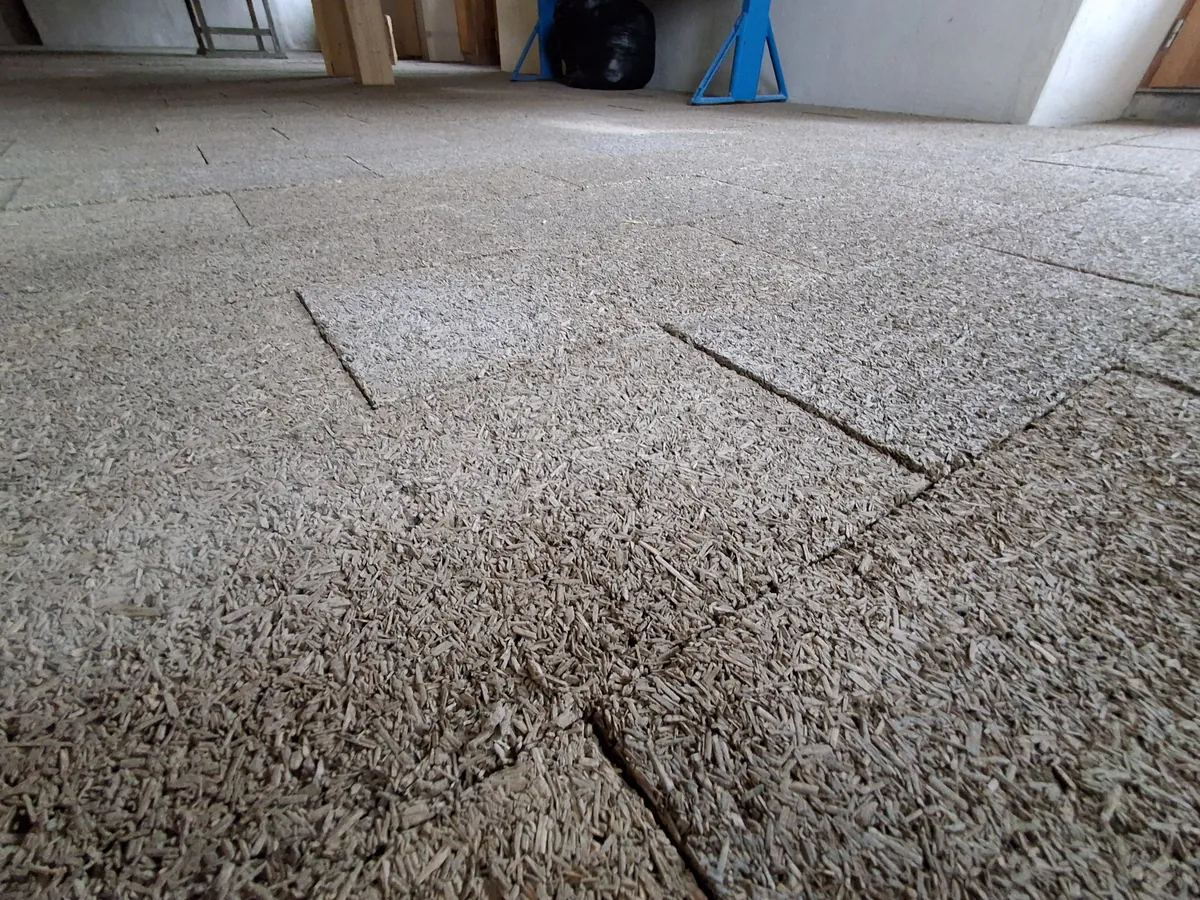
Hemp floor insulation uses MULTICHANVRE blocks designed for floors, with a density of around 300 kg/m³ and a thermal conductivity close to 0.065 W/(m.K). These blocks provide effective moisture regulation and summer comfort thanks to their thermal lag. Installation involves tightly butted joints and selecting a thickness appropriate to the intended use.
Hempcrete for floor insulation: overview
The hempcrete used for floor insulation consists of 84% hemp shiv, the woody core of the hemp stem, combined with Vicat natural prompt cement binder, which is vapour-open. This formulation gives the block a density of around 300 kg/m³, contributing to its thermal and hygrothermal properties.
Hemp offers several advantages for floor insulation. Its vapour permeability allows natural regulation of indoor humidity, reducing the risk of condensation and helping to maintain a healthy indoor climate. In addition, hempcrete provides significant thermal lag, which improves summer comfort by slowing heat transfer through the floor.
For floor insulation, hempcrete offers specific benefits: it is compatible with various screed types, contributes to the building’s thermal mass, and is naturally resistant to rodents and pests. These properties make it an attractive material for both thermal renovation and new-build projects, especially when used with MULTICHANVRE blocks.
However, some limitations should be considered. Hempcrete is not load-bearing and must be installed on a suitable structural base. The thickness required to achieve sufficient thermal resistance is greater than that of conventional mineral insulations, which may reduce usable floor area for internal insulation. Furthermore, effective protection against water is essential, particularly in damp areas, to ensure the durability of the insulation.
For more information on the composition and general characteristics of hempcrete blocks, see our page Hempcrete blocks: composition, characteristics, range.
Technical specifications of MULTICHANVRE blocks for floors
| Thickness (cm) | Dry R value (m².K/W) | Useful R value (m².K/W) | Thermal lag (h) | Block weight (kg) | Packing (blocks/pallet) | Recommended use | |
|---|---|---|---|---|---|---|---|
| For floor insulation | 20 | 3.0 | 2.8 | 12.3 | 13 | 60 (10.8 m/pallet) | IWI, EWI, partitions, infill, floors |
| For floor insulation | 30 | 4.6 | 4.2 | 18.5 | 21 | 56 (10.08 m/pallet) | IWI, high-performance EWI, heavy partitions, infill, floors |
MULTICHANVRE blocks for floor insulation are mainly available in 20 and 30 cm thicknesses. Both formats meet the thermal requirements for floors, with a useful thermal resistance between 2.8 and 4.2 m².K/W, to be used in thermal calculations. Density is stable at around 300 kg/m³, with a dry lambda thermal conductivity of approximately 0.065 W/(m.K).
Thermal lag, which contributes to summer comfort, is significant: 12.3 hours for the 20 cm block and 18.5 hours for the 30 cm block. This means it takes this long for heat to pass through the material, delaying indoor temperature peaks.
Industrial packing provides 60 blocks per pallet for the 20 cm and 56 blocks for the 30 cm, equating to around 10 m² of insulated surface per pallet. Individual block weights are 13 kg for the 20 cm and 21 kg for the 30 cm, making them easy to handle on site.
These blocks are suitable for a range of uses: internal wall insulation (IWI), external wall insulation (EWI), partitions, timber frame infill, and floor insulation. For more details on the range, see the MULTICHANVRE range: thicknesses, R values, thermal lag, packing page.
Installing hemp block floor insulation
Installing MULTICHANVRE hemp blocks for floor insulation follows a precise method to ensure thermal performance and long-term durability. Preparing the substrate is essential: the first course of blocks is laid on a 2 cm bed of waterproof mortar, which acts as both a capillary break and to level the surface.
Blocks are laid edge to edge with tight joints, leaving no gaps between them. This arrangement minimises thermal bridging and ensures continuous insulation. Blocks are laid in a staggered bond as per the installation guide, which increases the stability of the masonry.
For routing electrical cables and ducts through the insulation, chases can be cut with a wall chaser, and holes made with a hole saw. Conduits and boxes are then fixed and filled with hempcrete or a product compatible with the finishing plaster, maintaining the integrity of the insulation.
MULTICHANVRE blocks are compatible with various floor finishes: traditional floating screed, liquid screed, or timber flooring. Compatibility with these systems should be considered at the design stage to ensure good mechanical bonding and adequate moisture protection.
Before installation, blocks should be stored under cover, in dry conditions, and pallets should not be stacked to preserve their quality. This is particularly important to maintain their natural resistance to mould and rodents.
For further details on best practice, our hemp block installation guide provides precise technical instructions and tailored recommendations.
Thermal and hygrothermal performance of hemp floor insulation
The useful thermal resistance of MULTICHANVRE blocks for floors is the value to use in thermal studies: 2.8 m².K/W for 20 cm and 4.2 m².K/W for 30 cm thickness. These values take into account installation and adjacent materials, providing a realistic estimate of performance.
Hempcrete plays an active role in regulating indoor humidity thanks to its vapour permeability. It maintains an optimal humidity level, helping to reduce condensation risks and improve indoor air quality. This property can reduce the need for mechanical ventilation, depending on the building’s configuration.
Thermal lag is another benefit of hemp: for a 20 cm thickness, it is around 12.3 hours, rising to 18.5 hours for 30 cm. This lag helps delay and soften temperature fluctuations, providing greater comfort in summer.
The block also has a fire reaction rating of B-s1,d0 (M1), meaning low smoke emission and no flaming droplets. Its natural resistance to rodents and pests is ensured by the formulation and nature of the material, contributing to the insulation’s durability.
Comparing hemp floor insulation with other bio-based solutions
| Material | Thickness (cm) | Useful thermal resistance R (m².K/W) | Thermal lag (h) | Advantages | Disadvantages |
|---|---|---|---|---|---|
| MULTICHANVRE block 20 cm | 20 | 2.8 | 12.3 | Moisture regulation, rodent resistance, thermal lag | Greater thickness, moderate weight |
| MULTICHANVRE block 30 cm | 30 | 4.2 | 18.5 | High thermal performance, summer comfort | Reduced usable floor area, higher cost |
| Wood fibre | 12-14 | 2.5-3.0 | Variable (less than hemp) | Thinner, flexible to install | Less effective humidity regulation |
| Expanded cork | 8-10 | 2.5-3.0 | Variable | Water-resistant, natural insulation | High cost, specific installation |
Hemp blocks require a greater thickness than other natural insulations to achieve comparable thermal resistance. This can reduce usable floor area for internal insulation. In return, hemp offers high thermal lag and natural humidity regulation, which are not always present in other materials.
The indicative cost of MULTICHANVRE blocks for floor insulation is around €66/m² for 20 cm and €95/m² for 30 cm, excluding installation. These prices are for guidance only and should be confirmed with partner builders’ merchants. They reflect the quality of the material, its local manufacture in Franche-Comté, and its specific performance.
For a more detailed comparison, see our page Comparison with concrete block, brick, aerated concrete and mineral wools.
Regulations, certifications and technical advice
The MULTICHANVRE range is currently undergoing certification. At present, it does not have a technical assessment or ATEx for floor insulation. An ATEx case A covering only internal wall insulation is being reviewed by CSTB, but this does not apply to floor insulation and its approval is not guaranteed. It is therefore important to refer to a thermal study and the technical support service before use.
Hempcrete is not load-bearing. Blocks must always be combined with a solid, suitable structural base, such as a concrete slab or timber frame. This must be considered in the design and installation.
The usage rules for MULTICHANVRE blocks limit their use to floors, partitions, timber frame infill, and IWI/EWI insulation. They are not intended for roofs or pitched ceilings.
For specific projects, especially in high-rise buildings or exposed areas, it is recommended to consult the technical support service or carry out additional studies. Further information is available on the hemp block regulations and certification page.
Maintenance, durability and storage of floor insulation blocks
The hempcrete used in our blocks has demonstrated durability on our own sites since 2017. In France, hempcrete has been used since the 1980s with few known issues. However, no specific lifespan is claimed, as durability depends on installation and usage conditions.
Proper storage of blocks before installation is crucial. They must be kept dry and protected from moisture, with no stacking of pallets. This helps maintain their natural resistance to mould and rodents, and prevents premature deterioration.
In damp areas or rooms exposed to water splashes, the block must be protected with a suitable lining, such as plasterboard compliant with wet room standards. Hempcrete should not be in direct contact with water.
Compatible finishes for hemp blocks are varied: sprayed plaster, lime render, earth render or plasterboard indoors; lime render with full mesh reinforcement outdoors. These finishes help regulate humidity and protect the material.
For detailed advice on maintenance and durability, see our page Service life and maintenance of a hemp block wall.
Indicative price and how to buy floor insulation blocks
The recommended retail price of MULTICHANVRE blocks for floor insulation varies by thickness: around €66/m² for 20 cm and €95/m² for 30 cm, including VAT. These prices are for guidance only, exclude installation, and may vary depending on the merchant and delivery conditions.
Blocks are sold exclusively through a network of partner builders’ merchants across France. Blocks and most accessories are generally in stock, with average delivery times of about one week, ranging from a few days to a month depending on location and time of year.
Industrial packing optimises handling and storage on site. It is important to provide a dry, sheltered area to receive pallets, and stacking is not permitted.
For a detailed quote tailored to your project, please request a free quote for your insulation project. This service will direct you to the nearest and most suitable partner merchant.
Finally, installation training for the BIOSYS system is provided by our partner Vicat, but there is no official training for MULTICHANVRE installation. However, we can provide contacts for trained tradespeople on request.
Frequently asked questions
What thickness of hemp block should I choose for floor insulation?
For floor insulation, MULTICHANVRE blocks in 20 or 30 cm thickness are recommended. They provide a useful thermal resistance of 2.8 m².K/W, suitable for floor thermal requirements. The choice will depend on the desired insulation level and site configuration.
Can a screed be laid directly on hemp blocks?
Yes, MULTICHANVRE blocks are compatible with floating or liquid screeds. Installation must ensure tightly butted joints and a level base. Particular care is needed to ensure good adhesion and protection against water.
Do hemp blocks for floor insulation provide good moisture regulation?
Hempcrete naturally regulates indoor humidity thanks to its vapour permeability. It maintains an optimal humidity level, contributing to hygrothermal comfort in insulated spaces, without the need for a vapour barrier, provided the wall is vapour-open on the inside or outside.
What are the advantages of hemp for floor insulation compared to conventional insulations?
Hemp offers good thermal lag, effective moisture regulation, and natural resistance to rodents. However, it is thicker than some mineral insulations for the same thermal resistance, so there is a trade-off with usable floor area.
Are there certifications for hemp blocks for floor insulation?
At present, the MULTICHANVRE range is undergoing certification but does not have a technical assessment or ATEx for floor insulation. It is advisable to refer to a thermal study and the technical support service before use.
How are hemp blocks for floor insulation sold?
Blocks are sold exclusively through a network of partner builders’ merchants, with delivery throughout France. Packing varies by thickness and format, and supply is generally available within a week.
Is hempcrete resistant to mould and rodents?
Yes, the formulation and nature of hemp give the block natural resistance to rodents and mould. However, blocks must be stored in dry conditions to avoid any deterioration.
Read next
Planning a hemp block project?
Tell us about your project: we will reply within 48 working hours with a tailored costing.