Price of hemp external wall insulation per m²: technical guide and comparison
The price of hemp external wall insulation per m² depends on the block thickness, system chosen and finish. Expect to pay between €35 and €95/m² incl. VAT for the MULTICHANVRE range, excluding installation and render. This guide compares these costs with thermal performance and sets out the key technical criteria.
 By Julien Compain
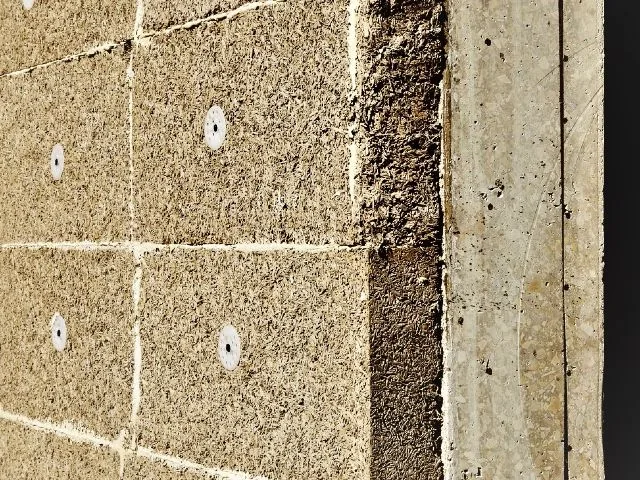
The price per m² for external hempcrete insulation depends on the block thickness, the chosen system and the finish. Expect to pay between €35 and €95/m² incl. VAT for the MULTICHANVRE range, excluding installation and render. This guide compares these costs with thermal performance and sets out the key technical criteria.
Principles and features of external hempcrete insulation
External hempcrete insulation uses a composite material known as hempcrete, made up of 84% hemp shiv – the woody core of locally grown hemp stems from Franche-Comté – bound with Vicat natural prompt cement, a vapour-open hydraulic binder. This composition gives the material several thermal functions: as well as insulation, hempcrete regulates indoor humidity and improves summer comfort thanks to its thermal lag.
However, it’s important to note that hempcrete requires a greater thickness than some conventional insulants to achieve equivalent thermal resistance. This may mean a trade-off on usable floor area, especially for internal wall insulation (IWI).
Hempcrete is not structural: insulation blocks must always be combined with a load-bearing structure (post-and-beam, supporting wall, timber or concrete frame). For external wall insulation (EWI), the system does not require a vapour barrier, provided at least one face of the wall remains open to water vapour and liquid transfer, ensuring good vapour permeability.
Overview of external hempcrete insulation systems
The main range for external hempcrete insulation is MULTICHANVRE, comprising straight-edged blocks measuring 60 × 30 cm, available in four thicknesses: 10, 15, 20 and 30 cm. Each thickness has a corresponding dry thermal resistance (R) and a useful value to use in thermal calculations. These range from 1.5 to 4.6 m².K/W (dry R), and 1.4 to 4.2 m².K/W (useful value).
The system is currently undergoing certification and does not yet have a technical assessment. Installation is by thin-bed masonry using a lime-based mortar, with staggered joints, followed by a lime or earth render. This method ensures thermal continuity and limits thermal bridging, although bridges can never be fully eliminated in EWI.
By contrast, the BIOSYS system, designed for new build, uses dry-stacked interlocking blocks as permanent insulating formwork on a reinforced concrete post-and-beam frame. BIOSYS is not suitable for standalone external insulation and is not currently covered by a valid technical assessment.
Factors affecting the price of external hempcrete insulation per m²
- Block thickness: The thicker the block, the higher the thermal resistance, but also the price per m². The choice of thickness should balance thermal performance and cost.
- Packing and weight: Pallet quantities vary by thickness and weight, affecting delivery charges and on-site handling.
- Additional costs: Renders, mortars, fixings and any protective measures during installation all add to the total cost.
- Loss of usable space: EWI preserves internal floor area, but increases the external envelope, which may create architectural constraints.
- Role of the builders’ merchant network: Distribution is exclusively via partner merchants, so prices and lead times may vary by location.
Price comparison per m² by MULTICHANVRE block thickness
| Thickness (cm) | Dry R (m².K/W) | Useful R (m².K/W) | Thermal lag (h) | Block weight (kg) | Blocks per pallet | Pallet coverage (m²) | Indicative price incl. VAT (/m²) | Recommended uses |
|---|---|---|---|---|---|---|---|---|
| 10 | 1.5 | 1.4 | 6.1 | 6.5 | 120 | 21.6 | €35 | IWI, EWI |
| 15 | 2.3 | 2.1 | 9.25 | 10 | 80 | 14.4 | €51 | IWI, EWI, partitions |
| 20 | 3.0 | 2.8 | 12.3 | 13 | 60 | 10.8 | €66 | IWI, EWI, partitions, infill, floors |
| 30 | 4.6 | 4.2 | 18.5 | 21 | 56 | 10.08 | €95 | High-performance IWI/EWI, heavy partitions, infill, floors |
These prices are indicative for merchant sales, excluding installation and finishes. Heavier blocks in greater thicknesses can affect handling and delivery. Pallet quantities also decrease as thickness increases.
For more technical details, see MULTICHANVRE range: thicknesses, R, thermal lag, packaging and hemp block prices per m² in 2026.
Installation: technical details and indirect costs
MULTICHANVRE blocks are installed in three stages: apply lime-based mortar (M.B.M.) with a notched trowel, lay blocks with staggered joints and 3 mm thin-bed mortar, overlapping by at least one third of the block length, then finish with render. This ensures thermal continuity and bonded masonry strength.
The first course is laid on a 2 cm waterproof mortar bed, acting as a capillary break and ensuring level and flatness. For EWI, it must be at least 15 cm above ground level, on a concrete plinth or a base profile fixed to the wall.
For fixings, only the 20 and 30 cm blocks allow loads up to 10 kg using VBA 6 × 100 screws without pre-drilling. For heavier loads, chemical anchors are needed, or through-fixings to the structural frame for loads over 30 kg. The 10 and 15 cm blocks are not suitable for load-bearing fixings.
Electrical services in EWI can be chased into the blocks, with holes and repairs using a product compatible with the finish render. Care is needed to maintain thermal integrity and water tightness.
Pallets must be stored dry and under cover, not stacked, to preserve block quality as they are not rot-proof. Good logistics and handling are therefore an indirect cost to factor in.
For a full installation guide, see Hemp block installation: IWI, EWI, partitions and floors.
Economic and technical comparison with other EWI insulants
To achieve similar thermal performance, hemp blocks require greater thickness than conventional insulants such as mineral wool or expanded polystyrene. This extra thickness means a larger external envelope and higher material costs.
However, the price per m² adjusted to the useful R value gives a more accurate assessment of the real cost of thermal performance. MULTICHANVRE blocks provide natural humidity regulation and thermal lag, delivering summer comfort unmatched by synthetic insulants.
Traditional systems can have more pronounced thermal bridges due to junctions and fixings, which is not the case for hempcrete laid in thin-bed masonry with staggered joints. However, no insulant can eliminate thermal bridges entirely.
Technical constraints to consider include the non-structural nature of the block, the need for a supporting frame, and the fact that hemp blocks are not suitable for roofs or sloping ceilings, limiting use to masonry and external wall insulation.
Decision support: quotes, merchants and tailored choices
To get an accurate price for external hempcrete insulation per m², we recommend requesting a free online quote via our website. This service will direct you to the nearest partner merchant based on your postcode.
Delivery times vary depending on location, carrier and accessory availability, from a few days up to a month, with longer lead times during holiday periods.
Sales are exclusively through this merchant network; there are no direct sales from the factory or to private individuals. This ensures local stock and support.
Installation training is available from our partner Vicat for the BIOSYS system, while for MULTICHANVRE we can refer you to qualified tradespeople in some areas.
The choice of thickness should be guided by thermal needs, budget and architectural constraints, with support from our technical team and thermal study.
For more information on applications, see IWI, EWI, partitions, floors and timber frame infill and Where to buy hemp blocks: our partner merchants by region.
Durability, maintenance and environmental aspects of hempcrete insulation
The hemp shiv used is 100% sourced from Franche-Comté, from a local supply chain involving around 200 partner farmers, ensuring regional raw material and full traceability.
Hemp absorbs a significant amount of carbon during growth, which remains stored in the finished block. This storage helps reduce the building’s carbon footprint, though it does not claim a negative or neutral carbon balance, as the life cycle assessment (LCA) assumes carbon is re-emitted at end of life.
Reference projects date back to 2017, with few documented defects. The material is not rot-proof, so pallets must be kept dry and under cover before use. The block is naturally resistant to rodents, pests and mould.
It is rated B-s1,d0 (M1) for fire, an important criterion for fire safety.
For more on these topics, see Hemp as a material: the French supply chain and environmental impact and Service life and maintenance of hemp block walls.
Frequently asked questions
What is the average price per m² for external hempcrete insulation?
The indicative price for external insulation with MULTICHANVRE hemp blocks ranges from €35/m² incl. VAT for 10 cm thickness up to €95/m², excluding installation and finishes. These prices should be confirmed with partner merchants.
What thickness of hemp block should I choose for effective external insulation?
The choice of thickness depends on the required performance. 10–15 cm blocks are suitable as additional insulation, while 20–30 cm are recommended for higher performance. The useful thermal resistance value is given for each thickness and should be included in the thermal study.
Can hemp blocks support heavy fixings in EWI?
With 20 and 30 cm MULTICHANVRE blocks, fixings up to 10 kg can be made using VBA 6 × 100 screws without pre-drilling. For heavier loads, chemical anchors are needed, and for even greater weights, fixings must go through to the structural frame.
Is the MULTICHANVRE system certified for external insulation?
The MULTICHANVRE system is currently undergoing certification. No certification, technical assessment or ATEx has yet been issued for external insulation, and the certification in progress only covers internal insulation.
How are electrical services managed in external hemp block insulation?
Services can be chased into the blocks, with repairs using a compatible product for the render. For EWI, chases are made directly in the block, and boxes are fixed afterwards, taking care to maintain water tightness and thermal continuity.
What are the environmental benefits of external hempcrete insulation?
The hemp shiv is locally grown in Franche-Comté, capturing a large amount of carbon which remains stored in the blocks. The material also regulates indoor humidity and provides summer comfort thanks to its thermal lag.
Where can I buy hemp blocks for external insulation?
MULTICHANVRE blocks are sold exclusively through a network of partner merchants across France. We recommend requesting a free online quote to be directed to your nearest merchant.
Read next
Planning a hemp block project?
Tell us about your project: we will reply within 48 working hours with a tailored costing.