Hemp block or monolithic clay brick: the complete guide before you decide
Choosing between hemp blocks and monolithic clay bricks depends on your priorities: thermal, hygrothermal, ecological, and installation factors. Hemp blocks naturally regulate humidity and offer significant thermal lag, while monolithic bricks focus on thermal insulation performance. A careful analysis of your constraints and intended use is essential before deciding.
 By Julien Compain
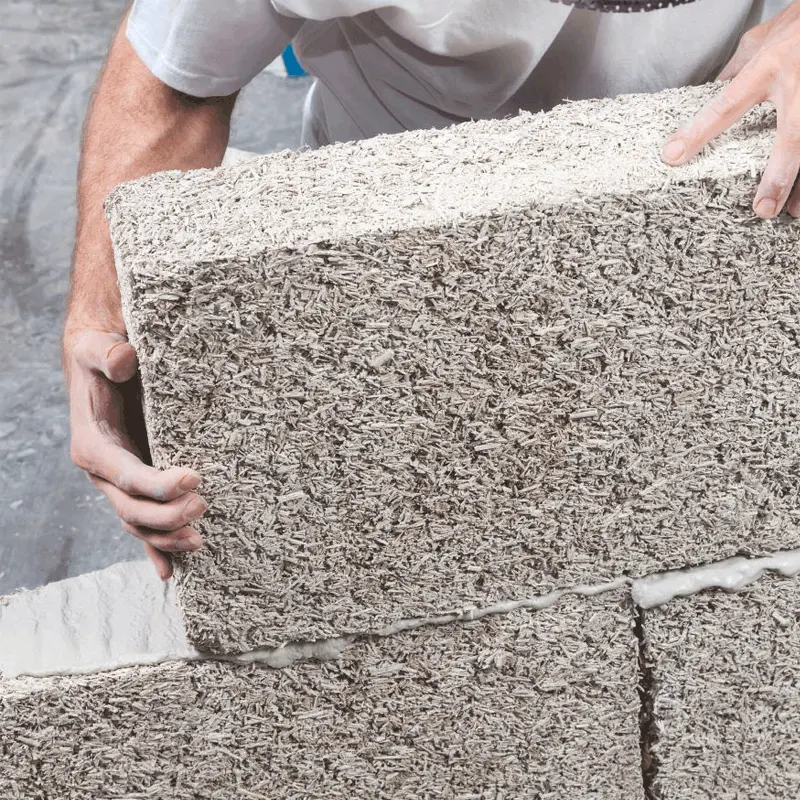
The choice between hempcrete block and monolithic clay block depends on your priorities in terms of thermal, hygrothermal, ecological performance, and installation method. Hempcrete blocks provide natural humidity regulation and significant thermal lag, while monolithic clay blocks focus primarily on thermal insulation. A careful analysis of your specific requirements and intended use is essential before making a decision.
Understanding the materials: composition and principles
Hempcrete block is a composite material made up of 84% hemp shiv—the woody core of the hemp stem—combined with a vapour-open hydraulic binder, Vicat natural prompt cement. This formulation gives the block a density of around 300 kg/m³ and a dry thermal conductivity of approximately 0.065 W/(m.K). These characteristics partly explain its insulation and hygrothermal regulation properties.
By comparison, monolithic clay block is a cellular ceramic material with built-in thermal insulation. Its density is significantly higher than that of hempcrete block, which affects the overall wall weight and certain aspects of installation.
Thermally, hempcrete block acts not only as an insulator but also as a humidity regulator. The hemp shiv, together with its porous structure and moisture storage capacity, enables natural regulation of indoor humidity, contributing to improved summer comfort through significant thermal lag. Monolithic clay block delivers effective thermal insulation mainly through its mass and internal cavities, often providing greater thermal mass but less humidity regulation.
Finally, the environmental impact of hempcrete block is notable due to its renewable, bio-based composition and dry installation process requiring no drying time, with a declared carbon footprint in its FDES (French environmental product declaration). For more details on the composition and characteristics of hempcrete block, see the page Hempcrete block: composition, characteristics, product range.
Thermal and hygrothermal performance compared
| Hempcrete block thickness (cm) | Thermal resistance R (m².K/W) | Thermal lag (h) | Approximate block weight (kg) | Pallet quantity (blocks/pallet and m²) | Recommended use |
|---|---|---|---|---|---|
| 10 | 1.5 | 6.1 | 6.5 | 120 blocks / 21.6 m² | Partition walls, light lining |
| 15 | 2.3 | 9.25 | 10 | 80 blocks / 14.4 m² | Standard lining, partitions |
| 20 | 3.0 | 12.3 | 13 | 60 blocks / 10.8 m² | High-performance internal (IWI) and external (EWI) wall insulation |
| 30 | 4.6 | 18.5 | 21 | 56 blocks / 10.08 m² | High-performance EWI |
The hempcrete block range offers thermal resistance values from 1.5 to 4.6 m².K/W depending on thickness. Thermal lag is significant, reaching around 18.5 hours for 30 cm, which helps maintain summer comfort by limiting rapid temperature fluctuations.
Monolithic clay block also provides good thermal insulation and substantial thermal mass due to its density, but it does not offer the same natural humidity regulation as hempcrete block. Hempcrete blocks help maintain a stable indoor humidity level, generally within a comfortable range, which can reduce condensation and improve indoor air quality. Hempcrete block is also rated B-s1 d0 for fire resistance and A+ for indoor air quality.
For a more detailed technical comparison, see the comparison with concrete block, clay block and common insulants page. The guide Thermal performance of hempcrete block also explains R-values, thermal lag and summer comfort in detail.
Installation: methods and practical considerations
Hempcrete blocks are laid using a lime-based mortar applied with a notched trowel, with staggered joints to ensure a uniform bond. Blocks are fixed to the substrate with brackets—2 to 5 per m²—before applying a suitable render. Compatible finishes include spray plaster, lime, earth or clay plasters indoors, and lime with full mesh reinforcement outdoors, all of which help preserve the wall’s hygrothermal properties.
The MULTICHANVRE range of hempcrete blocks features straight edges, making them suitable for traditional bonded masonry. In contrast, monolithic clay blocks are often designed for flat-bed laying, sometimes with integrated tongues and grooves, allowing for faster and sometimes more airtight installation.
Site times for hempcrete blocks are controlled thanks to factory prefabrication and no drying time, with installation rates of up to 30 m² per day (maximum, on a suitable site) for the BIOSYS dry-stack system. However, this does require labour trained in the specifics of the material, especially compatible renders and joint management.
Hempcrete blocks can be used for a variety of applications: internal wall insulation (IWI), external wall insulation (EWI), partitions, floor insulation under screed, and timber frame infill. However, the block is not load-bearing and must be combined with a supporting wall or structural frame, which is an important limitation to consider.
Finally, the thickness required to achieve high thermal resistance leads to a noticeable loss of living space with IWI, which should be factored into your material choice. The practical guide to choosing hempcrete block thickness provides detailed advice on this point. A sectional diagram showing the order of installation and layers in a hempcrete block wall for IWI or EWI illustrates these aspects.
Cost comparison and economic considerations
The indicative price of hempcrete block starts at around €35/m² incl. VAT for a 10 cm thickness, rising with thickness in line with the amount of material required. This estimate should be confirmed with a personalised quote, taking into account quantities, installation method, renders and finishes.
Monolithic clay block, meanwhile, varies in cost depending on brand, density and format—often higher than standard insulants, but with the advantage of being load-bearing and sometimes quicker to install. In renovation projects, its cost can increase due to the adaptations needed for older walls.
Economic analysis should include installation costs, labour, compatible finishes and any structural adaptations. The loss of living space with IWI using hempcrete block can also have an indirect impact on the overall project cost.
In all cases, it is advisable to compare offers and factor these aspects into your overall budget. For more information, see the page Hempcrete block prices per m²: 2026 benchmarks and technical comparisons.
Best uses and application contexts
Hempcrete block is particularly well-suited to eco-friendly renovation, especially for old stone walls, thanks to its hygrothermal compatibility and ability to regulate moisture. It is also used in new builds, often as timber frame infill or lining, but always in conjunction with a load-bearing structure.
Monolithic clay block is more commonly used in new construction, where its load-bearing capacity and integrated insulation simplify installation and provide consistent thermal performance.
Hempcrete blocks are also used for floor insulation under screed and for partitions, with solutions tailored to thickness and weight requirements. Their lightness is an advantage in these applications.
In terms of compatibility, hempcrete block pairs easily with timber frames, while monolithic clay block is integrated directly into traditional masonry. The choice will therefore depend on the type of structure and project objectives.
For practical examples, see the pages applications for IWI, EWI, partitions and floors and stone wall renovation with hempcrete block.
Detailed technical advantages and disadvantages
- Advantages of hempcrete block: natural humidity regulation, significant thermal lag for improved summer comfort, renewable and recyclable material, low density for easy handling and installation, and a favourable environmental profile.
- Disadvantages of hempcrete block: requires greater thickness to achieve high thermal resistance, is not load-bearing and needs a supporting structure, and must be finished with compatible renders to maintain its hygrothermal properties.
- Advantages of monolithic clay block: integrated strength and compactness, fast installation thanks to size and assembly technique, and consistent thermal insulation from its cellular structure.
- Limitations of monolithic clay block: less effective humidity regulation, environmental impact from ceramic manufacturing, and higher weight which can complicate some projects.
These technical points should be weighed according to your project’s context and priorities. It is recommended to read technical data sheets and user guides carefully, and to consult technical assessments and regulatory documents.
Selection criteria and key points before ordering
- Accurately assess the building’s thermal and hygrothermal needs, considering its use, orientation and environment.
- Consider the living space and any loss due to the thickness of your chosen insulation, especially for internal wall insulation.
- Check compatibility with existing substrates and structures, verifying the required load-bearing capacity and any necessary adaptations.
- Consult technical assessments, guides and regulatory documents to ensure the material and installation comply, especially with RE2020 (France’s environmental building regulation).
- Contact the technical support team for a personalised thermal study to optimise your choice and design.
For more on these points, see the frequently asked questions about hempcrete block and related technical guides.
Frequently asked questions
What thickness of hempcrete block should I choose for effective insulation?
The required thickness depends on the desired thermal resistance: from 10 cm (R 1.5) to 30 cm (R 4.6). For high-performance IWI or EWI, opt for 20 to 30 cm, bearing in mind the loss of living space with IWI.
Can hempcrete block replace monolithic clay block in new builds?
Hempcrete block can be used in new construction, particularly with a timber frame or load-bearing wall. However, it is not load-bearing and requires a supporting structure, unlike monolithic clay block.
What are the advantages of hempcrete block for renovation?
Hempcrete block provides excellent hygrothermal regulation, improves indoor air quality, stores CO₂, and offers effective thermal insulation compatible with old walls, while maintaining breathability.
What finishes are compatible with hempcrete block?
Recommended finishes include spray plaster, lime, earth or clay plasters indoors, and lime with mesh reinforcement outdoors, all suitable for the material’s humidity regulation.
Is hempcrete block fire resistant?
Yes, hempcrete block is rated B-s1 d0 for fire, meaning good fire performance with little smoke and no flaming droplets.
What is the difference in density between hempcrete block and monolithic clay block?
Hempcrete block has a density of around 300 kg/m³, much lighter than monolithic clay block, which is denser and affects total weight and installation.
How do I choose between hempcrete block and monolithic clay block for a stone house?
Hempcrete block is often preferred for its hygrothermal compatibility with stone walls, enabling natural humidity regulation and reducing the risk of condensation.
Read next
Planning a hemp block project?
Tell us about your project: we will reply within 48 working hours with a tailored costing.