Building with hempcrete blocks: complete guide and technical checklist
Building with hempcrete blocks means choosing between MULTICHANVRE and BIOSYS depending on your project, understanding the specific properties of the material (thickness, loadbearing structure), and following the correct installation and storage procedures. This guide covers the key steps and criteria to check before starting your build.
 By Julien Compain
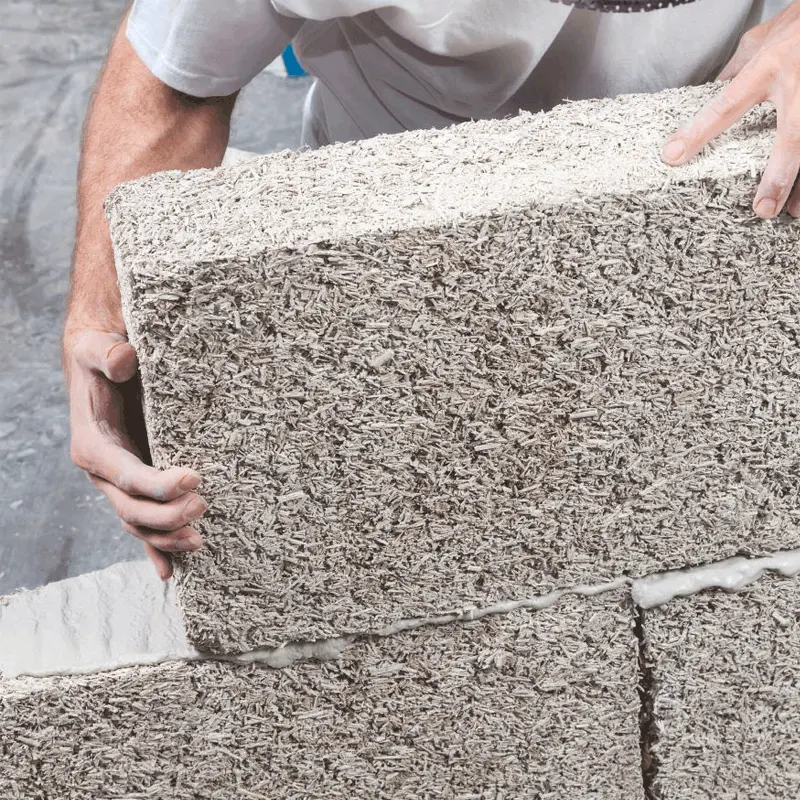
Building with hemp blocks requires choosing between MULTICHANVRE and BIOSYS depending on the intended use, taking into account the specific characteristics of the material (thickness, loadbearing structure), and following the correct installation and storage procedures. This guide outlines the key steps and criteria to check before starting your project.
Understanding hemp blocks: composition and technical characteristics
Hemp blocks are made primarily from hemp shiv, the woody core of the hemp stalk, making up 84% of the mix, bound with Vicat natural prompt cement. This vapour-open hydraulic binder gives the block its mechanical properties while preserving its partly bio-based nature.
In terms of thermal performance, the block has a conductivity of around 0.065 W/(m.K) when dry. Thermal lag—the time taken for heat to pass through the wall—can reach up to 18.5 hours for the thickest blocks. This helps keep interiors cooler in summer by limiting overheating.
The density is around 300 kg/m³, resulting in a lightweight material that is easy to handle. For fire safety, the block is rated B-s1,d0, meaning low smoke emission and no flaming droplets.
Hemp blocks also contribute to indoor air quality with an A+ rating, confirming the absence of harmful emissions. They naturally regulate humidity, maintaining a comfortable level and promoting a healthy indoor climate.
Additionally, the material offers a sound absorption coefficient α of 0.4, helping to reduce both impact and airborne noise. Its composition provides natural resistance to rodents and pests, with no need for chemical treatment.
It is important to note, however, that to achieve the same thermal resistance as some thinner insulants, hemp blocks require greater thickness. This may slightly reduce usable floor area, especially for internal wall insulation (IWI), and should be factored into project design.
Choosing between the MULTICHANVRE and BIOSYS ranges for your project
The choice of hemp block system depends mainly on the intended use and project constraints. Two ranges are available: MULTICHANVRE and BIOSYS.
- MULTICHANVRE is a range of straight-edged blocks available in four thicknesses (10, 15, 20 and 30 cm), suitable for various insulation applications: IWI, external wall insulation (EWI), partitions, floor insulation under screed, and timber frame infill. This system is built using lime mortar with staggered joints, mechanically fixed with brackets, and finished with render. At present, MULTICHANVRE does not have an Avis Technique or ATEx, although an ATEx case A for IWI is in progress.
- BIOSYS is a patented building system from the Vicat group, manufactured in partnership with us. It consists of dry-stacked interlocking blocks, using grooves and tongues, with no glue or mortar. With a standard thickness of 30 cm, it is designed to be combined with a reinforced concrete post-and-beam structure to take the loads. The CSTB Avis Technique previously held by BIOSYS has expired and is currently being renewed. This system enables fast, precise assembly, with a rate of up to 30 m² per day (maximum, on a suitable site) by two operatives, including the structure.
The installation method therefore differs between the two ranges, affecting the skills required and site logistics. MULTICHANVRE is suited to a variety of insulating uses, especially in renovation or lightweight new-build, while BIOSYS is aimed at new-build projects with a reinforced concrete loadbearing structure.
Your choice should also take into account regulatory requirements and the nature of the project, particularly the need for an Avis Technique for certain contracts. For more information, see the MULTICHANVRE range details and the BIOSYS building system.
Preparatory steps before building with hemp blocks
Before starting a hemp block build, several preparatory steps are essential to ensure a successful project.
- Project analysis: First, determine whether the project is new-build or renovation, considering architectural, thermal and local regulatory constraints. The site environment, orientation and condition of existing substrates will influence technical choices.
- Selecting thicknesses: Depending on the required thermal performance and current regulations, choose the appropriate block thickness. MULTICHANVRE blocks are available in 10, 15, 20 and 30 cm, each with different thermal resistances. This choice also affects the final usable floor area, especially for IWI.
- Defining the loadbearing structure: Hemp blocks are not structural. You will need a supporting wall, timber frame or reinforced concrete structure, especially for BIOSYS. The structure must be compatible with the chosen system.
- Organising storage and site logistics: Pallets of blocks must be stored dry and under cover, without stacking, to prevent damage. Logistics should allow for delivery in line with the work schedule and safe handling on site.
- Technical consultation: We recommend contacting our technical team and referring to the comprehensive guide to installing hemp blocks to confirm your choices, especially regarding installation method and compatible finishes.
Technical comparison of MULTICHANVRE block thicknesses and performance
| Thickness | Dry R value (m².K/W) |
Useful R value (m².K/W) |
Thermal lag (hours) |
Block weight (kg) |
Packing (blocks/pallet) |
Recommended uses |
|---|---|---|---|---|---|---|
| 10 cm | 1.5 | 1.4 | 6.1 | 6.5 | 120 | Floor insulation, partitions |
| 15 cm | 2.3 | 2.1 | 9.25 | 10 | 80 | Infill, partitions |
| 20 cm | 3.0 | 2.8 | 12.3 | 13 | 60 | Thermal insulation IWI / EWI / partitions / infill / floors |
| 30 cm | 4.6 | 4.2 | 18.5 | 21 | 56 | High-performance EWI and construction |
These figures show the thermal resistance when dry and the useful value, the latter being the one to use in any thermal study. Thermal lag increases with thickness, improving summer comfort.
Pallet packing and block weight are also important for site logistics and handling. The recommended uses help guide your choice to the format best suited for insulation or structural infill.
For more details, see the MULTICHANVRE range and the full technical product sheet for hemp block thermal insulation.
Practical tips for installing MULTICHANVRE and BIOSYS hemp blocks
The installation methods for the two ranges are quite different and must be followed to ensure durability and performance.
Installing MULTICHANVRE blocks
- Installation is done in three stages: apply lime-based mortar to the joints with a notched trowel, lay the blocks with staggered joints to minimise thermal bridging, and mechanically fix with brackets (2 to 5 per m²) for stability.
- Bonding to the substrate is essential, as is careful jointing and following the correct sequence to ensure airtightness and mechanical strength.
- Internal finishes can be spray plaster, lime, earth or clay. For exteriors, lime-rich renders with full mesh reinforcement are recommended to protect the block while maintaining breathability.
Installing BIOSYS blocks
- BIOSYS blocks are dry-stacked using grooves and tongues, with no glue or mortar, enabling fast and precise assembly.
- They act as permanent insulating formwork and infill for a reinforced concrete post-and-beam structure, which takes the loads.
- This method requires careful coordination with the concrete works and adherence to execution drawings.
- Finishes are similar to those for MULTICHANVRE blocks, compatible with plaster, lime or earth inside, and lime render outside.
In both cases, chases for electrical conduits can be cut directly into the blocks or into a service void, depending on site organisation.
Following the comprehensive guide to installing hemp blocks is essential to ensure quality workmanship and the long-term durability of your build.
Regulations, storage and durability of hemp blocks
Hemp blocks have a fire reaction rating of B-s1,d0, ensuring low smoke emission and contributing to building fire safety. Their A+ indoor air quality rating confirms the absence of harmful emissions—important for comfort and health.
Pallets must be stored dry, under cover and never stacked, as the blocks are not rot-proof. This prevents damage before installation and ensures the material’s durability.
Their sensitivity to moisture also means good building design is needed to prevent water ingress and ensure adequate ventilation.
Regulatory-wise, the BIOSYS Avis Technique has expired and is being renewed, and MULTICHANVRE is undergoing certification with an ATEx expected for IWI. Keep up to date with regulatory developments and consult available guidance.
We recommend reading the regulations and uses for hemp blocks in 2026 to stay informed about current requirements.
Indicative costs and supply: planning your budget and logistics
The indicative price for MULTICHANVRE blocks starts at around €35/m² incl. VAT for the 10 cm thickness. This price increases with thickness and block type. These figures are for guidance only and should be confirmed with a personalised quote.
Sales are through our network of partner builders’ merchants, with delivery available throughout France.
We respond to quote requests within 48 working hours, allowing you to plan your project’s finances and logistics effectively.
The choice of thickness and range directly affects the overall budget, including purchase cost, labour and required finishes.
It is advisable to schedule orders and deliveries in line with your works programme to avoid shortages or overstocking, and to follow the recommended storage conditions.
Maintenance, repairs and feedback for long-lasting construction
Hemp blocks require minimal maintenance, mainly regular checks of renders and mechanical fixings. Good upkeep of finishes helps maintain the insulation’s durability.
Repairs are usually limited to the render, which can be redone without affecting the block itself. It is important to act quickly if damage occurs to prevent moisture reaching the material.
Technical feedback highlights that durability depends greatly on quality of installation and correct storage before use.
Installer training and following technical recommendations are key to ensuring the performance and longevity of hemp block buildings.
For more on best practice, a range of resources and guides are available on our website to support both professionals and self-builders.
Frequently asked questions
What thickness of hemp block should I choose for effective insulation?
The choice depends on the required thermal performance and site conditions. MULTICHANVRE blocks are available in 10, 15, 20 and 30 cm thicknesses, with useful thermal resistances from 1.4 to 4.2 m².K/W. The useful value should be used in your thermal calculations.
Can hemp blocks be used as a structural element?
No, hemp blocks are not structural. They must be combined with a loadbearing structure, such as a supporting wall, timber frame or reinforced concrete post-and-beam structure for BIOSYS.
How do you install MULTICHANVRE blocks in renovation projects?
Install MULTICHANVRE blocks in three steps: apply lime-based mortar with a notched trowel, lay blocks with staggered joints, fix with brackets, then finish with a compatible render.
What are the risks of storing hemp blocks on site?
Hemp blocks are not rot-proof. They must be stored dry, under cover and never stacked, to prevent damage before installation.
What finishes are compatible with hemp blocks?
Internal finishes include spray plaster, lime, earth or clay. For exteriors, lime-rich renders with full mesh reinforcement are recommended.
Are hemp blocks good for sound insulation?
Hemp blocks have a sound absorption coefficient α = 0.85, providing effective acoustic insulation for partitions and infill applications.
Is there an Avis Technique for MULTICHANVRE blocks?
No, at present MULTICHANVRE blocks do not have an Avis Technique, but an ATEx case A for IWI use is expected.
Read next
Planning a hemp block project?
Tell us about your project: we will reply within 48 working hours with a tailored costing.