Technical comparison: hemp vs cellulose wadding for insulation
Hemp and cellulose wadding are two bio-based insulators with attractive thermal and hygrothermal properties. Hemp offers better moisture regulation and greater thermal lag, while cellulose wadding is often lighter and easier to install in lofts. The right choice depends on your application and technical constraints.
 By Julien Compain
Hemp and cellulose wadding are two bio-based insulation materials with interesting thermal and hygrothermal properties. Hemp offers better moisture regulation and greater thermal lag, while cellulose wadding is often lighter and easier to install in loft spaces. The choice will depend on the intended use and technical constraints.
Material composition and origin
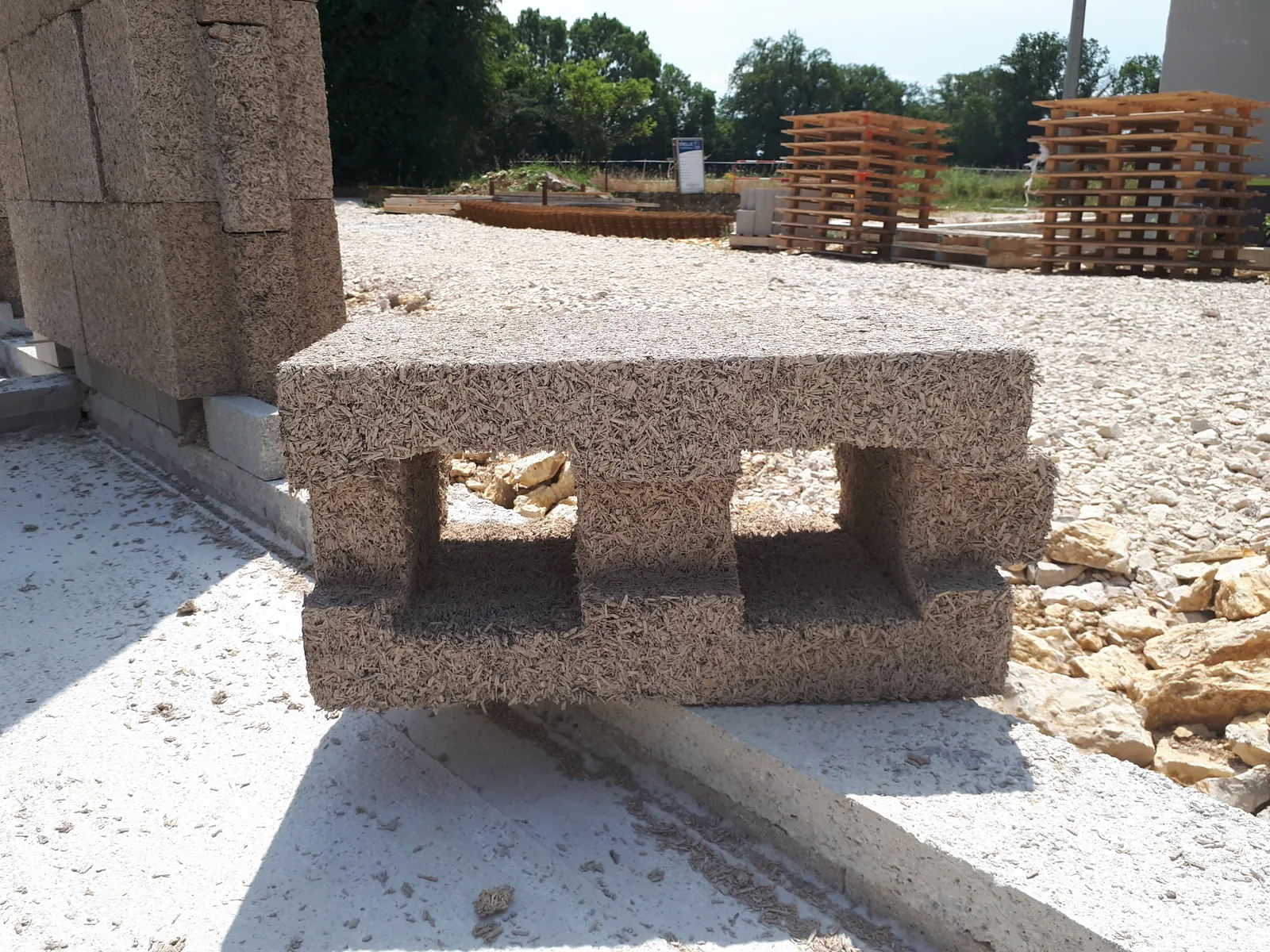
Hemp blocks are made primarily from hemp shiv, the woody core of the hemp plant, making up 84% of the block. This stem core is bound with Vicat natural prompt cement, a hydraulic binder that is vapour-open. This formulation gives the block its specific properties, particularly in terms of moisture regulation and thermal lag. The hemp shiv used is grown in Franche-Comté, within a local supply chain that uses no irrigation or chemical treatments, ensuring a renewable origin and soil-friendly farming.
Cellulose wadding is made from recycled paper fibres, treated to improve fire and insect resistance. It is also part of a recycling and waste recovery approach. Its manufacture relies on industrial processes that include additives to ensure durability and stability, but it remains a recycled, bio-based material.
- Hemp is linked to a local agricultural supply chain with a dedicated crop, beneficial for carbon capture and soil quality improvement.
- Cellulose wadding is based on the recovery of recycled paper fibres, with its environmental impact depending on collection, processing and transport.
For more details, see our page on the hemp supply chain and environmental impact.
Thermal performance and thermal lag
Hemp blocks have a dry thermal conductivity of around 0.065 W/(m·K). Depending on the thickness selected, their thermal resistance varies, with dry values from 1.5 m²·K/W for 10 cm to 4.6 m²·K/W for 30 cm. The useful value, to be used in a thermal study, is slightly lower, for example 4.2 m²·K/W for 30 cm. The thermal lag, calculated using a standardised formula, can reach 18.5 hours for a 30 cm block, which helps provide notable summer comfort by limiting overheating.
Cellulose wadding, depending on its density and installation method (blown or injected), generally offers a thermal conductivity between 0.038 and 0.045 W/(m·K). Its thermal lag depends on its density and configuration, but is often lower than that of solid hemp blocks. The lower density of cellulose wadding, typically around 40 to 60 kg/m³, makes it easy to install in lofts, but can reduce its thermal capacity.
- Hemp requires greater thickness to achieve the same thermal resistance as cellulose wadding, but compensates with higher thermal lag.
- Cellulose wadding often has better thermal conductivity, but its real-world performance depends on installation quality and achieved density.
The weight of a hemp block, around 300 kg/m³, contributes to its thermal mass, while cellulose wadding is much lighter. For a detailed overview of hemp thicknesses and performance, see the MULTICHANVRE range page, and for a general overview, our bio-based insulation comparison.
Moisture management and hygrothermal regulation
Hempcrete naturally regulates indoor humidity thanks to the vapour permeability of its hydraulic binder and the hygroscopic capacity of hemp shiv. This regulation limits the risk of condensation and helps maintain stable indoor comfort. A vapour barrier is not always required, provided at least one face of the wall remains open to moisture transfer. If the wall is sealed, for example with a cement render, feasibility should be checked with a thermal study. In damp areas or rooms exposed to water splashes, specific protection such as a compliant plasterboard lining is recommended.
Cellulose wadding is also hygroscopic, but more sensitive to moisture. Its effectiveness depends on careful installation to avoid compaction and water ingress. Poor installation can lead to condensation, deterioration and sagging of the material. As a result, cellulose wadding often requires more careful protection against moisture, especially in damp environments or old walls with high permeability.
- Hemp offers better natural hygrothermal regulation, reducing moisture-related issues.
- Cellulose wadding requires suitable protection and careful installation to ensure durability in the presence of moisture.
For more information, see our guide on hemp and moisture as well as the guide Natural insulation and moisture.
Installation and site integration
MULTICHANVRE hemp blocks are laid in a staggered bond in three steps: application of a lime-based mortar (M.B.M. mortar) with a notched trowel, laying the blocks with thin joints of around 3 mm and overlapping at least one third of the block length, then mechanically fixing to the substrate with brackets, straps or washers before rendering. The first course is laid on a 2 cm bed of waterproof mortar to provide a capillary break and proper levelling. This method applies to the MULTICHANVRE system only.
The BIOSYS system, designed for construction, uses tongue-and-groove blocks that are dry-stacked, without glue or mortar. The blocks act as a permanent insulating formwork for a reinforced concrete post-and-beam structure. Laying rates can reach around 30 m² per day for two workers on a suitable site, making for rapid progress.
Cellulose wadding is generally installed by blowing or injection, particularly in unconverted lofts or cavities. It requires specialist equipment and expertise to achieve the correct density and avoid compaction or thermal bridging. Installation is often quicker in lofts, but less suitable for load-bearing walls or linings that require rigidity.
- Laying hemp blocks requires specific training, especially for mortar and fixings, but offers an integrated and durable solution.
- Cellulose wadding is easier and quicker to install in lofts, but depends on appropriate equipment and installation.
Fixings in hemp blocks are possible for 20 and 30 cm thicknesses: up to 10 kg with 6×100 VBA screws without pre-drilling, up to 30 kg with chemical anchors. For heavier loads, fixings must be made into the structural frame.
Pallets of blocks must be stored under cover, dry and not stacked. Cellulose wadding, supplied in bags or loose, also needs to be kept dry to maintain its properties.
You will find a comprehensive hemp block installation guide as well as an overview of the bio-based insulation comparison.
Cost comparison and supply
Indicative retail prices for hemp blocks vary by thickness: around €35/m² incl. VAT for 10 cm, €51/m² for 15 cm, €66/m² for 20 cm and €95/m² for 30 cm. These prices are indicative and may vary depending on the merchant, order volume and destination. Average delivery time is about one week, ranging from a few days to a month depending on location and time of year.
Cellulose wadding is generally cheaper per square metre, especially for loose or blown-in insulation. However, it must be installed by equipped professionals, which can increase the overall cost. Lead times are usually short, with good regional availability.
- Hemp blocks are sold exclusively through a network of partner builders' merchants, with delivery throughout France.
- Cellulose wadding is more widely distributed through traditional insulation channels.
For any enquiry, requesting a free quote allows you to receive a tailored estimate and be directed to the nearest local merchant, also accessible via our partner merchant network page.
Comparison table of main technical characteristics
| Criterion | Hemp block (MULTICHANVRE / BIOSYS) | Cellulose wadding |
|---|---|---|
| Composition | 84% hemp shiv + Vicat natural prompt cement | Treated recycled paper fibres |
| Formats | MULTICHANVRE: 60×30 cm, thicknesses 10, 15, 20, 30 cm; BIOSYS: 60×30.8×30 cm tongue-and-groove blocks | Blown, injected, loose or in panels |
| Density | ~300 kg/m³ | 40 to 60 kg/m³ depending on installation |
| Thermal conductivity λ (W/(m·K)) | Approx. 0.065 | 0.038 to 0.045 depending on density |
| Thermal resistance R dry / R useful (m²·K/W) |
|
Varies by thickness and density, often 2 to 6 depending on installation |
| Thermal lag | Up to 18.5 h (MULTICHANVRE 30 cm, standard formula) | Lower, depends on density and configuration |
| Fire rating | B-s1,d0 | Varies by treatment, generally class B or C |
| Hygrothermal regulation | Natural regulation, vapour barrier not always required | Hygroscopic, moisture sensitive, needs protection |
| Load fixings | 20 and 30 cm: up to 10 kg with screws, 30 kg with chemical anchors | Not suitable for heavy fixings |
| Installation | MULTICHANVRE: lime mortar, staggered joints, mechanical fixings; BIOSYS: dry interlocking | Blown or injected, specialist equipment |
| Storage | Dry, under cover, not stacked | Dry and under cover |
| Indicative price per m² incl. VAT | €35 (10 cm) to €95 (30 cm), depending on thickness | Varies, often cheaper to buy |
| Observed durability | In use since 2017, few reported issues | Prone to compaction and moisture, maintenance required |
Environmental impact and carbon storage
Hemp cultivation is recognised for its ability to capture large amounts of atmospheric carbon during growth, which is then stored in the hempcrete block. Local cultivation in Franche-Comté uses no irrigation or chemical treatments, with deep roots that break up the soil and improve its quality. Vieille Matériaux issues carbon credits each year, demonstrating the environmental value of this material.
Cellulose wadding is made from recycled paper fibres, thus recovering waste and limiting the use of virgin resources. However, its carbon footprint depends on industrial processing and transport.
It is important to consider the full life cycle when assessing impacts. In particular, life cycle analysis (LCA) considers that the carbon captured in bio-based materials is re-emitted at end of life, which qualifies any final assessment. The environmental benefit should therefore be considered over the long term, with the local supply chain and absence of chemical treatments as positive points for hemp.
For more information, see our page on the hemp supply chain and environmental impact.
Durability, maintenance and usage restrictions
Hempcrete has proven durability, with several years of use in France since the 1980s and very few reported issues. However, the block is not rot-proof, so it must be stored dry and under cover before installation. Its natural resistance to rodents, pests and mould is a distinct advantage.
Cellulose wadding, while durable in good conditions, is sensitive to compaction and moisture. Poor protection or prolonged exposure to water can cause deterioration, requiring regular maintenance and checks.
Hemp blocks must not be used for roof, sloping or loft insulation. The BIOSYS U ring beam block is only for forming masonry slopes and not as insulation. In wet rooms, hemp must be protected from water splashes with a suitable lining.
- Hemp requires good management of installation and storage but offers good durability.
- Cellulose wadding needs strict protection from moisture and regular checks.
Detailed recommendations are available in our guide on service life and maintenance and in the hemp block usage guide.
Choosing according to project and technical recommendations
Hemp blocks are suitable for distributed insulation in many applications: internal wall insulation (IWI), external wall insulation (EWI), partitions, floor insulation and timber frame infill. They always require an associated load-bearing structure and a prior thermal study to determine the appropriate thickness and system. Installation is suitable for both private individuals and building professionals.
Cellulose wadding is often preferred in unconverted lofts or for blown-in insulation, where its lightness and ease of installation are advantages. It is less suitable for load-bearing walls or insulation requiring structural rigidity.
The choice will depend on the geographical area, climate constraints, existing substrates and intended use. We recommend requesting a free quote for personalised advice from a partner merchant and to choose the most suitable solution for your project.
Finally, for an overview, our bio-based insulation comparison completes this article.
Frequently asked questions
Is hemp more insulating than cellulose wadding?
Hemp and cellulose wadding have similar thermal conductivities. Hemp offers better thermal lag and more pronounced moisture regulation, but often requires greater thickness to achieve equivalent thermal resistance.
Can you fix heavy items to a hemp block wall?
On 20 and 30 cm hemp blocks, fixings up to 10 kg are possible with 6×100 VBA screws without pre-drilling, and up to 30 kg with chemical anchors. For heavier loads, fixings must be made into the underlying structural frame.
Is cellulose wadding suitable for damp walls?
Cellulose wadding is sensitive to moisture. It requires good protection from water and careful installation to avoid condensation and deterioration risks.
Does hemp require a vapour barrier?
Hempcrete naturally regulates moisture. A vapour barrier is not always necessary if at least one face of the wall remains open to liquid and vapour water transfer. For sealed walls, a thermal study is recommended.
How do the costs of hemp and cellulose wadding compare?
Hemp blocks range from €35 to €95/m² incl. VAT depending on thickness. Cellulose wadding may be cheaper to buy but must be installed by professionals. The final cost will depend on installation type and project complexity.
What is the service life of hempcrete?
The durability of hempcrete is demonstrated by several years of use in France since the 1980s, with few reported issues. No precise service life figure is given.
Is hemp or cellulose wadding more environmentally friendly?
Hemp captures a large amount of carbon during cultivation, which is stored in the block. Cellulose wadding uses recycled paper. The overall environmental impact should be considered in a full life cycle analysis.
Read next
Planning a hemp block project?
Tell us about your project: we will reply within 48 working hours with a tailored costing.