Insulating a house extension with hempcrete blocks: technical details and feedback
Insulating a house extension with hempcrete blocks offers thermal mass, moisture regulation and tailored thermal performance. Choosing the right thickness offsets the higher heat loss typical of extensions, with staggered joints and suitable finishes. Careful detailing at the junction with the existing building is essential to avoid cold spots.
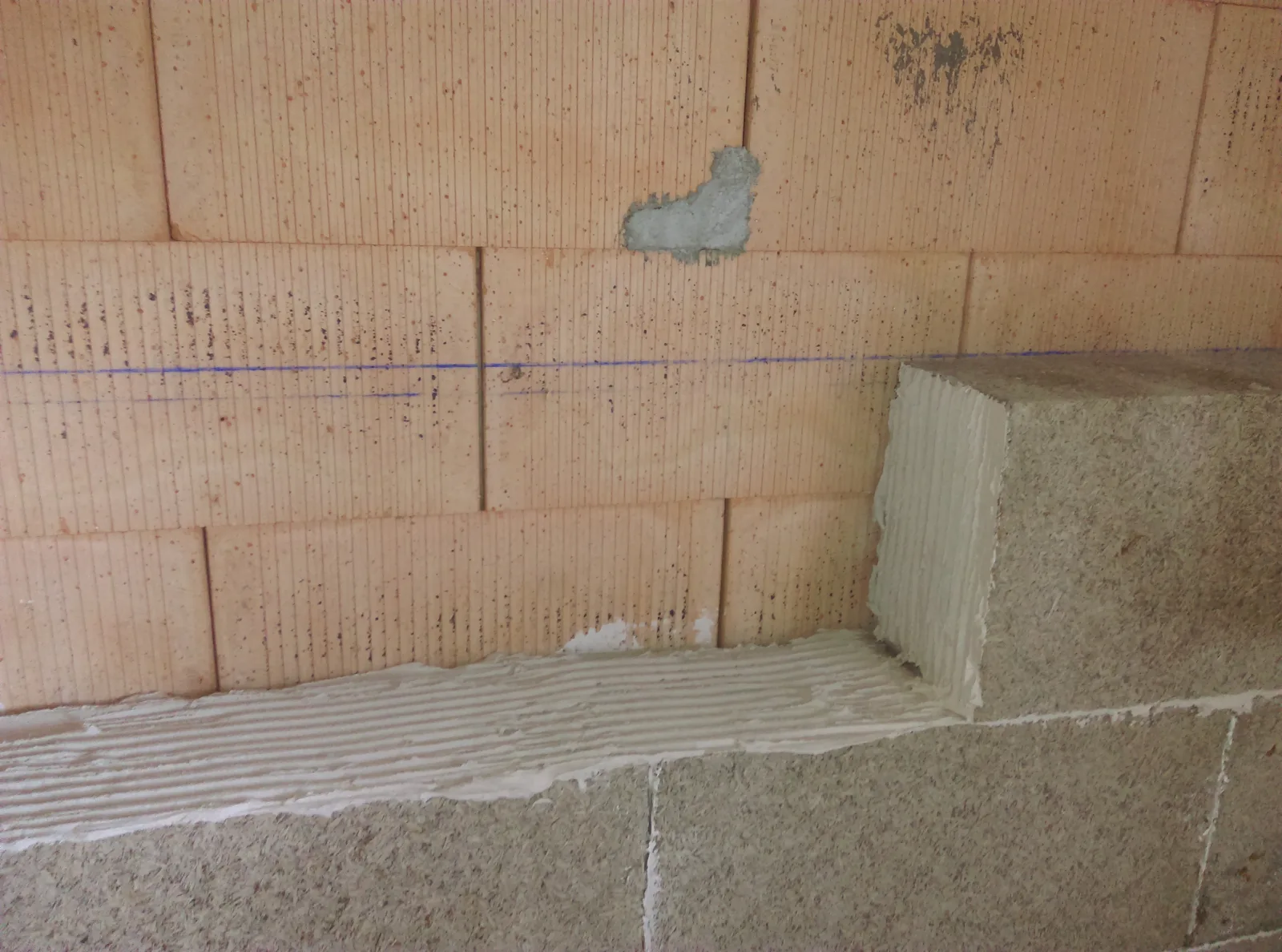
| Solution used | IWI · 20 cm |
|---|---|
| Area treated | 62 m² of walls |
| Town | Valdahon |
| Département | Doubs |
| Year | 2025 |
Insulating a house extension with hempcrete blocks combines thermal mass, moisture regulation and suitable thermal performance. Choosing the right thickness compensates for higher heat loss, with blocks laid in a staggered bond and appropriate finishes. Careful detailing at the junction with the existing building is essential to avoid cold spots.
Hempcrete blocks for insulating extensions: overview
Hempcrete blocks are a composite material made up of 84% hemp shiv (the woody core of the hemp stem) bound with a vapour-open hydraulic binder: Vicat natural prompt cement. This formulation produces a bio-based, renewable and recyclable product, manufactured locally at the Mérey-sous-Montrond plant in Bourgogne-Franche-Comté. The block has a density of around 300 kg/m³, making it a lightweight, non-loadbearing masonry unit, designed for lining a supporting wall or infilling a timber frame.
The blocks are available in the MULTICHANVRE range, with a standard size of 60 × 30 cm and four thicknesses: 10, 15, 20 and 30 cm. Each thickness provides a specific thermal resistance (R), from 1.5 to 4.6 m²·K/W, as well as significant thermal lag—up to 18.5 hours for the 30 cm block—improving summer comfort.
In addition to thermal insulation, hempcrete blocks naturally regulate humidity, maintaining indoor relative humidity within a comfortable range. This reduces the risk of condensation and contributes to excellent indoor air quality, rated A+. The material also offers a sound absorption coefficient α = 0.85 and a fire rating of B-s1 d0. Its formulation provides natural resistance to rodents. These hygrothermal and acoustic properties contribute to overall comfort in the home.
The block is not structural. Its main uses are for internal wall lining (IWI), external wall insulation (EWI), lightweight partitions, floor insulation under screed, or timber frame infill. For more technical details, see the composition and characteristics of hempcrete blocks on our website, as well as the MULTICHANVRE range and available thicknesses.
The tricky part: joining to existing buildings
When insulating an extension built with hempcrete blocks adjoining an older building, special care must be taken at the junction between materials. If a new vapour-open structure meets an existing airtight one—such as a polystyrene lining with a vapour barrier—a transition zone can form where water vapour is blocked by the membrane, leading to condensation and potential damage.
On this 34 m² extension project in Vesoul, the 1950s house had been lined in 2012 with 8 cm of expanded polystyrene and a vapour barrier. The technical solution was to remove this lining for one metre on either side of the junction and replace it with 15 cm hempcrete blocks, ensuring continuity in moisture management between the two walls. This homogeneity greatly reduces the risk of localised condensation.
Post-completion monitoring included a thermal imaging survey one year after the works, which revealed no significant cold spots at the junction. This check is essential to confirm the quality of the connection and the overall effectiveness of the insulation.
The extension itself: technical details and material choices
| Item | Selected option |
|---|---|
| Floor area created | 34 m² |
| Insulated wall area | 62 m² |
| Block thickness | 20 cm — R = 3.0 m²·K/W |
| Internal finish | two coats of clay plaster |
| Junction treatment | 15 cm block for 1 m either side |
| Project duration | 7 weeks |
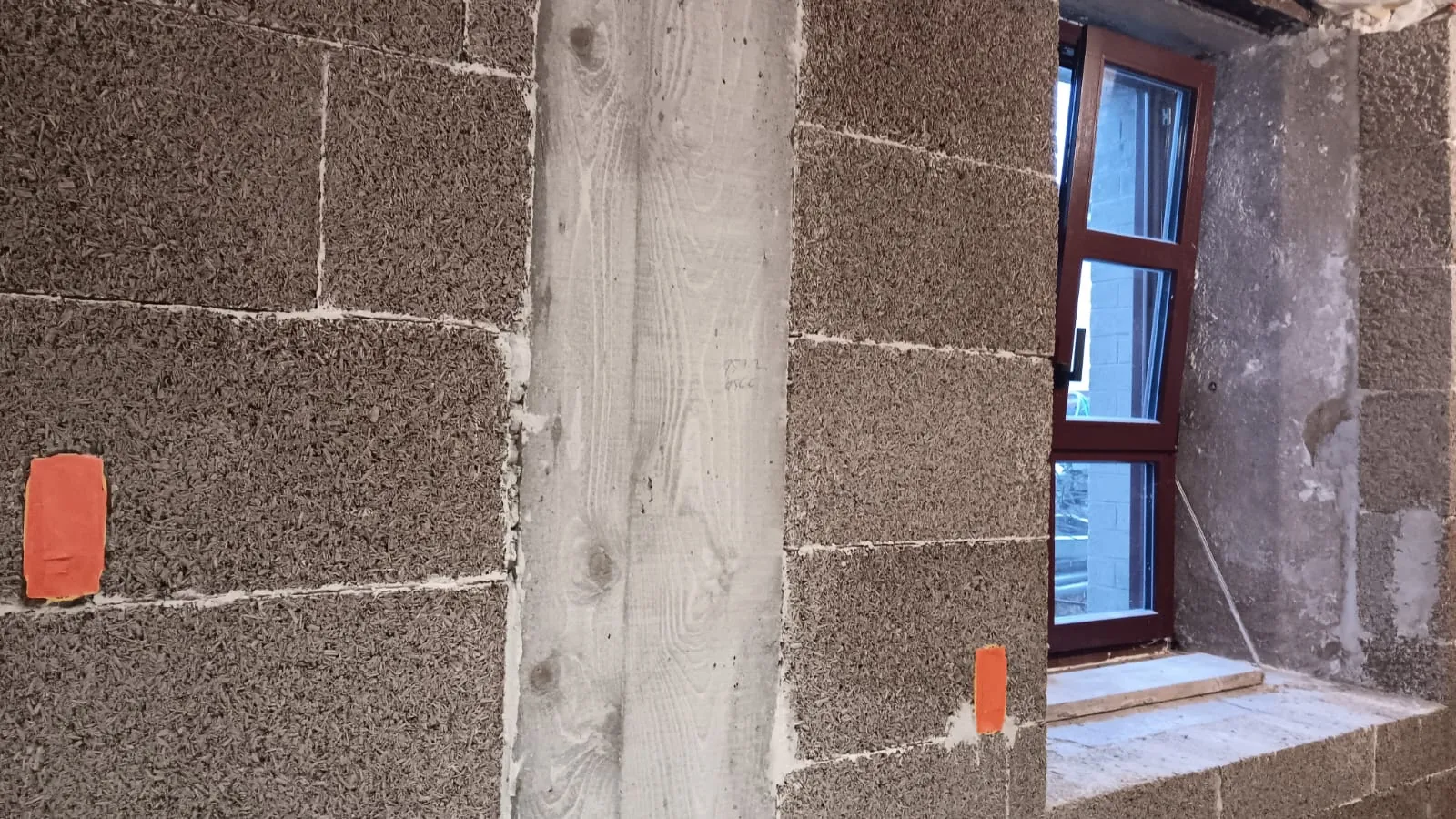
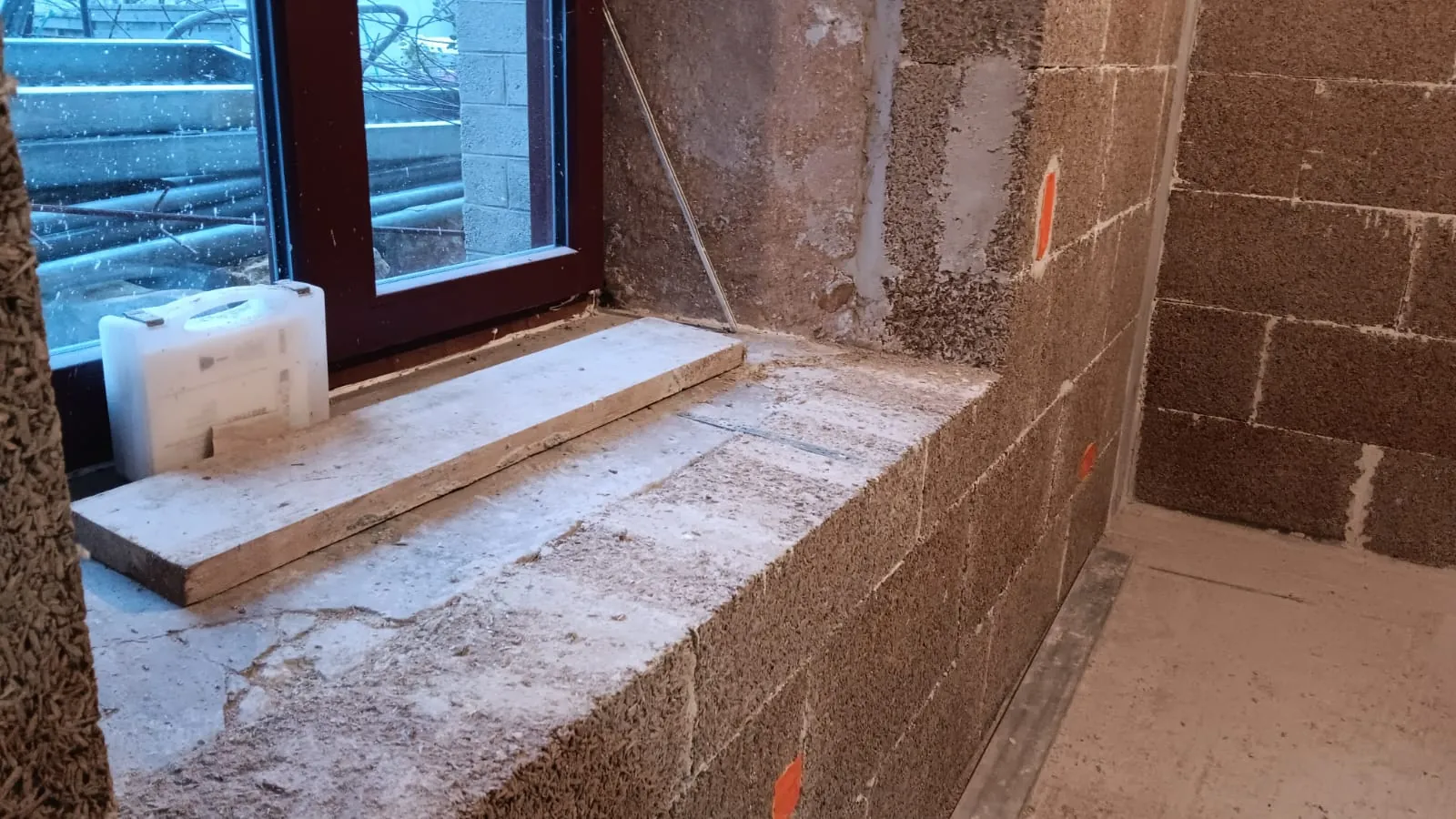
The extension is a south-facing living space adjoining the existing house. Lightweight masonry was built using 20 cm MULTICHANVRE blocks, laid in a staggered bond with a lime-based mortar applied using a notched trowel. Fixing to the concrete substrate was achieved with two to five fixings per m², ensuring block stability without the need for adhesive mortar.
The new floor area is 34 m², with 62 m² of insulated walls. The internal finish consists of two coats of clay plaster, a material compatible with the block’s natural vapour permeability, which helps regulate humidity and improve indoor air quality.
The specific treatment of the junction with the existing building—installing a 15 cm hempcrete block for one metre either side—was a key stage of the project. The total duration was seven weeks, including preparation, block installation and finishing.
For further technical information on installation and finishes, see the installation guide and the section on hempcrete block applications for insulation.
Why choose 20 cm rather than 15 cm thickness for the extension?
The choice of 20 cm rather than 15 cm thickness is due to the particular geometry of an extension. Here, the surface-to-volume ratio is unfavourable: the area of walls exposed to the cold is large compared to the heated volume, increasing heat loss.
The 15 cm MULTICHANVRE block provides a thermal resistance R of 2.3 m²·K/W, sufficient for a more compact space. However, for an extension, the 20 cm block with R = 3.0 m²·K/W offers better compensation for heat loss and improves overall thermal comfort.
This increase in thickness represented an additional material cost of around €640 on this project—a cost to weigh against potential energy savings and the long-term durability of the build. This reasoning is explained in our guide to choosing insulation thickness, which takes into account the specifics of the space and the thermal performance of the blocks.
Thermal performance, summer comfort and moisture regulation
- Hempcrete blocks have a thermal conductivity λ of around 0.065 W/(m·K), with thermal resistance varying by thickness: from 1.5 m²·K/W for 10 cm to 4.6 m²·K/W for 30 cm.
- Thermal lag—the time taken for heat to pass through the material—is significant: up to 18.5 hours for a 30 cm block, helping to prevent daytime overheating and improve summer comfort.
- Natural moisture regulation, provided by the hemp shiv and compatible plaster, keeps indoor humidity within a comfortable range, preventing condensation and improving air quality (rated A+).
- Internal finishes such as clay plaster, lime or spray-applied plaster maintain vapour permeability and help preserve these balances.
- This system reduces condensation by limiting thermal bridges and allowing water vapour to diffuse outwards.
Combined, these properties ensure a healthy indoor environment, reduced heating needs and stable thermal comfort all year round. For more on these topics, see the guide to the thermal performance of hempcrete blocks.
Comparing hempcrete blocks with other extension materials
Compared to other insulation materials commonly used in extensions, hempcrete blocks have specific features to consider:
- Thickness: For the same thermal resistance, hempcrete blocks require greater thickness than mineral wool or expanded polystyrene. For example, an R of 3.0 m²·K/W is achieved with 20 cm of hempcrete block, while 15 cm is often enough with mineral wool.
- Usable floor area: This extra thickness can reduce the usable internal space, a factor to consider in the design.
- Durability and renewability: Hemp is a bio-based, renewable and recyclable material with a low carbon footprint, whereas synthetic materials have a higher environmental impact.
- Moisture management: Hempcrete blocks are vapour-open, improving humidity regulation and reducing condensation risk, unlike polystyrene, which is virtually impermeable.
- Buildability: Lightweight hempcrete masonry is compatible with existing structures and facilitates renovation work.
These aspects are discussed in the comparison with concrete block, brick, aerated concrete and mineral wools, as well as in dedicated articles on insulation materials.
Installation and suitable finishes for hempcrete block extensions
Hempcrete blocks should be installed using a precise method to ensure continuous insulation and lasting results:
- MULTICHANVRE blocks are laid in a staggered bond on a supporting substrate (concrete wall or timber frame), with lime-based mortar applied using a notched trowel.
- Fixing is done with brackets, two to five per square metre, providing mechanical stability without the need for adhesive mortar or glue.
- Compatible internal finishes include clay plaster, lime or spray-applied plaster, applied in two coats for a regular, vapour-permeable finish.
- Externally, a lime render with full mesh reinforcement is recommended to protect the wall while maintaining vapour permeability.
- Features specific to extensions, such as large glazed openings or junctions with existing structures, must be carefully detailed to avoid thermal bridges and ensure airtightness.
The project duration depends on the area and complexity, but for a 34 m² extension, block installation and plastering took around ten days, out of a total of seven weeks including other phases. Quality control—such as thermal imaging—is recommended to check insulation effectiveness.
Thermal regulations and studies required for a hempcrete-insulated extension
Under current thermal regulations (RE2020, France's environmental building regulation), a thermal study is mandatory for any extension creating more than 50 m² of floor area. Below this threshold, element-by-element regulations apply, with minimum thermal resistance requirements.
In this case, with 34 m² of new floor area, a full thermal study was not required, but the achieved performance level far exceeds the minimum requirements. This approach ensures good energy efficiency and lasting comfort.
Building an extension with hempcrete blocks is also part of a low-carbon approach, thanks to the local supply chain and use of bio-based materials. The material stores CO₂, which has a positive impact on the project's overall carbon footprint.
It is recommended to seek technical advice and specialist support to optimise design and installation, particularly for thickness selection, junction detailing and compatibility with the existing building.
Feedback and practical advice from the project
After a year in use, the extension is used all year round with only minimal supplementary heating, demonstrating good thermal performance. The clay plaster internal finish helps regulate humidity, which is especially useful in a room with large windows that can dry out the air in sunlight.
Thermal checks confirmed the absence of cold spots at the junction with the existing building, validating the technical solution chosen. The indicative material cost, starting from €35/m² for 10 cm thickness, increases with thickness but remains competitive given the performance and durability.
To avoid common issues, it is advisable to use a staggered bond, bracket fixings, and compatible, vapour-permeable plasters. Post-completion monitoring with thermal imaging or similar methods is a good indicator of quality.
This project is part of a series of builds illustrating the versatility of hempcrete blocks, particularly for single house extensions, timber frame infill, and both internal and external wall insulation.
Frequently asked questions
Can you insulate an extension with hempcrete blocks if the existing building is insulated differently?
Yes, but you must ensure continuity in moisture management to avoid condensation and mould. On this project, the existing polystyrene lining was replaced with 1 metre of 15 cm hempcrete block on either side of the junction.
Why choose 20 cm rather than 15 cm thickness for an extension?
An extension has an unfavourable surface-to-volume ratio, increasing heat loss. The 20 cm block with R = 3.0 compensates for this, providing better thermal performance and greater comfort.
How long does it take to build a hempcrete-insulated extension?
For a 34 m² extension and 62 m² of insulated walls, the project took 7 weeks, including around 10 days for block installation and internal plastering.
Are hempcrete blocks loadbearing?
No, they are used only as insulation for lining or timber frame infill. The loadbearing element remains the existing wall or a dedicated structure, such as a post-and-beam frame.
Which plasters are compatible with hempcrete blocks in extensions?
For interiors, clay plaster, lime or spray-applied plaster are suitable; for exteriors, a lime render with mesh reinforcement is recommended to ensure vapour permeability and protection.
Is a thermal study required for a hempcrete-insulated extension?
A thermal study is mandatory for extensions over 50 m². Below this, element-by-element regulations apply, but technical advice is recommended to optimise performance.
What is the thermal conductivity of hempcrete blocks?
The block has an approximate conductivity λ of 0.065 W/(m·K), providing good natural insulation with a notable thermal lag effect.
Similar projects in pictures
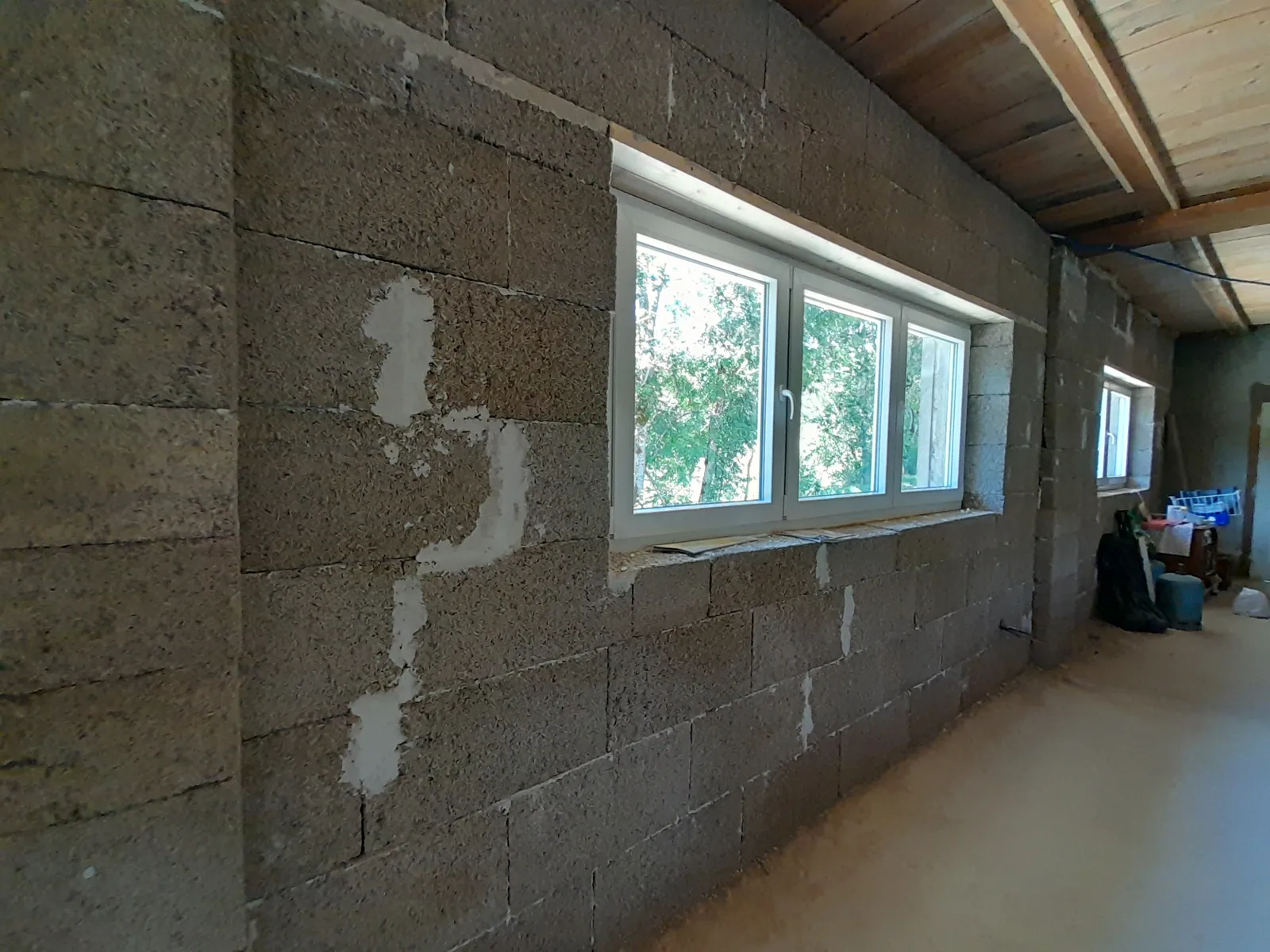
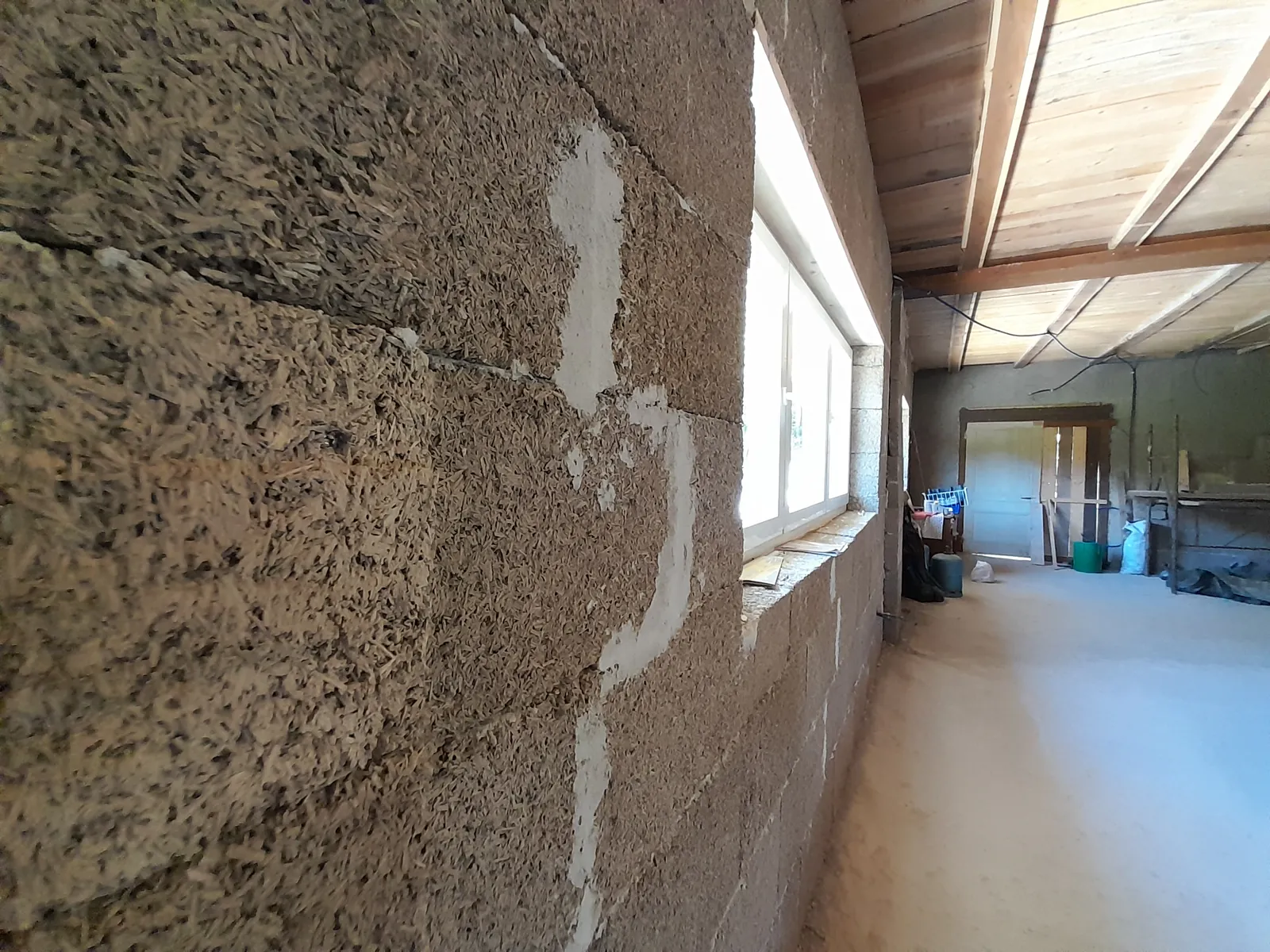
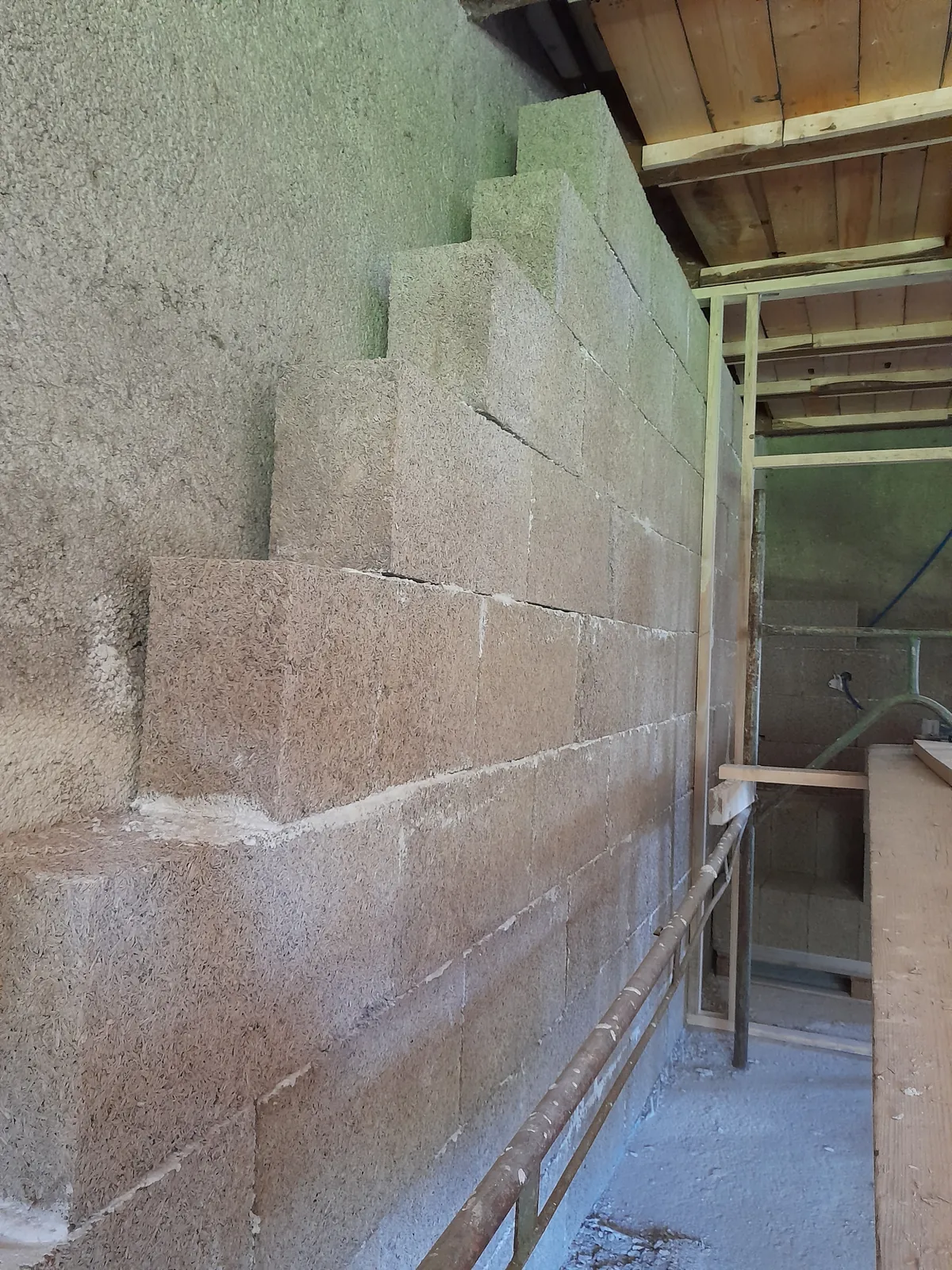
MULTICHANVRE projects of the same kind, carried out by our customers.
Read next
Planning a hemp block project?
Tell us about your project: we will reply within 48 working hours with a tailored costing.