How to keep your home cool in summer: principles and site feedback
A cool house in summer relies on effective insulation, high thermal lag, and suitable moisture regulation. Hempcrete blocks, with their thermal mass and vapour-open structure, help prevent overheating during hot spells. Success also depends on overall design and finishing details.
 By Julien Compain
A cool house in summer relies on effective insulation, high thermal lag, and suitable humidity regulation. Hempcrete blocks, with their thermal mass and vapour-open structure, help to reduce overheating during hot spells. Success also depends on the overall building design and finishing choices.
Thermal principles for keeping your house cool in summer
Keeping a house cool in summer is based on several key thermal principles. One of the most important is thermal lag: the delay between the peak outdoor temperature and when that heat reaches the interior. High thermal lag means heat takes longer to penetrate, smoothing out temperature spikes indoors during the hottest hours.
The material’s ability to store and release heat—its thermal mass—also plays a crucial role. Materials with moderate to high density can absorb heat during the day and release it at night, helping to maintain a more stable indoor temperature.
Humidity regulation is another important factor. Materials that absorb and release moisture help to moderate the perceived temperature, as indoor humidity affects both thermal comfort and air quality. This regulation also improves building durability by reducing the risk of condensation and mould.
Acoustic absorption also contributes to comfort, reducing external noise which can be more noticeable in summer (wind, traffic, outdoor activities). Finally, minimising thermal bridges is essential to avoid rapid heat transfer in certain areas. Proper ventilation—whether natural or mechanical—completes these measures by renewing indoor air and removing accumulated heat.
For example, in a renovation project, particular attention to eliminating thermal bridges at wall-to-window junctions can prevent localised heat ingress that causes discomfort. Similarly, using natural night-time ventilation—by opening windows and vents—helps cool indoor spaces without the need for air conditioning.
Hempcrete blocks: properties that help keep homes cool in summer
Hempcrete blocks offer a range of technical properties that make them well suited to keeping homes cool in summer. They are made from around 84% hemp shiv—the woody core of the hemp stem—combined with a hydraulic binder, Vicat natural prompt cement, which is vapour-open.
Their thermal conductivity is around 0.065 W/(m.K), placing them among the best insulators for limiting heat transfer. This conductivity remains stable when dry, which is the normal condition in use.
Thermal lag varies with block thickness, reaching around 18.5 hours for a 30 cm block. This means it takes nearly 18 and a half hours for heat to pass through the material, delaying internal overheating.
With a density of around 300 kg/m³, hempcrete blocks provide moderate thermal mass, sufficient to smooth out temperature swings. Their ability to regulate indoor humidity helps maintain a relative humidity of around 50–60%, supporting both thermal comfort and healthy living conditions.
The material is also rated B-s1,d0 for fire resistance and A+ for indoor air quality, ensuring greater safety and a healthy atmosphere in the home.
For example, hempcrete blocks can be used in a detached house in the Mediterranean region, where summers are hot and dry. Thanks to their high thermal lag, hempcrete walls delay heat transfer, preventing indoor temperatures from rising too quickly during the day. Humidity regulation also helps reduce the sensation of dry air, improving comfort for occupants without the need for active cooling systems.
Comparing MULTICHANVRE block thicknesses for heat control
The MULTICHANVRE range includes straight-edged blocks in 60 × 30 cm format, available in four main thicknesses to suit different uses and thermal performance needs. The table below shows the main technical characteristics and recommended uses by thickness:
| Block thickness (cm) | Dry R value (m².K/W) | Useful R value (m².K/W) | Thermal lag (h) | Block weight (kg) | Pallet quantity (m²/pallet) | Recommended uses |
|---|---|---|---|---|---|---|
| 10 | 1.5 | 1.4 | 6.1 | 6.5 | 21.6 | Internal (IWI) and external (EWI) wall insulation |
| 15 | 2.3 | 2.1 | 9.25 | 10 | 14.4 | IWI, EWI and partitions |
| 20 | 3.0 | 2.8 | 12.3 | 13 | 10.8 | IWI, EWI, partitions, timber frame infill, floor insulation under screed |
| 30 | 4.6 | 4.2 | 18.5 | 21 | 10.08 | High-performance IWI and EWI, heavyweight partitions, frame infill, floors |
Balancing thickness against the loss of internal floor area (for IWI) is important. Thicker blocks offer better thermal performance and lag, but reduce available living space. The best choice depends on your project and space constraints. The useful R value is the one to use for detailed thermal calculations.
When choosing thickness, consider the type of wall and the room’s function. For example, in a south-facing bedroom in a hot region, a thicker block with higher thermal lag is preferable to limit overheating. In a technical or unheated space, a thinner block may suffice.
Using 30 cm blocks for external wall insulation (EWI) provides effective protection against heat build-up in the structure, while for internal wall insulation (IWI), care must be taken not to reduce living space too much, especially in smaller homes.
For more details on the range, see MULTICHANVRE range: thicknesses and performance.
On-site installation: technical feedback
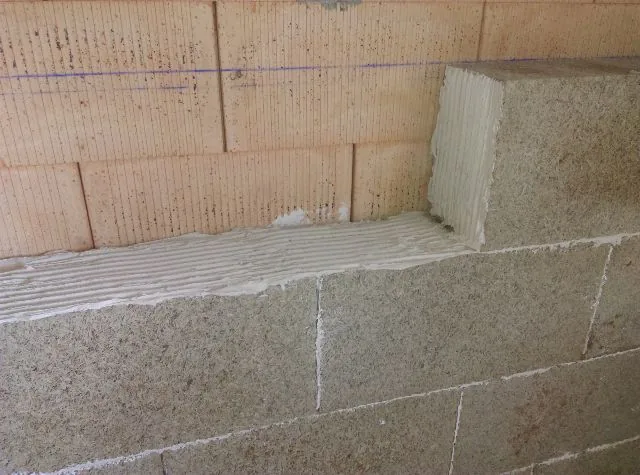
MULTICHANVRE blocks are installed in three main steps. The blocks are laid with a lime-based mortar applied using a notched trowel, with staggered joints to minimise thermal bridges. The blocks are fixed to the substrate using metal brackets, strapping, or fixing discs—typically 2 to 5 fixings per square metre. Finally, a breathable render is applied as a finish.
This method ensures good mechanical stability and continuous insulation. Compatible finishes include spray plaster, lime, and earth plasters for interiors, and lime renders with full mesh reinforcement for exteriors. These finishes help regulate humidity and improve wall durability.
Pallets must be stored carefully: keep them dry, protected from moisture, and do not stack, to preserve block quality. While the material is naturally resistant to rodents, pests, and mould, it is not rot-proof.
It is essential to remember that neither MULTICHANVRE blocks nor the BIOSYS system are load-bearing. They must always be combined with a suitable structural frame (post-and-beam, supporting wall, timber frame, etc.).
The BIOSYS system allows for quick and easy assembly thanks to its dry interlocking tongue-and-groove blocks, with no glue or mortar. It acts as both an insulating permanent formwork and infill for a reinforced concrete structure. For more information, see the BIOSYS building system page.
A comprehensive installation guide is available on the website, useful for preparing and carrying out your project: complete guide to installing hempcrete blocks.
On site, it is important to organise work in the following order: prepare and check substrates, lay the first rows with precise alignment and level, carefully apply mortar in staggered joints, fix the blocks, then apply the renders. This sequence ensures the wall’s thermal performance and durability.
It is also advisable to train teams in these specific techniques, especially joint management and applying breathable renders. Poor application can compromise both thermal performance and moisture control.
Additional factors for a cool house in summer
Beyond insulation, several other factors affect how cool a house stays in summer. Bioclimatic design optimises window orientation to limit direct solar gain and maximise free heat outside the cold season.
Active solar protection (shutters, brise-soleil, planting for shade) is essential to reduce the impact of direct sunlight. Suitable ventilation, whether natural or mechanical, helps remove accumulated heat and renew indoor air.
External finishes should be both breathable and durable to avoid moisture problems and preserve the insulating properties of the material. A detailed thermal study is recommended to confirm choices based on climate, orientation, and building use.
- Bioclimatic design and window orientation
- Solar protection (shading, shutters, brise-soleil)
- Appropriate natural or mechanical ventilation
- Durable, breathable external finishes
- Thermal study for validation
For example, in a densely built-up urban area, window placement can be designed to avoid direct summer sun while maximising winter solar gain. Installing external blinds or green pergolas helps reduce indoor temperatures without sacrificing natural light.
Natural ventilation can be optimised by positioning openings to catch prevailing winds, creating a stack effect to remove heat. Where this is not enough, a mechanical ventilation system (MVHR) with heat recovery can be considered, ensuring it also allows for cooler night-time air exchange.
It is also important to choose external finishes that do not trap moisture, to avoid degrading insulation performance. Lime renders or ventilated cladding are suitable for this purpose.
A full thermal study will take all these factors into account, allowing you to simulate building performance year-round and accurately define insulation thickness, solar protection, and ventilation strategies.
For more on performance, see the guide thermal performance of hempcrete blocks and summer comfort.
Indicative cost and availability of hempcrete blocks for summer insulation
The indicative price of MULTICHANVRE blocks starts at around €35/m² incl. VAT for the 10 cm thickness, rising with greater thickness. These prices must be confirmed by a quote tailored to your project.
We manufacture the blocks at our Mérey-sous-Montrond factory in Bourgogne-Franche-Comté, using locally grown hemp shiv. Distribution is via a nationwide network of builders' merchants, making the materials widely accessible.
We respond to commercial enquiries within 48 working hours, ensuring a prompt service for tradespeople, architects, and private clients.
For a detailed quote, you can request a quote for hempcrete blocks online.
Frequently asked questions
What thickness of hempcrete block should I choose to keep my house cool in summer?
The block thickness depends on the level of insulation required. The 30 cm MULTICHANVRE block offers a thermal lag of around 18.5 hours, which is useful for delaying heat ingress. The right balance between thickness, living space, and performance depends on your project.
How do hempcrete blocks help reduce summer overheating?
Hempcrete blocks combine good thermal mass (thanks to their density) with high thermal lag, delaying heat penetration. Their humidity regulation also improves comfort by limiting indoor moisture.
Can hempcrete blocks be used in renovation to improve summer comfort?
Yes, MULTICHANVRE blocks can be installed as internal (IWI) or external (EWI) wall insulation, making them suitable for renovation. Installation follows a detailed guide using lime-based mortar and breathable renders.
What is the difference between the MULTICHANVRE and BIOSYS systems?
MULTICHANVRE is an insulating block to be laid with mortar, available in several thicknesses, without technical certification. BIOSYS is a dry interlocking system, acting as permanent formwork for reinforced concrete structures.
Are hempcrete blocks resistant to rodents and mould?
The blocks are naturally resistant to rodents, pests, and mould due to their composition. However, they are not rot-proof: pallets must be stored dry and protected.
Which renders are compatible with hempcrete block walls to help keep interiors cool?
Lime-based renders, earth plasters, or spray plaster are all compatible and allow the wall to breathe, helping to regulate humidity and indoor temperature.
Do hempcrete blocks completely eliminate thermal bridges in EWI?
No, external wall insulation (EWI) with hempcrete blocks greatly reduces thermal bridges thanks to bonded masonry and the insulating thickness, but the mortar joint remains a thermal bridge to consider.
Read next
Planning a hemp block project?
Tell us about your project: we will reply within 48 working hours with a tailored costing.