Hempcrete block or concrete block: analysis and site feedback
The choice between hempcrete block and concrete block depends on your priorities for thermal insulation, installation, cost and intended use. Hempcrete blocks provide natural insulation with moisture regulation, but require a load-bearing structure. Concrete blocks are structural and quicker to lay, but offer less insulation. Site feedback highlights these practical differences.
 By Julien Compain
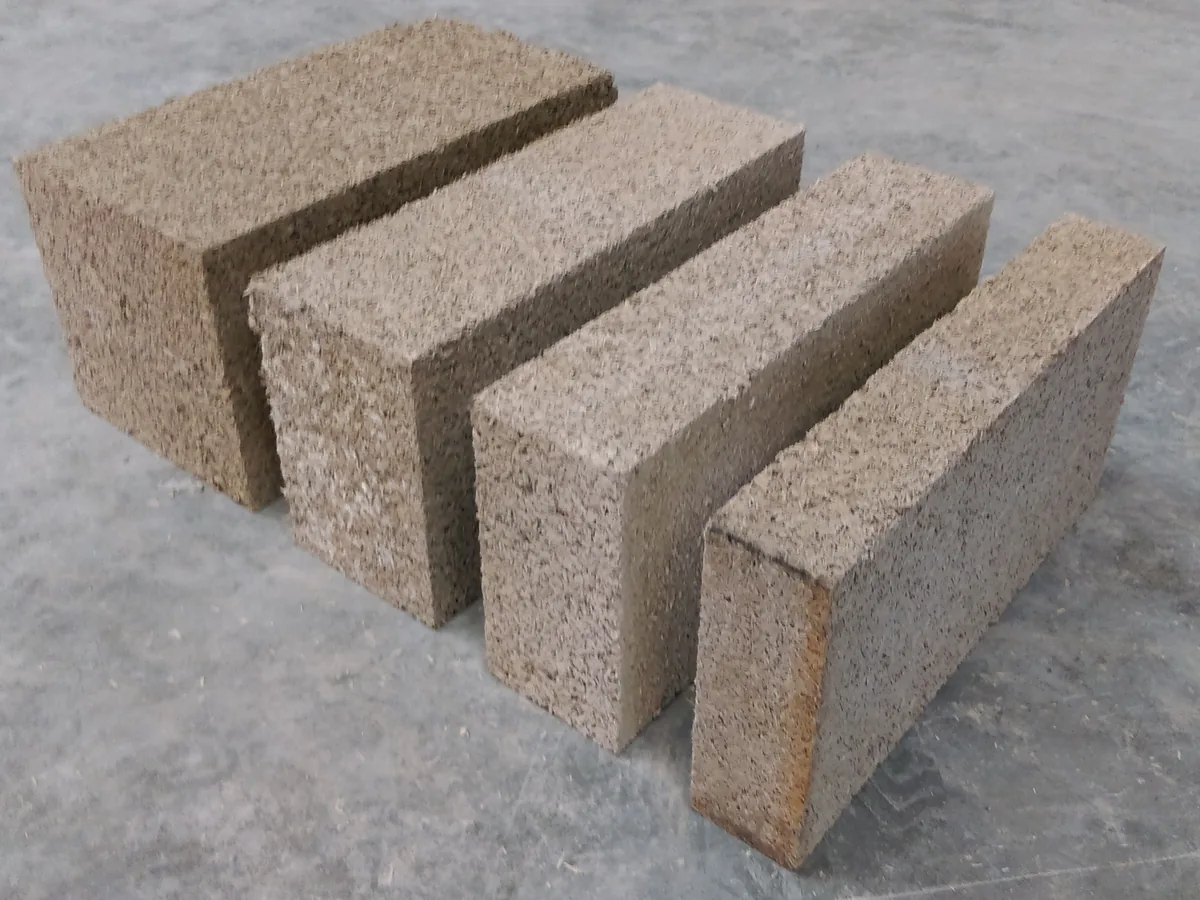
The choice between hempcrete block and concrete block depends on your priorities for thermal insulation, installation method, cost and intended use. Hempcrete blocks provide natural insulation with moisture regulation, but require a load-bearing structure. Concrete blocks are structural and quicker to lay, but offer less insulation. Site feedback highlights these practical differences.
Overview: hempcrete blocks vs concrete blocks
Hempcrete blocks are made primarily from hemp shiv, the woody core of the hemp stem, combined with a mineral binder known as Vicat natural prompt cement. With 84% hemp shiv content, these blocks offer specific thermal insulation and hygrothermal regulation properties. Hempcrete blocks are designed mainly for insulation and infill; they are not load-bearing. We manufacture them locally at our Mérey-sous-Montrond plant in Bourgogne-Franche-Comté, using exclusively French raw materials.
Traditional concrete blocks are masonry units made industrially from mainly mineral components. Their main function is structural, supporting the building’s loads. Widely used in construction, they often form the load-bearing walls.
- Hempcrete block: insulating, infill material, non-load-bearing
- Concrete block: structural, load-bearing element
- Hempcrete block made locally from French hemp supply chain
- Concrete block produced industrially, used for frames and load-bearing walls
This functional distinction is crucial when choosing for a project. Hempcrete blocks do not replace concrete blocks for structural roles, but offer a high-performance alternative for insulation, suitable for timber frame builds or existing load-bearing walls.
For more technical details on these materials, see our comparison with concrete blocks and other materials.
Thermal performance and hygrothermal comfort
The thermal resistance of hempcrete blocks varies with thickness. For example, the MULTICHANVRE range offers blocks from 10 to 30 cm thick, with useful thermal resistance values from 1.4 to 4.2 m².K/W. By comparison, a hollow concrete block has a lower thermal resistance, usually less than 1 m².K/W, so often requires additional insulation.
Beyond insulation, hempcrete blocks naturally regulate wall humidity, helping to balance indoor moisture. This property improves overall comfort by reducing condensation risk and improving air quality. The material also offers significant thermal lag—up to 18.5 hours for the 30 cm block—helping to smooth temperature swings and improve summer comfort.
Both materials limit thermal bridging, but hempcrete blocks, laid with adhesive mortar and staggered joints, further reduce bridges compared to traditional concrete block masonry. However, neither material eliminates thermal bridging entirely.
For internal wall insulation (IWI), hempcrete blocks require significant thickness, which can reduce usable floor space. For example, to achieve a useful R above 2 m².K/W, you need at least a 15 cm block. This trade-off between performance and space should be considered at the design stage.
A cross-section diagram of a wall insulated with hempcrete block clearly shows the layers and their thicknesses, helping to understand the thermal performance and comfort provided.
Mechanical properties and structural role
Concrete blocks are recognised load-bearing elements. They support the building’s vertical loads, making them a go-to material for new builds and structural walls. Their use is integral to architectural designs that rely directly on their mechanical strength.
Hempcrete blocks, by contrast, do not take structural loads. They must always be combined with a load-bearing structure—whether a supporting wall, timber frame, or reinforced concrete post-and-beam system. This requirement is fundamental and means hempcrete blocks are used for insulation or infill only.
The BIOSYS system
The BIOSYS system is a construction solution using dry-stacked, interlocking hempcrete blocks combined with a reinforced concrete post-and-beam frame. This allows for fast, precise assembly without mortar. The system combines insulation with a concrete structure, offering a technical alternative for new builds.
This approach changes architectural design and site management, as the concrete load-bearing frame must be planned in advance. Hempcrete blocks have good rigidity and fire resistance (B-s1,d0 rating), but durability depends on proper storage and installation.
On-site installation: steps and considerations
Installing MULTICHANVRE hempcrete blocks involves three steps: applying a lime-based mortar with a notched trowel, laying the blocks with staggered joints, then mechanically fixing them to the substrate with brackets (2 to 5 per m²). This ensures good adhesion and a wall ready for rendering.
The BIOSYS system stands out for its dry interlocking assembly, using grooves and tongues. This mortar- and adhesive-free method simplifies and speeds up installation, but is reserved for walls with a reinforced concrete structure.
By comparison, concrete blocks are laid in the traditional way: set in mortar, aligned, and left to cure to ensure stability and strength.
- MULTICHANVRE hempcrete block: adhesive mortar, staggered joints, fixed with brackets
- BIOSYS system: dry interlocking, rapid assembly without mortar
- Concrete block: laid in mortar, requires curing time
- Hempcrete block pallets must be stored sheltered, dry, and not stacked
- Careful handling required due to the weight and relative fragility of hempcrete blocks
Installation speed depends on the system. BIOSYS, with a rate of around 30 m² per day (maximum, on a suitable site) for two workers, offers a fast pace. MULTICHANVRE takes longer due to mortar and fixings. Concrete blocks are generally quicker to install thanks to their modularity and structural function.
For a step-by-step guide, see our comprehensive hempcrete block installation guide.
Comparison: insulation, weight, dimensions and packaging
| Characteristic | MULTICHANVRE hempcrete block 10 cm | MULTICHANVRE hempcrete block 15 cm | MULTICHANVRE hempcrete block 20 cm | MULTICHANVRE hempcrete block 30 cm | Standard concrete block (estimate) |
|---|---|---|---|---|---|
| Useful thermal resistance (m².K/W) | 1.4 | 2.1 | 2.8 | 4.2 | ≈ 0.7 to 1.0 |
| Average weight per block (kg) | 6.5 | 10 | 13 | 21 | ≈ 15 to 20 |
| Block size (cm) | 60 × 30 (variable thickness) | ≈ 50 × 20 × 20 | |||
| Area covered per pallet (m²) | 21.6 | 14.4 | 10.8 | 10.08 | Variable, generally over 10 |
| Thermal conductivity λ (W/(m.K)) | ≈ 0.065 | ≈ 0.7 | |||
| Installation rate | Varies by system, BIOSYS 30 m²/day | Fast, structural function | |||
| Indicative price per m² | ≈ €35 incl. VAT (10 cm) | Increases with thickness | Variable, generally lower than hempcrete block | ||
This table summarises key data from the technical data sheet and site observations. It shows that hempcrete blocks, while lighter than some concrete blocks, require greater thickness to achieve equivalent insulation. The BIOSYS system enables a high installation rate thanks to its dry interlocking design.
For more details, see our page on the MULTICHANVRE range and thicknesses.
Environmental impact and sustainable choice
The hemp used in our blocks is grown locally in Franche-Comté, with a growth cycle of around 120 days, requiring no irrigation or chemical treatments. This crop improves soil quality, as its taproots break up and clean the ground.
The carbon captured by the plant during growth remains stored in the hemp shiv within the block. This storage helps reduce the material’s carbon footprint, though the finished product cannot be described as fully low-carbon. The formulation includes a mineral binder, Vicat natural prompt cement, which is not entirely natural in origin.
Hempcrete blocks are renewable, recyclable, and naturally resistant to rodents and mould. They have a lower carbon footprint compared to some traditional cement-based materials.
By contrast, concrete blocks are cement-based, and their manufacture generates higher CO₂ emissions. Hempcrete blocks can therefore be part of a sustainable approach, especially in the context of RE2020 (France’s environmental building regulation), for which a detailed thermal study is recommended.
For more information, see our page Hemp as a material: the French supply chain and environmental impact.
Site feedback: points to anticipate and best practice
One key point to consider is the balance between insulation thickness and loss of usable floor area with IWI. Hempcrete blocks require more thickness than mineral wool to achieve the same R-value, which can reduce available interior space.
Joint management is also crucial for limiting thermal bridges. MULTICHANVRE hempcrete blocks use adhesive masonry with staggered joints, while BIOSYS uses dry interlocking, providing better insulation continuity.
Hempcrete block pallets must be stored sheltered and dry, and not stacked, to prevent damage. This is separate from their natural resistance to rodents and mould, and does not replace good storage practice.
Interior and exterior finishes must be suitable: lime, earth or clay plasters indoors, lime renders outdoors. These finishes respect the material’s moisture-regulating properties and ensure durability.
Coordination with the load-bearing structure and other trades is essential, especially for integrating services and mechanical fixings.
- Anticipate loss of floor area with IWI due to hempcrete block thickness
- Take care with jointing to limit thermal bridges
- Store pallets sheltered, dry and not stacked
- Choose finishes compatible with hempcrete blocks
- Plan coordination with the load-bearing structure and other trades
- Avoid common mistakes by following technical guides
To support professionals, we provide various documents in the Technical documentation section.
Cost and availability: access and logistics
The indicative price for hempcrete blocks starts at around €35 incl. VAT per square metre for 10 cm thickness. This price increases with thickness and should always be confirmed with a personalised quote. Concrete blocks, as a standard industrial product, are generally cheaper per square metre, but do not offer the specific benefits of hempcrete blocks.
We do not sell direct: our blocks are distributed through our network of builders’ merchants across France. Commercial enquiries are answered within 48 working hours, helping you plan your project.
Our main manufacturing and distribution area covers Bourgogne-Franche-Comté, Doubs, Jura and Besançon, but delivery is available throughout France.
Logistics costs, especially for transport and handling, should be factored into your site budget due to the weight and volume of pallets.
For a detailed cost overview, see our hempcrete block price guide.
Frequently asked questions
Can hempcrete blocks fully replace a concrete block wall?
No, hempcrete blocks are not load-bearing. They are used for insulation and infill within a load-bearing structure such as a timber frame or existing structural wall. Concrete blocks are structural elements.
What thickness of hempcrete block is needed for insulation equivalent to a hollow concrete block?
Hempcrete blocks generally need to be thicker to achieve comparable thermal resistance. For example, the MULTICHANVRE 20 cm block provides a useful R-value of around 2.8 m².K/W, exceeding the usual thermal performance of hollow concrete blocks.
What are the storage requirements for hempcrete blocks on site?
Hempcrete block pallets must be stored sheltered, dry and not stacked to prevent rot. This is separate from their natural resistance to rodents and mould.
How does BIOSYS installation compare to MULTICHANVRE blocks?
BIOSYS is a dry interlocking system, with no adhesive or mortar, used with a reinforced concrete post-and-beam frame. MULTICHANVRE requires adhesive mortar with staggered joints and mechanical fixings.
What are the benefits of hempcrete blocks for indoor comfort?
In addition to thermal insulation, hempcrete blocks naturally regulate indoor humidity thanks to their moisture-buffering capacity, provide significant thermal lag and moderate sound absorption, all contributing to overall comfort.
Are hempcrete blocks compatible with all types of interior finishes?
Yes, they are compatible with lime, earth, clay or spray-applied plaster finishes, provided these are suitable for the material’s moisture properties and correct installation and drying practices are followed.
What is the installation rate for hempcrete blocks on site?
For the BIOSYS system, a team of two can install around 30 m² per day (maximum, on a suitable site), including the structure. The rate for MULTICHANVRE depends on mortar preparation, fixings and rendering.
Read next
Planning a hemp block project?
Tell us about your project: we will reply within 48 working hours with a tailored costing.