Hemp block or cork: a complete guide to choosing the right solution
Choosing between hemp blocks and cork depends on technical factors: thermal resistance, required thickness, installation method, structural compatibility, moisture regulation and durability. This guide provides a comprehensive checklist to compare these materials before making your decision.
 By Julien Compain
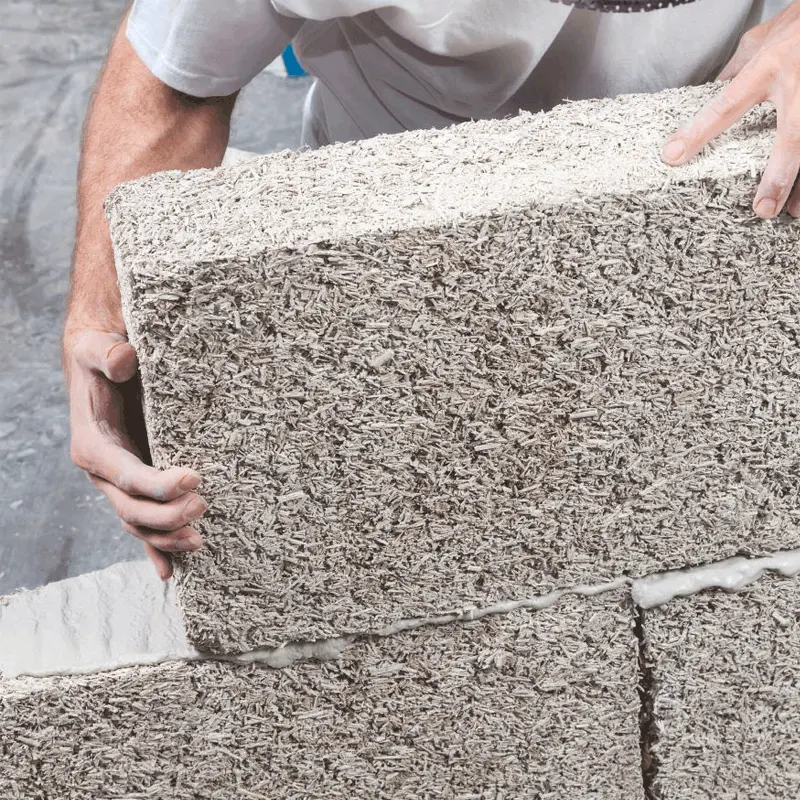
The choice between hempcrete block and cork depends on technical criteria: thermal resistance, required thickness, installation method, structural compatibility, moisture regulation and durability. This guide provides a comprehensive checklist to help you compare these materials before making a decision.
Overview of hempcrete blocks and cork
Hempcrete block is a bio-based material made primarily from hemp shiv—the woody core of the hemp stem—combined with a mineral binder, in this case Vicat natural prompt cement. This mix is around 84% hemp shiv with a vapour-open hydraulic binder. The hemp is grown in France, especially in Franche-Comté, without irrigation or chemical treatments, and reaches maturity in about 120 days. The crop also helps to break up compacted soils thanks to the hemp’s deep taproots.
Cork, on the other hand, comes from the bark of the cork oak. It is a natural, renewable material valued for its insulating properties and ability to regulate humidity. Cork is typically sold as panels or blocks, depending on the manufacturer, and is suitable for a range of construction and renovation uses.
Hempcrete blocks are available in standard sizes, notably 60 × 30 cm for the MULTICHANVRE range, in several thicknesses (10, 15, 20, 30 cm), and for BIOSYS as a 60 × 30.8 × 30 cm block. Cork is supplied as rigid or semi-rigid panels, with sizes and thicknesses varying by product.
Typically, hempcrete blocks are used for internal wall insulation (IWI) or external wall insulation (EWI), for partition walls, floor insulation beneath screeds, or as infill for timber frames. Cork is also used for both internal and external insulation, as well as under roofs, floors, and sometimes for acoustic insulation. The choice between these two materials depends on your project, technical constraints and the required performance.
Thermal performance compared: thickness and thermal resistance
| Thickness (cm) | Hempcrete block MULTICHANVRE R dry (m².K/W) | Hempcrete block MULTICHANVRE R effective (m².K/W) | Thermal lag (h) | Block weight (kg) | Pallet coverage (m²/pallet) | Recommended use |
|---|---|---|---|---|---|---|
| 10 | 1.5 | 1.4 | 6.1 | 6.5 | 21.6 | floors, partitions |
| 15 | 2.3 | 2.1 | 9.25 | 10 | 14.4 | infill, partitions |
| 20 | 3.0 | 2.8 | 12.3 | 13 | 10.8 | IWI, standard EWI |
| 30 | 4.6 | 4.2 | 18.5 | 21 | 10.08 | high-performance EWI, construction |
Hempcrete block has a thermal conductivity of around 0.065 W/(m.K) when dry. To achieve an effective thermal resistance, for example an R value of 3.0 m².K/W, you’ll need at least 20 cm thickness. Thermal lag is also important, with the ability to delay temperature changes by up to 18.5 hours at 30 cm thickness, which helps keep interiors cooler in summer.
By comparison, cork generally offers lower thermal conductivity, around 0.04 W/(m.K) depending on the product. This means you can achieve the same thermal resistance with less thickness, which can help minimise loss of living space, especially for internal wall insulation.
The thickness you choose should always be considered alongside available space and building constraints. For IWI, hempcrete blocks require more thickness than a cork panel for the same R value, so you may need to balance performance against usable space. For more detail, see our practical guide to choosing hempcrete block thickness.
Installation and structural compatibility
The MULTICHANVRE hempcrete block has straight edges and is laid in bonded masonry using a lime-based mortar, applied with a notched trowel. Installation is a three-step process: apply mortar, assemble with staggered joints, then fix with brackets before rendering. This system is suitable for IWI, EWI, partitions, floors and timber frame infill. The BIOSYS block is a dry-stacked system with tongue-and-groove joints, requiring no glue or mortar, and is combined with a reinforced concrete post-and-beam structure. This method allows for quick, precise assembly and acts as an insulating permanent formwork.
Hempcrete block is not load-bearing. It must always be used with a supporting structure: a backing wall, timber frame, or reinforced concrete for BIOSYS. This requirement should be considered from the design stage. Cork panels are also non-structural, but are often easier to install, usually by adhesive or mechanical fixings to the substrate.
Hempcrete blocks are suitable for renovation, especially on old stone walls, but require careful assessment of substrate compatibility and moisture management. Cork can also be used in these situations, sometimes with a quicker installation process.
For more details on installation and structural compatibility, see our comprehensive guide to installing hempcrete blocks.
Moisture regulation and indoor air quality
Moisture regulation is a well-known benefit of hempcrete block. Its formulation allows it to absorb and slowly release moisture, helping to maintain relative humidity within a comfortable range. This helps prevent condensation and mould growth, improving indoor air quality. The material is also highly vapour-open, compatible with lime or earth renders.
Cork also has moisture-regulating properties, with good water resistance and variable vapour permeability depending on density. It is recognised as suitable for damp environments, which can be an advantage when renovating old, moisture-prone walls.
In damp environments or on stone walls, the choice between hempcrete block and cork should be made with careful consideration of moisture management and substrate compatibility. A detailed technical assessment is recommended, especially for hempcrete block.
Durability, resistance to biological attack and environmental impact
Hempcrete block is naturally resistant to rodents, pests and mould, which contributes to its long-term durability. However, it is not rot-proof. It must be stored dry, under cover, and not stacked, to preserve its properties before installation. This storage requirement is separate from its natural resistance to biological attack.
The raw materials for hempcrete block are 100% French, with a bio-based formulation of 84% hemp shiv. The mineral binder is a natural prompt cement, vapour-open. The hemp supply chain is localised in Bourgogne-Franche-Comté, with crops grown without chemical treatments or irrigation.
Hemp absorbs carbon as it grows, which remains locked in the block after manufacture. However, a full assessment of the finished material’s carbon footprint should not be assumed without precise evaluation. Cork, harvested from cork oak bark, is also renewable and recyclable, with a recognised environmental benefit, though this depends on production and transport methods.
Indicative costs and material availability
The indicative price for hempcrete block starts at around €35/m² incl. VAT for 10 cm thickness, with higher costs for greater thickness. These prices are for guidance only and should be confirmed by a quote, as they depend on project specifics and quantities.
Cork is available from suppliers with prices varying according to density, thickness and form (panels or blocks). These prices should be checked locally with suppliers and according to quantity.
Hempcrete blocks are manufactured in France, at Mérey-sous-Montrond (Doubs), and distributed nationwide through a network of builders’ merchants. Commercial enquiries are answered within 48 working hours, with technical support available.
To compare costs and choose according to your location and logistics, we recommend requesting a personalised quote via our Request a quote page.
Typical applications and choosing for your project
Hempcrete block can be used for both internal (IWI) and external (EWI) wall insulation. For IWI, the required thickness affects usable floor area, which is an important consideration. For EWI, hempcrete block greatly reduces thermal bridging, especially thanks to bonded masonry with staggered joints, though some bridging can still occur at the joints.
Cork, with its often thinner panels, provides effective insulation for both EWI and IWI with less impact on floor space. Both materials are compatible with lime-based renders, supporting vapour-open wall construction.
Hempcrete block is also suitable for partitions, floor insulation beneath screeds, and timber frame infill. The BIOSYS system, with its interlocking blocks, enables complete construction combined with a reinforced concrete structure.
To meet regulatory requirements, especially RE2020 (France’s environmental building regulation), you need to consider the effective thermal resistance value and carry out a detailed thermal study. Our dedicated applications page gives full details of possible uses for hempcrete block.
Final checklist for choosing between hempcrete block and cork
- Assess the required thermal performance for your project and available space. See the technical comparison between hempcrete block and cork.
- Evaluate available thickness and space constraints, especially for IWI. The practical guide to choosing hempcrete block thickness can help with this decision.
- Check compatibility with the load-bearing structure and existing substrates. Hempcrete block requires a suitable structure, unlike cork.
- Consider site environmental conditions, especially moisture and wall type (old, stone, concrete).
- Take into account local material availability, delivery times and indicative costs.
- Contact the technical team for specific questions and carry out a thermal study tailored to your project.
This analysis process helps you make a technical, pragmatic choice between hempcrete block and cork, taking into account performance, applications and site constraints.
For more on installation, characteristics and practical advice, see our complete technical product sheet for hempcrete block insulation (in French) and our French hemp supply chain and environmental impact.
Frequently asked questions
Can hempcrete block replace cork in all insulation situations?
Hempcrete block and cork have different characteristics: hemp requires more thickness for the same insulation and needs a supporting structure. The choice depends on technical context and project. A thermal study is recommended.
What thickness of hempcrete block is needed for insulation equivalent to cork?
Generally, hempcrete block needs to be thicker than cork to achieve the same thermal resistance, which can reduce usable floor area for IWI. Exact values vary by product.
Is hempcrete block suitable for damp or stone walls?
Hempcrete block has good moisture-regulating properties, but its use on damp walls should be carefully assessed. Cork may be more suitable in some cases. See our technical guides.
What are the installation differences between hempcrete block and cork?
MULTICHANVRE hempcrete block is laid with lime mortar and staggered joints and usually needs a render. Cork can be installed as panels, glued or nailed. BIOSYS block is dry-stacked with a reinforced concrete structure.
Is hempcrete block recyclable and renewable?
Hempcrete block is made from French-grown hemp shiv and a mineral binder. It is renewable and recyclable, with natural resistance to rodents. Cork is also renewable, made from cork oak bark.
Does hempcrete block reduce thermal bridging like cork?
Hempcrete block greatly reduces thermal bridging thanks to bonded masonry with staggered joints, but some bridging can still occur at the joints, as with cork.
What renders are compatible with hempcrete block and cork?
For hempcrete block, lime, earth or sprayed plaster renders are recommended. Cork also accepts lime-based renders. These choices affect vapour permeability and durability.
Read next
Planning a hemp block project?
Tell us about your project: we will reply within 48 working hours with a tailored costing.