Sprayed hempcrete or hemp block: choosing the right solution
The choice between sprayed hempcrete and hempcrete blocks depends on technical requirements, site conditions and installation constraints. Blocks offer fast, structured installation, while spraying is better suited to irregular shapes and complex surfaces.
 By Julien Compain
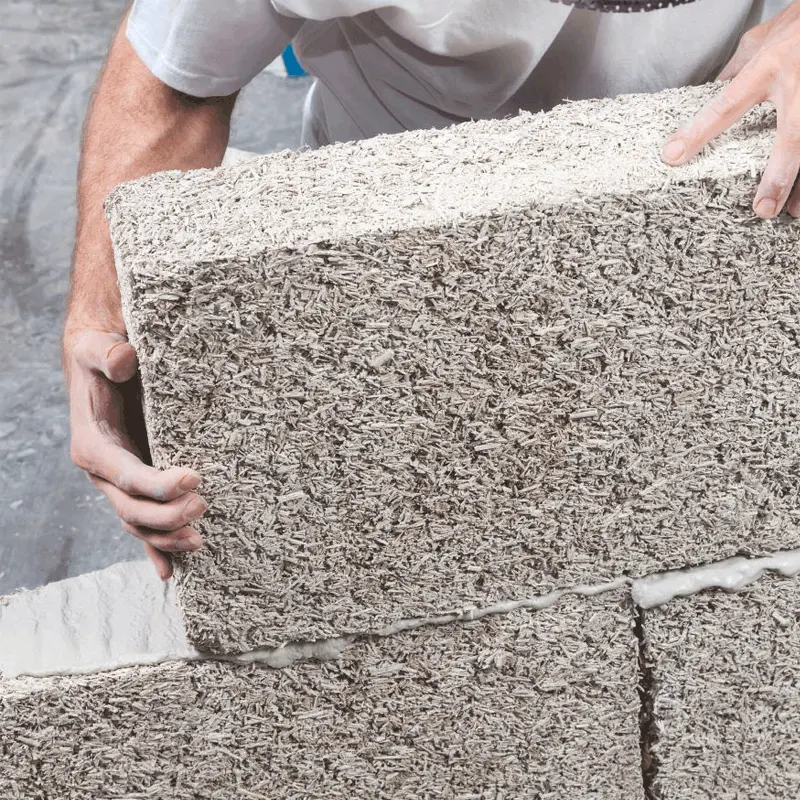
The choice between sprayed hempcrete and hempcrete blocks depends on technical requirements, site conditions and installation constraints. Blocks offer fast, structured installation, while spraying is better suited to irregular shapes and complex surface treatments.
Material composition and characteristics
Hempcrete blocks are made up of 84% hemp shiv—the woody core of the hemp stem—combined with Vicat natural prompt cement, a vapour-open hydraulic binder. This composition ensures good vapour permeability and helps regulate indoor humidity. Sprayed hempcrete uses a similar mix of hemp shiv and hydraulic binder, but the exact proportions and properties can vary depending on the manufacturer and chosen mix.
In terms of density, MULTICHANVRE blocks are around 300 kg/m³, with a dry thermal conductivity of about 0.065 W/(m.K). These values can differ for sprayed hempcrete, which is often more variable depending on spray density and application. The fire reaction of the blocks is rated B-s1,d0, equivalent to M1, a valued feature for fire safety. Both solutions naturally resist rodents, thanks to the properties of hemp and the absence of chemical treatments.
The vapour-open hydraulic binder plays a key role in durability and moisture management: it allows the wall to breathe, preventing internal condensation and the risks associated with trapped moisture.
Thermal performance and hygrothermal comfort
MULTICHANVRE blocks are available in four thicknesses, each with a dry thermal resistance (R) and a calculated useful value for thermal studies:
- 10 cm: dry R 1.5, useful R 1.4 m².K/W, thermal lag 6.1 hours
- 15 cm: dry R 2.3, useful R 2.1 m².K/W, thermal lag 9.25 hours
- 20 cm: dry R 3.0, useful R 2.8 m².K/W, thermal lag 12.3 hours
- 30 cm: dry R 4.6, useful R 4.2 m².K/W, thermal lag 18.5 hours
Sprayed hempcrete also offers good thermal performance, but the thermal lag and exact resistance depend on spray density and applied thickness. Both systems regulate indoor humidity thanks to vapour permeability and the hygroscopic nature of hemp, contributing to lasting hygrothermal comfort.
Summer comfort is enhanced by thermal lag, which is particularly high in the thickest blocks (up to 18.5 hours for 30 cm). For sprayed hempcrete, lag is generally lower and less standardised, as it depends on density and finish. Blocks also provide continuous insulation, greatly reducing thermal bridging, though installation with mortar or interlocking does not eliminate all bridges.
It should be noted that to achieve R values equivalent to mineral wool, hempcrete must be significantly thicker, which can reduce usable floor area for internal insulation—a point to consider when choosing materials (full technical comparison).
Installation: laying, time and site constraints
MULTICHANVRE blocks are installed in three stages: apply a lime-based mortar (M.B.M. mortar) with a notched trowel, lay the blocks in a staggered bond with at least one third overlap (20 to 40 cm), then fix to the substrate using brackets, straps or washers, followed by a finishing render. The first course is laid on a 2 cm waterproof mortar bed to provide a capillary break and level base. BIOSYS blocks are dry-stacked using a tongue-and-groove interlocking system, with no glue or mortar, making assembly quicker and easier. This system acts as permanent insulating formwork for a reinforced concrete post-and-beam structure.
Sprayed hempcrete is applied directly to the substrate or onto mesh using a spraying machine, allowing the material to follow irregular or complex surfaces. This technique is especially suited to renovating old walls or non-standard architectural forms. It requires specialist equipment and know-how to ensure the layer is even, well-bonded and at the right density.
In all cases, neither blocks nor sprayed hempcrete are loadbearing: they must be combined with a structural frame, whether post-and-beam, supporting wall, or timber or metal frame. BIOSYS blocks can be installed at a rate of up to 30 m² per day by two workers on a suitable site. Sprayed hempcrete takes longer, depending on volume, complexity and desired finish.
The required tools differ: blocks need only standard masonry tools and mortar, while spraying requires a dedicated machine and trained personnel. For more details on installation, see our reliable hemp block installation guide.
Indicative costs and budget management
Indicative retail prices for MULTICHANVRE blocks, as seen at builders' merchants, vary by thickness:
- 10 cm: around €35/m² incl. VAT
- 15 cm: around €51/m² incl. VAT
- 20 cm: around €66/m² incl. VAT
- 30 cm: around €95/m² incl. VAT
These prices should be confirmed by requesting a quote from our partner merchant network. They do not include installation or any accessories. Sprayed hempcrete costs vary depending on labour, equipment hire or depreciation, and site complexity. Spraying can be more expensive for small areas or sites with difficult access.
Budget control also depends on project volume and geometry. Blocks are supplied on standard pallets, allowing precise planning of quantities, whereas spraying requires a more variable estimate of required volumes. Block delivery times average around one week, depending on location and time of year.
Environmental impact and stored carbon
The hemp used for the blocks is grown in Franche-Comté, without irrigation or chemical treatments, across around 200 farms. Hemp cultivation captures a significant amount of atmospheric carbon during growth, which remains stored in the shiv within the blocks. Vieille Matériaux issues carbon credits each year in recognition of this carbon sink.
However, this balance should be put into perspective, as life cycle analysis assumes that the captured carbon is released at the end of the material's life. The hydraulic binder, though natural, is not impact-free. Sprayed hempcrete shares these characteristics, though formulations may vary between suppliers.
For more information on the supply chain and environmental impact, see our page on the French hemp sector and environmental assessment.
Durability, maintenance and resistance to damage
Our hempcrete blocks have been used on our own reference sites since 2017, with a track record in France dating back to the 1980s. Documented issues remain very rare. The material is naturally resistant to rodents and pests, thanks to the nature of the hemp shiv and the absence of attractive substances.
However, the block is not rot-proof. Pallets must be stored under cover, in dry conditions, and not stacked, to preserve product quality before installation. On site, it is important to protect hempcrete work from water splashes, especially in wet rooms, for example with a compliant plasterboard lining.
Compatible finishes include sprayed plaster, lime or earth renders, and plasterboard for interiors. Regular maintenance is recommended to keep renders in good condition and ensure the longevity of the structure (lifespan and maintenance of a hemp block wall).
Technical comparison table: sprayed hempcrete vs. blocks
| Criterion | Hempcrete blocks (MULTICHANVRE / BIOSYS) | Sprayed hempcrete |
|---|---|---|
| Composition | 84% hemp shiv + Vicat natural prompt cement, vapour-open hydraulic binder | Hemp shiv + hydraulic binder, formulation varies by supplier |
| Density | Approx. 300 kg/m³ (MULTICHANVRE blocks) | Varies with spray density |
| Thermal conductivity λ dry | ≈ 0.065 W/(m.K) (MULTICHANVRE blocks) | Variable, generally similar to blocks |
| Thermal resistance R | 1.5 to 4.6 m².K/W depending on thickness (10 to 30 cm) | Varies with thickness and density, less standardised |
| Thermal lag | Up to 18.5 h for 30 cm (blocks calculated to standard formula) | Approx. 8 to 10 h (internal data, not standardised) |
| Fire reaction | B-s1,d0 (M1) | Varies by formulation, generally similar |
| Rodent resistance | Natural | Natural |
| Installation | Dimensioned blocks, lime mortar for MULTICHANVRE, dry interlocking for BIOSYS | Machine spraying, suited to complex shapes |
| Loadbearing structure | Required (post-and-beam, frame, supporting wall) | Required |
| Installation rate | Up to 30 m²/day for BIOSYS with two workers, variable for MULTICHANVRE | Varies by site, often slower |
| Indicative price | €35 to €95/m² incl. VAT depending on thickness (blocks) | Variable, depends on equipment and labour |
| Storage | Pallets under cover, dry, not stacked | Not applicable (material sprayed on site) |
| Finishes | Plaster, lime, earth, plasterboard | Compatible renders, depending on chosen finish |
| Prohibited uses | Roof, lofts (BIOSYS U block only for gable formwork) | Roof, lofts |
Suitability for use and regulatory limitations
BIOSYS blocks are intended for new builds with a reinforced concrete post-and-beam structure, providing distributed insulation for external walls of detached houses and small commercial buildings, up to one upper floor (R+1) with a lightweight roof. MULTICHANVRE blocks are designed for internal insulation (IWI), external insulation (EWI), partitions, floor insulation and timber frame infill. Neither BIOSYS nor MULTICHANVRE blocks are loadbearing and must always be combined with a structural frame.
Neither range currently has a valid technical approval or final certification. MULTICHANVRE is undergoing certification, with an ATEx (technical assessment) in progress for internal insulation only, with no date or extension to other uses. The BIOSYS Technical Approval has expired and renewal is underway, with no known date.
It is important to note that use in roofs and lofts is prohibited for these materials. The BIOSYS U ring beam block is only intended for gable slope formwork in masonry.
For specific cases, especially in renovation or complex builds, a tailored thermal study is recommended to validate the performance and suitability of hempcrete.
Practical choice: when to choose spraying or blocks
For renovation, especially on old, uneven or complex walls, sprayed hempcrete adapts better to surfaces and allows a uniform finish without major cutting or adjustments. It is a flexible solution for unusual projects.
For new builds with post-and-beam or timber frame structures, hemp blocks provide a dimensioned solution for fast, controlled installation. The BIOSYS system, with its dry interlocking, makes assembly easier and reduces site time on suitable projects.
Speed of installation is a key advantage of blocks, especially BIOSYS, with rates of up to 30 m² per day for two workers. Spraying requires more preparation and specialist labour.
Finally, an official BIOSYS installation training course is available from our partner Vicat. For MULTICHANVRE, there is no official installer network or dedicated training, but we can recommend experienced tradespeople in different regions.
For any specific request or quote, we invite you to request a free quote to be directed to the partner merchant nearest your site.
Frequently asked questions
What is the main difference between sprayed hempcrete and blocks?
Sprayed hempcrete is applied in situ as a layer, ideal for irregular shapes, while hempcrete blocks are factory-made, ready to install as dimensioned, standardised elements.
Are hemp blocks loadbearing?
No, neither MULTICHANVRE nor BIOSYS blocks are loadbearing. They must always be combined with a structural frame such as post-and-beam, supporting wall or timber frame.
Can you use a vapour barrier with hempcrete?
Generally, hempcrete naturally regulates moisture and does not require a vapour barrier if the wall remains open to liquid and vapour diffusion. In some cases, a specific study is recommended.
Is hempcrete suitable for roof insulation?
No, neither blocks nor sprayed hempcrete are recommended for this use. The BIOSYS U ring beam block is only for gable slope formwork in masonry.
What are the indicative prices for hemp blocks?
Observed retail prices at builders' merchants range from €35/m² incl. VAT for 10 cm to €95/m² incl. VAT for 30 cm, indicative and to be confirmed by quote from the merchant network.
How are loads fixed to hemp blocks?
For 20 and 30 cm blocks, light loads up to 10 kg can be fixed with VBA screws without pre-drilling, heavier loads with chemical anchors, and heavy loads must be supported by the structural frame.
Is there training for installing hempcrete blocks?
BIOSYS installation training is available from our partner Vicat. For MULTICHANVRE, there is no official installer network or dedicated training, but we can recommend experienced tradespeople.
Read next
Planning a hemp block project?
Tell us about your project: we will reply within 48 working hours with a tailored costing.