Comparing hempcrete floor insulation with other solutions
Hempcrete floor insulation offers excellent thermal lag, natural humidity regulation and a B-s1,d0 fire rating. However, its thermal conductivity is not as low as some mineral insulants, and the indicative cost is higher. Installation requires specialist know-how and careful moisture management.
 By Julien Compain
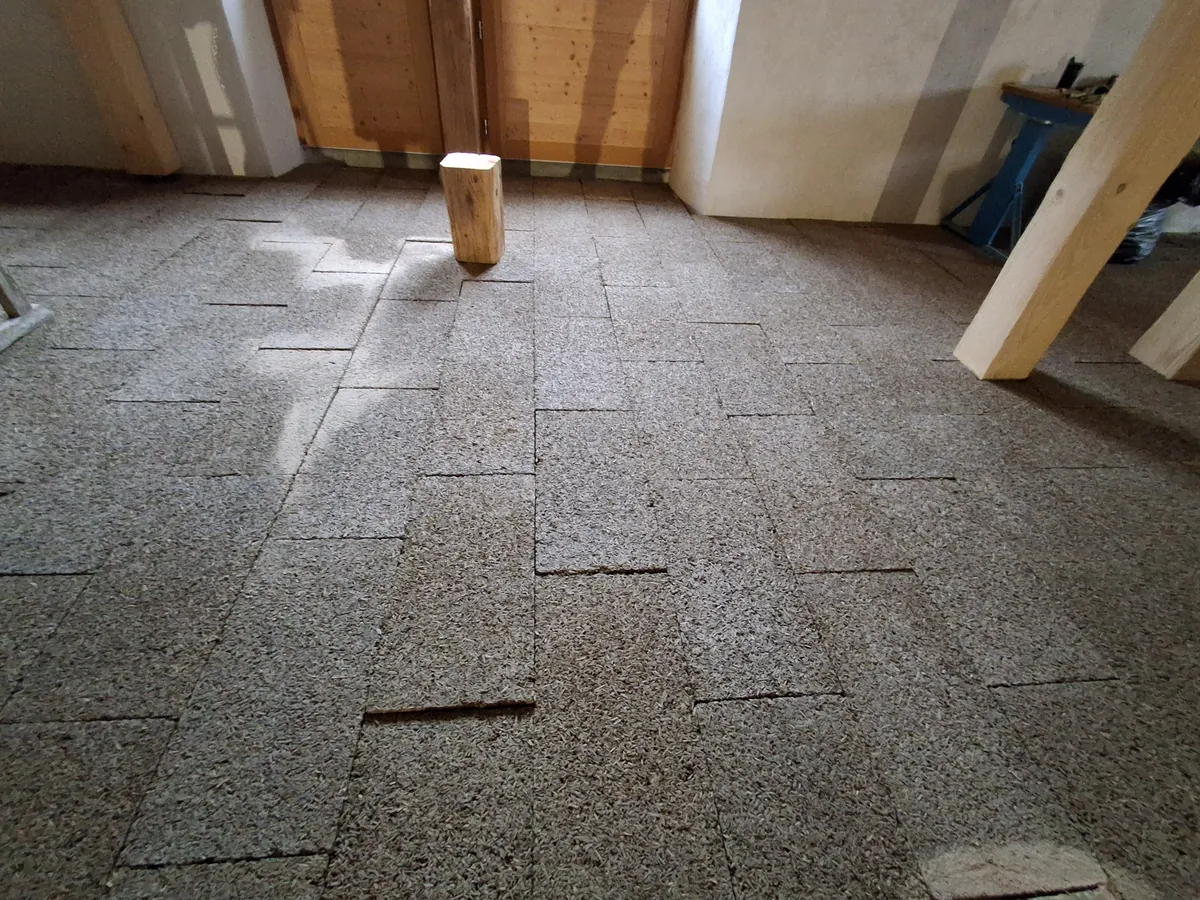
Hemp floor insulation offers excellent thermal lag, natural humidity regulation, and a B-s1,d0 fire resistance rating. However, its thermal conductivity is lower than some mineral insulants, and the indicative cost is higher. Installation requires specific expertise and careful management of moisture.
Thermal performance and thermal lag
Hemp blocks, especially the MULTICHANVRE range, have a dry thermal conductivity λ of around 0.065 W/(m.K), placing them among the high-performing bio-based insulants, though they insulate less than certain mineral or synthetic wools. Their thermal resistance R depends on the thickness selected:
- 10 cm: dry R 1.5 / effective R 1.4 m².K/W
- 15 cm: dry R 2.3 / effective R 2.1 m².K/W
- 20 cm: dry R 3.0 / effective R 2.8 m².K/W
- 30 cm: dry R 4.6 / effective R 4.2 m².K/W
By comparison, rock wool and expanded polystyrene achieve higher thermal resistance values at lower thicknesses, meaning hemp requires greater thickness to match their performance. For example, to achieve an R of 3.0, rock wool will use less thickness than a hemp block.
On the other hand, hemp stands out for its superior thermal lag, which contributes to summer comfort. Thermal lag is the time it takes for heat to pass through the material. MULTICHANVRE blocks provide a lag of 6.1 hours at 10 cm thickness, rising to 18.5 hours at 30 cm, helping to limit indoor temperature swings during heatwaves. This is particularly valuable in regions where summer comfort is a priority.
Note, however, that this lag, calculated using standardised formulas for MULTICHANVRE, should not be directly compared to the BIOSYS system, which is based on non-standardised internal tests.
For more details on thermal characteristics, the MULTICHANVRE range for insulation is a useful resource. The choice of thickness will depend on the required thermal performance and space constraints, especially for internal wall insulation (IWI), where loss of living space must be considered.
Moisture management and humidity regulation
Hempcrete has high water vapour permeability thanks to its permeable hydraulic binder and the hemp shiv, which makes up 84% of the block. This porous structure allows natural regulation of indoor humidity, preventing condensation that can be problematic with some less permeable synthetic or mineral insulants.
Unlike synthetic insulants, which often require a vapour barrier, hemp blocks do not always need one. It is sufficient for the wall to retain at least one face open to liquid and vapour water exchange for effective regulation. If the opposite face is sealed, for example with a cement render, a thermal and hygrothermal study is needed to confirm suitability.
For floor insulation, moisture management is especially important. MULTICHANVRE blocks must be laid on a bed of waterproof mortar about 2 cm thick, which acts as a capillary break and levels the surface. It is essential to protect both the slab and the blocks from water, especially in exposed areas, as the blocks are not rot-proof. Protection may include a suitable screed and effective drainage.
Mineral insulants such as rock wool are generally hydrophilic and lose performance if damp, while some synthetic insulants are impermeable but do not regulate humidity. Hemp, being vapour-open, offers an interesting compromise in buildings where wall breathability is desired.
Installation and technical considerations
MULTICHANVRE blocks for floor insulation are laid edge-to-edge with a lime-based mortar (M.B.M. mortar) applied using a notched trowel. Joints are thin, around 3 mm, and blocks are laid in a staggered pattern with at least one third overlap (20 to 40 cm). The first course sits on a waterproof mortar bed, providing a capillary break.
Each block weighs between 6.5 kg (10 cm) and 21 kg (30 cm), and is supplied on suitable pallets (for example, 120 blocks at 10 cm thickness cover 21.6 m² per pallet). Installation requires specific expertise, particularly to ensure continuous insulation and to manage details such as electrical services.
Electrical cables are installed in chases and holes, fixed in place and then filled with a product compatible with the finishing plaster. Compatibility with the screed or final slab must be checked, as the screed must be suitable for use with hempcrete.
By comparison, common insulants such as polystyrene or mineral wool panels are often lighter, thinner, and laid directly under the screed without mortar. Their installation is more standardised and quicker, but they do not regulate humidity. Rolls or boards also require cutting for services, but are generally easier to handle.
It is important to note that neither MULTICHANVRE nor BIOSYS are load-bearing: they must always be combined with a supporting structure (slab, timber frame, or supporting wall).
For more detailed installation advice, our comprehensive guide to installing hemp blocks offers practical tips.
Durability and on-site performance
Hempcrete is naturally resistant to rodents and pests, which is an advantage for floor insulation. This property comes from its composition of hemp shiv bound with natural prompt cement. However, this resistance does not remove the need to store pallets in a dry, sheltered place, without stacking, to avoid damage before installation.
The material is sensitive to prolonged moisture, especially during storage and installation. Exposure to water or excessive humidity can damage the product. Site protection and appropriate delivery timing are therefore important.
Compared to mineral or synthetic insulants, hempcrete does not suffer from mould under normal conditions, but does require specific attention on site. Mineral insulants are generally inert, but can lose their properties if damp. Synthetics resist water but do not help regulate humidity.
The durability of hemp blocks is demonstrated by reference projects dating back to 2017 and French experience since the 1980s, with few reported issues. Maintenance is minimal, but if repairs are needed, specialist expertise is required.
A pallet of BIOSYS blocks delivered to site illustrates the packaging and the texture of the bound hemp shiv (BIOSYS block pallet on site, visible hemp shiv texture).
Environmental impact and carbon footprint
The hemp used in our blocks is grown in Franche-Comté without irrigation or chemical treatments, across around 200 farms. The crop absorbs a large amount of atmospheric carbon during growth, which is stored in the hemp shiv (84% of the block). This carbon remains locked in the material throughout its service life.
The hemp sector is recognised for its carbon capture efficiency, comparable to that of a hectare of forest over the same period. Hemp cultivation also brings agronomic benefits, such as natural soil loosening by its taproots and suitability as a break crop.
However, caution is needed regarding the overall end-of-life carbon balance: according to life cycle analyses (LCA), all captured carbon is considered re-emitted. Therefore, hempcrete or its blocks should not be described as "low carbon" or "carbon neutral".
Hempcrete has a verified FDES (environmental product declaration). By comparison, mineral and synthetic insulants have a higher carbon impact due to manufacturing and transport, and do not store carbon.
For more on the supply chain and environmental impact, see the page Hemp as a material: the French supply chain and environmental impact.
Key characteristics: numerical comparison
| Characteristic | MULTICHANVRE block 10 cm | MULTICHANVRE block 15 cm | MULTICHANVRE block 20 cm | MULTICHANVRE block 30 cm | Mineral insulants (e.g. rock wool) | Synthetic insulants (e.g. polystyrene) |
|---|---|---|---|---|---|---|
| Thermal conductivity λ (W/(m.K)) | ≈ 0.065 | ≈ 0.035 to 0.045 | ≈ 0.030 to 0.040 | |||
| Dry thermal resistance R (m².K/W) | 1.5 | 2.3 | 3.0 | 4.6 | Variable, higher at lower thickness | Variable, higher at lower thickness |
| Effective thermal resistance R (m².K/W) | 1.4 | 2.1 | 2.8 | 4.2 | – | – |
| Thermal lag (hours) | 6.1 | 9.25 | 12.3 | 18.5 | Variable, generally lower than hemp | Variable, generally lower than hemp |
| Density (kg/m³) | ≈ 300 | Varies by product | Varies by product | |||
| Weight per m² (kg) | 6.5 | 10 | 13 | 21 | Lighter | Lighter |
| Fire reaction | B-s1,d0 | Variable, often A1 or A2 | Variable, often rated E or higher | |||
| Indicative price incl. VAT per m² | €35 | €51 | €66 | €95 | Generally lower | Generally lower |
Overall cost and availability
Indicative retail prices for MULTICHANVRE blocks vary by thickness:
- 10 cm: around €35/m² incl. VAT
- 15 cm: around €51/m² incl. VAT
- 20 cm: around €66/m² incl. VAT
- 30 cm: around €95/m² incl. VAT
These prices are indicative and must be confirmed by a quote from a partner builders' merchant. Installation costs should also be considered: lime-based mortar, staggered laying, block cutting, and the need for training or specialist skills can increase both time and complexity compared to lighter, easier-to-handle standard insulants.
Blocks are available throughout France via a network of partner merchants. Average delivery time is about one week, depending on location and time of year.
By comparison, mineral and synthetic insulants are often cheaper and more widely available in major retailers, with faster installation but without the benefits of humidity regulation or thermal lag.
For a detailed price overview, see the guide to hemp block prices per m² in 2026.
Constraints and limitations to consider
- The required thickness of hemp blocks is greater than that of mineral wool to achieve equivalent thermal resistance, which can create space constraints, especially for IWI where loss of living space is a real trade-off.
- Hemp blocks are not designed for use in roofs or loft insulation: they should not be used as roof, sloping ceiling, or loft insulation.
- Installation requires a load-bearing structure, as neither MULTICHANVRE nor BIOSYS are structural. A supporting wall or suitable frame must be provided.
- The MULTICHANVRE range is undergoing certification, with no technical approval or ATEx issued to date. An ATEx case A is expected for internal insulation, but has not yet been obtained or extended to external, partition, or floor use.
- The CSTB technical approval for BIOSYS has expired and renewal is underway with no known date. BIOSYS is therefore not currently covered by a valid technical approval.
- If the opposite wall face is sealed (e.g. cement render), the feasibility of hemp block insulation requires a thermal and hygrothermal study to avoid moisture-related risks.
Suitable applications and advice for hemp floor insulation
MULTICHANVRE blocks are suitable for floor insulation, with recommended thicknesses from 15 cm upwards to ensure sufficient thermal resistance and good mechanical strength. Blocks can be laid edge-to-edge on a waterproof mortar bed, with thin joints, then covered with a compatible screed.
It is important to protect both the slab and the blocks from any water exposure, especially in damp areas. Electrical services are installed in chased grooves and holes, then filled with a compatible product.
Installation must be carried out carefully to minimise thermal bridging, ensuring continuity of joints and overlaps. Loads can be fixed to 20 and 30 cm blocks, according to technical guidelines.
For a specific project, we recommend requesting a free, personalised quote. We will then direct you to the partner merchant closest to your site.
For more on applications and installation, see the page IWI, EWI, partitions, floors and timber frame infill for further information.
Frequently asked questions
What thickness of hemp block is needed to insulate a floor slab?
The thickness depends on the required thermal performance. MULTICHANVRE blocks range from 10 to 30 cm, providing effective thermal resistance from 1.4 to 4.2 m².K/W. For floor insulation, thicknesses above 15 cm are preferred for better performance and strength.
Are hemp blocks suitable for insulating existing floor slabs?
Yes, hemp blocks can be used to insulate existing slabs, provided installation is correct and moisture is well managed. The existing slab must be protected and a screed compatible with hempcrete should be used.
Is a vapour barrier needed with hemp floor insulation?
Hempcrete naturally regulates humidity and does not always require a vapour barrier, as long as at least one face remains permeable to liquid and vapour water. If the wall is sealed, a thermal and hygrothermal study is recommended.
How is hemp block insulation fixed to a floor slab?
MULTICHANVRE blocks are laid edge-to-edge on a supporting layer, with thin lime-based mortar joints. They can be adapted around electrical services and required holes, then covered with a suitable screed or finish.
Is hempcrete resistant to rodents under floor slabs?
Hempcrete is naturally resistant to rodents due to its formulation. However, pallets must be stored dry and sheltered to avoid damage before installation.
What are the advantages of hemp for floor insulation compared to rock wool?
Hemp offers summer comfort thanks to higher thermal lag, natural humidity regulation, and a B-s1,d0 fire rating. However, it generally requires greater thickness for equivalent thermal resistance and is heavier.
Read next
Planning a hemp block project?
Tell us about your project: we will reply within 48 working hours with a tailored costing.