Hempcrete block partition walls: everything you need to know before you start
A hempcrete block partition wall is a non-loadbearing, insulating and moisture-regulating solution for interiors. It provides thermal and acoustic comfort thanks to its 84% hemp shiv content. MULTICHANVRE blocks in thicknesses from 15 to 30 cm are laid with mortar and finished with plaster.
 By Julien Compain
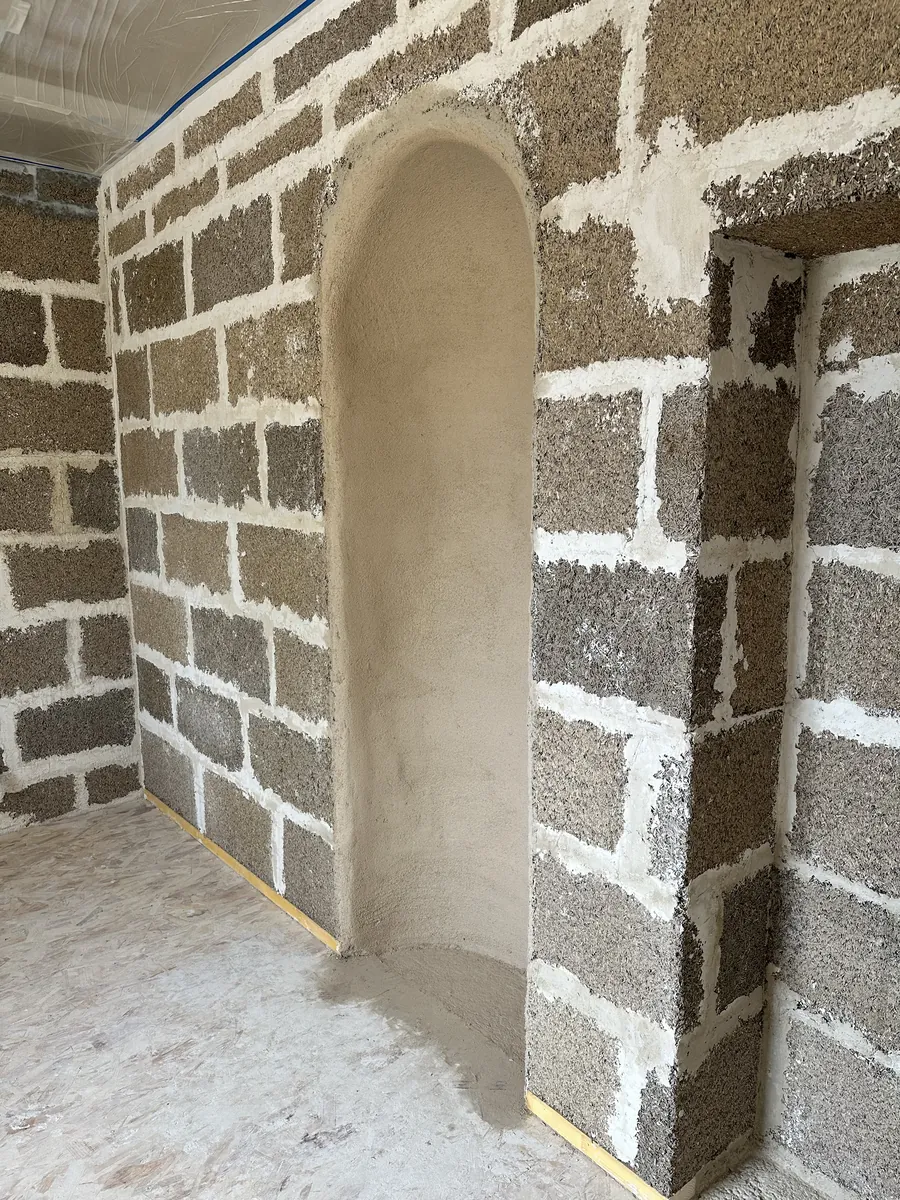
Hemp block partition walls provide insulation and moisture regulation for interiors. These non-loadbearing walls offer excellent thermal and acoustic comfort thanks to their 84% hemp shiv content. Installation uses MULTICHANVRE blocks in thicknesses from 15 to 30 cm, bonded with mortar and finished with plaster or render.
What is a hemp block partition wall?
A hemp block partition wall is built from blocks made with a mix containing 84% hemp shiv—the woody core of the hemp stalk—combined with a hydraulic binder, Vicat natural prompt cement. This composition gives the block its thermal insulation and moisture-regulating properties.
The blocks used for partitions are part of the MULTICHANVRE range, featuring straight-edged blocks sized 60 × 30 cm and available in several thicknesses to suit different applications. The density is around 300 kg/m³, with a dry thermal conductivity of approximately 0.065 W/(m.K).
It is important to note that hemp block partitions are not structural. They must always be combined with a loadbearing structure, such as a supporting wall, timber frame, or post-and-beam system. The block serves solely for insulation and infill.
For a detailed overview of the MULTICHANVRE range, see the dedicated page on the MULTICHANVRE range for insulation and partitions.
Thermal performance and comfort of hemp block partitions
The thermal performance of hemp block partitions mainly depends on the chosen thickness. The MULTICHANVRE range offers 15, 20 and 30 cm thicknesses suitable for partitions:
- 15 cm: dry thermal resistance (R dry) of 2.3 m².K/W, design value 2.1
- 20 cm: R dry 3.0, design value 2.8
- 30 cm: R dry 4.6, design value 4.2
The design value is the figure to use in a thermal study, taking real-life conditions into account.
Hemp provides significant thermal lag, improving summer comfort by delaying heat transfer indoors. This lag is 9.25 hours for 15 cm, 12.3 hours for 20 cm, and 18.5 hours for 30 cm thickness.
Beyond insulation, hempcrete naturally regulates humidity. It absorbs moisture when the air is damp and releases it when the air is dry, helping maintain an optimal indoor humidity level without the need for a vapour barrier, provided the wall remains vapour-open.
Additionally, the hemp shiv content helps improve indoor air quality by limiting condensation and avoiding pollutants from synthetic materials.
Compared to conventional partition insulations, hemp blocks offer better humidity regulation and superior summer comfort, although a greater thickness is required to achieve equivalent thermal resistance.
Uses and applications for hemp block partitions
Hemp block partitions are mainly used as non-loadbearing internal walls, both in new builds and renovations. They are especially suitable for residential and commercial spaces where moisture management and thermal comfort are priorities.
These partitions can be installed on a variety of substrates, including existing walls, with suitable linings or renders. They are compatible with standard interior finishes such as spray plaster, lime or earth renders, and plasterboard.
Remember, these partitions must not be used as structural elements, nor for roof or floor applications. Hemp blocks do not replace a loadbearing structure, but complement it for insulation and finishing.
For more information on the various uses of hemp blocks, see the applications of hemp blocks page for a full overview.
Installation techniques for hemp block partitions
Installing MULTICHANVRE hemp block partitions involves several precise steps to ensure stability and optimal performance:
- The first course of blocks is laid on a 2 cm bed of waterproof mortar. This acts as a capillary break and levels the substrate.
- The blocks are bonded with a lime-based mortar (M.B.M. mortar), applied with a notched trowel. Joints should be thin, about 3 mm thick.
- Masonry is laid in a staggered bond, with at least one third overlap of the block length (20 to 40 cm).
- The blocks are fixed to the substrate using metal brackets, strapping, or fixing discs, at a rate of 2 to 5 per square metre.
- Finally, the partition is finished with compatible materials such as spray plaster, lime or earth renders, or plasterboard.
Electrical services are installed by chasing the blocks with a wall chaser and drilling with a hole saw. After fixing conduits and boxes, chases are filled with hempcrete or a compatible finishing product.
This installation method is described in detail in the complete installation guide for hemp blocks.
Fixings and load integration on hemp block partitions
The ability to fix loads to a hemp block partition depends on the block thickness:
- For 10 and 15 cm blocks, no load-bearing fixings are recommended.
- For 20 and 30 cm blocks, loads up to 10 kg per VBA 6×100 screw can be fixed without pre-drilling.
- For loads up to 30 kg, chemical anchors are required: drill, clean, inject resin and use an M8 threaded rod.
- For loads above 30 kg, such as wall units or suspended sanitaryware, fixings must pass through the block and anchor directly to the loadbearing structure behind the partition.
These guidelines ensure mechanical stability of fixings without damaging the partition or compromising its insulation.
For further advice on load integration, consult the technical documents available on the technical documentation page.
Technical comparison of MULTICHANVRE block thicknesses for partitions
| Thickness (cm) | Dimensions (cm) | Weight per block (kg) | R dry value (m².K/W) | Design R value (m².K/W) | Thermal lag (h) | Packing (blocks/pallet) | Area per pallet (m²) | Recommended uses |
|---|---|---|---|---|---|---|---|---|
| 15 | 60 × 30 | 10 | 2.3 | 2.1 | 9.25 | 80 | 14.4 | IWI, EWI and partitions |
| 20 | 60 × 30 | 13 | 3.0 | 2.8 | 12.3 | 60 | 10.8 | IWI, EWI, partitions, infill and floors |
| 30 | 60 × 30 | 21 | 4.6 | 4.2 | 18.5 | 56 | 10.08 | High-performance IWI and EWI, heavy partitions, infill and floors |
This table summarises the main characteristics of MULTICHANVRE blocks suitable for partitions, helping you choose the right thickness for your thermal, acoustic and structural needs.
The chosen thickness should balance performance, space and weight. For example, a 30 cm partition will provide better insulation but take up more room.
See also the MULTICHANVRE range for insulation and partitions page for further details.
Advantages and limitations of hemp block partitions
Hemp block partitions offer several advantages:
- Moisture regulation: the block absorbs and releases moisture, helping maintain a stable and healthy indoor environment.
- Thermal comfort: with suitable thermal resistance and significant thermal lag, the partition contributes to energy performance and summer comfort.
- Fire resistance: fire reaction is rated B-s1,d0 (equivalent to M1), ensuring good fire safety.
- Natural rodent resistance: hemp shiv provides resistance to rodents and pests.
- Carbon storage: hemp absorbs a large amount of carbon during growth, which remains locked in the block, supporting the environmental credentials of the building.
Limitations include:
- The thickness required to achieve equivalent thermal resistance to other insulations is greater, reducing usable floor area, especially for internal insulation (IWI).
- The partition is not loadbearing, so a supporting structure is always needed.
- In wet rooms, the partition must be protected from water splashes, for example with a plasterboard lining suitable for wet areas.
All these factors should be considered when deciding whether to use a hemp block partition in your project. For more information, see the page on reviews, feedback and limitations.
Maintenance, durability and storage of blocks for partitions
The durability of hemp block partitions has been demonstrated on reference projects since 2017. Hempcrete is known for its long-term stability, provided it is installed and maintained correctly.
For on-site storage, block pallets must be kept sheltered, in a dry place and not stacked. This is essential to preserve block quality, as they are not rot-proof. This storage advice is separate from the blocks’ natural resistance to rodents and pests.
Sensitivity to moisture means effective protection is needed during construction, especially against bad weather and water splashes.
Interior finishes such as spray plaster, lime or earth renders, or plasterboard, help prolong the life of the partition by protecting the block while maintaining vapour permeability.
For more details on maintenance and durability, see the lifespan and maintenance of hemp block walls page.
How to buy blocks for a hemp partition wall
MULTICHANVRE hemp blocks are sold exclusively through a network of partner builders’ merchants in France. Direct sales from the factory or to private individuals are not available.
Average delivery time is about one week, but may vary from a few days to a month depending on location, hauliers and time of year. Some accessory orders can be made to measure.
The manufacturer, Vieille Matériaux SAS, produces these blocks at its Mérey-sous-Montrond (Doubs) plant, using hemp shiv sourced 100% from Franche-Comté via a local, responsible supply chain.
To get a free, personalised quote, use the free online quote request. This service will direct you to the partner merchant nearest your site, based on your postcode.
Although there is no specific training for installing MULTICHANVRE blocks, training is available for the BIOSYS system, developed with the Vicat group. However, BIOSYS is a different construction system and does not apply to the MULTICHANVRE range used for partitions.
To find a stockist or merchant, the partner merchant network for purchasing page provides a regional list.
Frequently asked questions
What thickness of hemp block should I choose for a partition?
Thicknesses from 15 to 30 cm are recommended for partitions, depending on your thermal and acoustic insulation needs. 15 cm is suitable for lightweight insulating partitions, 20 cm for enhanced insulation, and 30 cm for maximum performance.
Can I fix furniture or fittings to a hemp block partition?
Fixings on 20 and 30 cm blocks can support up to 10 kg per screw without pre-drilling, and up to 30 kg with chemical anchors. For heavier loads, fixings must be anchored to the supporting structure behind the partition.
Are hemp block partitions loadbearing?
No, hemp block partitions are not loadbearing. They must always be combined with a supporting structure, such as a timber frame or loadbearing wall, to ensure stability.
What renders can be used on a hemp block partition?
Compatible finishes include spray plaster, lime or earth renders, and plasterboard. These finishes preserve the vapour permeability of the block.
Do I need a vapour barrier with a hemp block partition?
For standard partitions, hempcrete regulates humidity without the need for a vapour barrier, provided the wall remains open to moisture transfer. In wet areas, a suitable lining is required.
How are hemp block partitions installed?
Installation involves three steps: applying a waterproof mortar bed to level the base, building up the blocks with thin, staggered lime mortar joints, then fixing with brackets or strapping before the final finish.
Where can I buy hemp blocks for partitions?
Blocks are sold only through a network of partner builders’ merchants across France. The online quote request is free and will direct you to the nearest merchant.
Read next
Planning a hemp block project?
Tell us about your project: we will reply within 48 working hours with a tailored costing.