Self-building with hempcrete blocks: options, installation and comparison
Self-building with hempcrete blocks means making informed choices between insulation and structural systems, understanding the material’s properties, and following correct installation practices. This guide explains the available systems, their thermal performance, the pros and cons, and the practical steps to successfully build your hempcrete block home.
 By Julien Compain
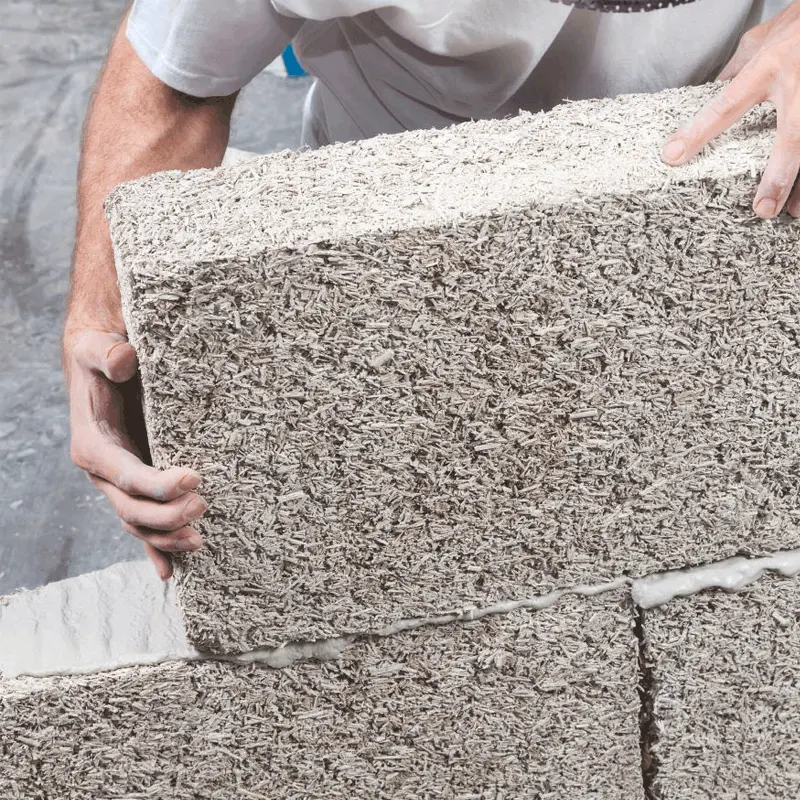
Self-building with hempcrete blocks requires an informed choice between insulation and structural use, a good understanding of the material’s properties, and adherence to correct installation practices. This guide explains the available systems, their thermal performance, the benefits and limitations, and the practical steps for a successful hempcrete block home.
Understanding hempcrete blocks and their technical characteristics
Hempcrete blocks are made from 84% hemp shiv, the woody core of locally grown hemp stems from Franche-Comté. This is combined with a hydraulic binder—a natural prompt cement from Vicat that is vapour-open—ensuring cohesion while allowing moisture regulation. The average density of MULTICHANVRE blocks is around 300 kg/m³, with a dry thermal conductivity λ of approximately 0.065 W/(m.K), indicating good insulating properties.
Hempcrete blocks provide excellent summer comfort thanks to significant thermal lag, which varies depending on the chosen thickness. This lag helps limit indoor temperature rises during hot spells. Their ability to regulate indoor humidity also contributes to a healthy, stable indoor climate, with no need for a vapour barrier as long as the wall remains vapour-open. In damp areas, however, additional protection is essential.
In terms of safety, the fire reaction of the blocks is rated B-s1,d0, equivalent to M1 classification, offering good fire resistance. The blocks are also naturally resistant to rodents, pests and mould, with durability proven by several years of documented use since 2017.
It is important to note that neither MULTICHANVRE nor BIOSYS blocks are load-bearing. They must always be used with a supporting structure (post-and-beam, supporting wall or timber frame). Finally, the blocks are not rot-proof: they must be stored under cover, in dry conditions, and not stacked, to preserve their quality before installation.
Available systems for self-building with hempcrete blocks
Two main systems are available for self-build projects using hempcrete blocks, each suited to different needs and applications:
MULTICHANVRE
MULTICHANVRE is a range of straight-edged blocks, available in four thicknesses (10, 15, 20 and 30 cm) and a 60 × 30 cm format. These blocks are suitable for a variety of uses: internal wall insulation (IWI), external wall insulation (EWI), partitions, floor insulation, or infill for timber frames. Installation is with a thin lime mortar, laid in a staggered bond, followed by a finishing render. The product is currently undergoing certification, with an ATEx (experimental technical assessment) expected for internal insulation only, but as yet no technical approval or certification has been issued.
BIOSYS
BIOSYS is a dry-stacked building system, launched in 2016 in partnership with the Vicat group. The blocks, sized 60 × 30.8 × 30 cm, interlock with tongue-and-groove joints without glue or mortar. They act as permanent insulating formwork for a reinforced concrete post-and-beam structure. BIOSYS provides a useful thermal resistance of 4.2 m².K/W. This system allows for rapid assembly, with a rate of around 30 m² per day for two workers on a suitable site. The CSTB Technical Approval for BIOSYS has expired, and renewal is in progress with no known date, so currently there is no valid technical approval for this system.
Differences and logistics
Installation differs significantly between the two systems: MULTICHANVRE requires lime mortar and careful jointing, while BIOSYS relies on fast mechanical assembly without mortar. Packaging also varies, with MULTICHANVRE supplied on larger pallets and BIOSYS on heavier, smaller pallets. For self-builders, logistics are handled exclusively through a network of partner builders’ merchants, with delivery available throughout France.
Thermal performance and choosing the right thickness
| System / Thickness | Dry R value (m².K/W) | Useful R value (m².K/W) | Thermal lag (h) | Weight (kg) | Recommended uses |
|---|---|---|---|---|---|
| MULTICHANVRE 10 cm | 1.5 | 1.4 | 6.1 | 6.5 | IWI, EWI |
| MULTICHANVRE 15 cm | 2.3 | 2.1 | 9.25 | 10 | IWI, EWI, partitions |
| MULTICHANVRE 20 cm | 3.0 | 2.8 | 12.3 | 13 | IWI, EWI, partitions, infill, floors |
| MULTICHANVRE 30 cm | 4.6 | 4.2 | 18.5 | 21 | IWI, high-performance EWI, heavyweight partitions, infill, floors |
| BIOSYS 30 cm | 4.6 | 4.2 | 8 to 10 (internal tests) | 21 | Construction, insulating formwork, post-and-beam walls |
The choice of block thickness depends on the project’s thermal requirements. MULTICHANVRE offers a full range, allowing you to tailor the R value to the application, while considering the impact on floor area—especially for internal insulation, where thickness reduces usable space. BIOSYS, at 30 cm, is designed for robust distributed insulation in load-bearing concrete walls.
Thermal lag helps regulate summer temperatures. MULTICHANVRE offers up to 18.5 hours at 30 cm, while BIOSYS achieves 8 to 10 hours according to non-standardised internal tests. These values should not be compared directly, as the testing methods differ.
Compared to conventional insulants such as mineral wool or polystyrene, hempcrete blocks require greater thickness to achieve the same thermal resistance, which is an important consideration. For a detailed technical comparison, see our comparison with concrete block, brick, aerated concrete and wools.
Key steps for self-building with hempcrete blocks
Success in a hempcrete block self-build project depends on rigorous installation, tailored to the chosen system.
Preparing the base and waterproof mortar bed (MULTICHANVRE)
For MULTICHANVRE, the first course of blocks is laid on a waterproof mortar bed about 2 cm thick, providing a capillary break and levelling the base. For external wall insulation, this first course must be at least 15 cm above ground level, on a concrete plinth or a fixed base profile.
Laying the blocks
- For MULTICHANVRE, installation involves three steps: applying a lime-based mortar (M.B.M. mortar) with a notched trowel, creating thin joints of around 3 mm in a staggered bond with at least one-third overlap, then fixing to the substrate with brackets, straps or washers before rendering.
- For BIOSYS, blocks are dry-stacked using tongue-and-groove joints, with no glue or mortar, allowing rapid assembly. This system requires a suitable site to optimise speed.
Fixings and anchors
Heavy fixings in MULTICHANVRE 20 and 30 cm blocks should use VBA 6 × 100 screws without pre-drilling for loads up to 10 kg, or chemical anchors (M8 threaded rod) for loads up to 30 kg. For heavier loads, fixings must be anchored to the supporting structure. For 10 and 15 cm blocks, no direct load fixings are recommended.
Electrical services
Electrical runs in MULTICHANVRE are made with chases cut using a wall chaser and holes drilled with a hole saw. Conduits and boxes are fixed and then filled with a mix compatible with the render. For IWI, if there is a gap between the supporting wall and the lining, services can run in this space. For BIOSYS, conduits are run by direct chasing or within a service void.
Finishes and protection
Internal finishes can be spray plaster, lime, earth plaster or plasterboard. Externally, lime-rich renders with full mesh reinforcement protect the wall. In damp areas, additional protection is needed, especially in rooms exposed to water splashes.
Water protection and damp area treatment
Hempcrete regulates humidity but is not waterproof. It must be protected from water ingress and splashes by appropriate construction details, especially at the base and in wet zones. Feasibility should be checked by a specialist study for particular cases.
Quantitative comparison of MULTICHANVRE and BIOSYS blocks for self-build
| Characteristic | MULTICHANVRE 10 cm | MULTICHANVRE 15 cm | MULTICHANVRE 20 cm | MULTICHANVRE 30 cm | BIOSYS standard 30 cm |
|---|---|---|---|---|---|
| Size (cm) | 60 × 30 | 60 × 30 | 60 × 30 | 60 × 30 | 60 × 30.8 × 30 |
| Unit weight (kg) | 6.5 | 10 | 13 | 21 | 21 |
| Blocks per pallet | 120 | 80 | 60 | 56 | 24 |
| Area per pallet (m²) | 21.6 | 14.4 | 10.8 | 10.08 | 4.44 |
| Dry R value (m².K/W) | 1.5 | 2.3 | 3.0 | 4.6 | 4.6 |
| Useful R value (m².K/W) | 1.4 | 2.1 | 2.8 | 4.2 | 4.2 |
| Thermal lag (h) | 6.1 | 9.25 | 12.3 | 18.5 | 8 to 10 (internal tests) |
| Assembly | Thin lime mortar, staggered bond | Dry-stacked, tongue-and-groove | |||
| Load fixings | No | No | Yes, up to 10 kg with screws, 30 kg with chemical anchors | Yes, up to 10 kg with screws, 30 kg with chemical anchors | Fixings only on supporting structure |
| Recommended uses | IWI, EWI | IWI, EWI, partitions | IWI, EWI, partitions, infill, floors | IWI, high-performance EWI, heavyweight partitions, infill, floors | Post-and-beam walls, insulating formwork |
| Fire reaction | B-s1,d0 (M1) | ||||
| Acoustic performance | Not specified | Sound absorption coefficient alpha = 0.85, sound reduction Rw 43 (-1;-2) dB | |||
| Installation rate | Varies, depends on mortar installation | Approx. 30 m²/day for 2 workers on a suitable site | |||
Advantages and limitations of self-building with hempcrete blocks
- Hemp cultivation is highly effective at capturing atmospheric carbon during growth, which is then stored in the block. The local supply chain in Franche-Comté ensures a controlled footprint, with no irrigation or chemical treatments.
- The hygrothermal properties of the blocks allow natural regulation of indoor humidity and appreciable thermal comfort, especially in summer thanks to thermal lag.
- Blocks require greater thickness than some conventional insulants to achieve equivalent thermal resistance, which can reduce usable floor area for internal insulation. This trade-off should be considered at the design stage.
- Neither MULTICHANVRE nor BIOSYS are load-bearing. A supporting structure is essential, limiting the complete autonomy of hempcrete block masonry.
- Logistics require covered storage, no stacking, and delivery via a network of partner builders’ merchants. Handling and availability must be planned accordingly.
- The blocks are not suitable for roofing or pitched attic insulation. Only the BIOSYS U ring beam block is used for gable end formwork in masonry.
Resources and support for a successful self-build project
Specific training in the BIOSYS system is offered by our partner Vicat, aimed at tradespeople and self-builders wishing to master the system. For MULTICHANVRE, there is no official training, but we can sometimes provide contacts for experienced tradespeople depending on the area.
Technical documentation is available, including installation guides, product data sheets and quick-reference sheets, all accessible on our website. The comprehensive hempcrete block installation guide covers best practice in detail.
Distribution is exclusively through a network of partner builders’ merchants, ensuring availability of blocks and accessories, with average delivery times of one week, depending on location and season. To find a nearby merchant, see our partner merchants for purchasing.
We invite you to request a free quote online, which allows us to direct you to the nearest merchant and provide an estimate tailored to your project. This service is free of obligation and helps with project planning.
Finally, we recommend consulting architects, thermal engineers and tradespeople for a detailed study of the performance and technical constraints specific to your project.
Frequently asked questions
Can you self-build a whole house with hempcrete blocks without a supporting structure?
No, neither MULTICHANVRE nor BIOSYS blocks are load-bearing. They must always be used with a supporting structure, such as post-and-beam, a supporting wall or a timber frame.
What thickness of hempcrete block should I choose for good insulation?
The choice depends on your thermal requirements: MULTICHANVRE is available from 10 to 30 cm, with useful thermal resistance from 1.4 to 4.2 m².K/W. The BIOSYS system is 30 cm thick with a useful R value of 4.2. Thickness affects both floor area and summer comfort.
How are blocks installed and fixed in a self-build project?
MULTICHANVRE is installed with a thin lime mortar in three steps, while BIOSYS is dry-stacked using tongue-and-groove joints. Heavy fixings must be anchored to the supporting structure, not directly into the blocks.
Does hempcrete require a vapour barrier?
For standard walls, hempcrete regulates indoor humidity and does not require a vapour barrier, provided the wall remains vapour-open. In damp areas, additional protection is necessary.
Where can I buy hempcrete blocks for a self-build project?
Sales are exclusively through a network of partner builders’ merchants with delivery throughout France. We recommend requesting a free online quote to be directed to the merchant nearest your site.
What finishes are compatible with hempcrete blocks?
Internally, spray plaster, lime, earth plaster or plasterboard are suitable. Externally, lime-rich renders with mesh reinforcement are recommended to protect the building.
What are the environmental benefits of hempcrete blocks?
Hemp absorbs a large amount of carbon during growth, which is stored in the block. Local cultivation in Franche-Comté uses no irrigation or chemical treatments, helping to keep environmental impact under control.
Read next
Planning a hemp block project?
Tell us about your project: we will reply within 48 working hours with a tailored costing.